

The Stories Nobody Is Telling: Why Documentary Filmmaking May Be Your Way Into Cinema
The most powerful documentary stories are not always found in headlines. They are found in people, places, traditions, struggles and moments that deserve to be remembered. Here is how to find one, make it matter and take it to DPIFF 2027.
Submit Your Documentary Read the FAQsEvery city has a story nobody has filmed. Every village has a memory nobody has recorded. Every family has a person whose life could fill a screen. Every community has something it is trying to preserve, protect, change or survive.
Documentary filmmaking begins when someone decides to pay attention.
That someone could be you.
You do not need a famous subject. You do not need a giant production company. You do not need a feature length script.
You need curiosity, patience, a camera and the courage to stay with a story long enough to discover what it is really about.
The Film May Already Be Around You
One of the biggest advantages of documentary filmmaking is that the starting point is not necessarily invented.
Reality is already happening.
Look closer.
The Person
Someone whose life, work, struggle or achievement reveals something larger.
The Place
A neighbourhood, village, workshop, river, street or building carrying a history.
The Tradition
A craft, ritual, language, performance or practice at risk of being forgotten.
The Change
A community, landscape or way of life transforming before your eyes.
The Struggle
A real problem experienced by real people that deserves deeper understanding.
The Memory
An old photograph, forgotten event or personal history waiting to be brought back.
A musician preserving an old art form. A farmer adapting to a changing climate. A student building something against the odds. A family protecting an ancestral tradition. A craftsperson whose skills may disappear with the next generation.
These are not simply topics.
They can become characters, conflict, atmosphere, emotion and cinema.
Why Short Documentaries Can Be So Powerful
A short documentary has a unique advantage: focus.
You do not have to explain an entire industry. You can follow one person.
You do not have to solve an entire social issue. You can show one human consequence.
You do not have to document an entire culture. You can capture one tradition that reveals something much larger.
One Person
Build an intimate portrait around a character whose experience carries emotional weight.
One Question
Build the film around a question that becomes more complicated as the story unfolds.
One Moment
Sometimes a single event can reveal an entire world.
One Truth
Give the audience one idea, feeling or perspective they cannot easily forget.
The shorter the film, the more important the choices become.
Every interview. Every pause. Every cut. Every sound. Every photograph.
Ask yourself:
What Makes a Documentary Feel Like Cinema?
Recording reality is not the same as making a documentary.
Cinema begins when the filmmaker starts making meaningful choices.
Observation
Do not only record what people say. Watch what they do, how they move and what surrounds them.
Access
The deeper your access, the more likely the audience is to see something they could not have seen elsewhere.
Structure
Real life is messy. Editing gives the audience a path through that complexity.
Sound
Room tone, footsteps, machines, voices, silence and music can transform how a scene feels.
A documentary does not become cinematic because the camera is expensive.
It becomes cinematic when the filmmaker understands what to show, what to leave out, when to stay and when to cut.
The Documentary Starter Blueprint
From Idea to Finished Short Film
You do not need to know everything before you begin. You need a process that helps you discover the film while you make it.
- Find the subject: Choose something you genuinely care about.
- Research: Learn the history, people, context and unanswered questions.
- Build trust: Spend time with your subjects before expecting them to reveal meaningful stories.
- Record deeply: Capture interviews, observation, environments, photographs, archives and details.
- Find the real story: Review the material and look for conflict, change, emotion and meaning.
- Build the structure: Create an opening, progression and ending that give the audience a reason to continue.
- Finish with intention: Edit, sound design, colour, subtitles and final quality control all matter.
The first idea you have about your documentary may not be the story you eventually discover.
That is normal.
Documentary filmmaking is partly the art of allowing reality to surprise you.
The Most Important Skill Is Listening
A documentary filmmaker is often less like a person who arrives with all the answers and more like a person who knows how to ask the next useful question.
Listen to what people say.
Listen to what they avoid.
Notice the pause before an answer.
Watch what happens when the camera is almost forgotten.
Sometimes the most important scene is not the interview.
It is what happens immediately after the interview.
That is why empathy is not a soft skill in documentary filmmaking.
It is part of the craft.
8 Documentary Stories You Can Explore
Human Portrait
Follow one person’s journey, work, transformation, ambition or struggle.
Culture and Heritage
Document languages, crafts, music, festivals, rituals, food and traditions.
Social Reality
Explore a social issue through the lived experience of the people affected by it.
Environment
Tell stories about conservation, climate, wildlife, water, land or changing landscapes.
Biography
Bring an overlooked life, achievement or legacy into public memory.
History
Use archives, testimony and locations to investigate an event or forgotten chapter.
Community
Show how a group lives, works, celebrates, adapts or survives together.
Experimental Non Fiction
Blend interviews, observation, animation, archival material and sound into a distinctive form.
There is no single documentary formula.
The strongest category is often the one you did not realise you were making until you started filming.
Documentary Cinema Is Creating Space for New Voices
The wider documentary ecosystem continues to evolve, with major platforms creating opportunities for non fiction filmmakers, short film creators and emerging voices.
The 19th Mumbai International Film Festival in 2026 described itself as a major platform for documentary, short fiction and animation films, with international and national competitions, special sections, masterclasses and industry programmes.
Its second WAVES Doc Bazaar in 2026 also created dedicated opportunities around completed documentaries, works in progress and documentary projects, including viewing, mentorship, co production and market access.
Even the films recognised at MIFF demonstrate how intimate stories can carry universal meaning. Its 2026 Best Documentary recognition highlighted a film about a fading nomadic musical tradition, praising its treatment of memory, voice and inheritance.
The Difficult Part: Telling Real Stories Responsibly
Documentary filmmaking gives you access to real lives.
That access comes with responsibility.
- Respect the dignity and privacy of your subjects.
- Be especially careful when filming children or vulnerable people.
- Explain the nature and intended use of the project where appropriate.
- Verify important factual claims before presenting them as fact.
- Do not deliberately manipulate an interview to create a meaning the subject did not express.
- Obtain the permissions and releases appropriate to your production.
- Secure rights for music, photographs, archival footage and other third party material.
- Keep a clear record of materials and permissions used in the film.
DPIFF’s current nomination terms require applicants to own or have obtained the necessary rights, licences and permissions required to submit their work. Submission does not transfer copyright ownership to DPIFF, while selected films may be used under limited rights for festival screening and promotion.
Why Take Your Documentary to a Film Festival?
You can upload your documentary to YouTube.
You can post a trailer on Instagram.
You can send the film to your friends.
All of those can be useful.
But a festival submission gives your documentary a different context.
It says: this is a completed film, and I am ready to put it forward for evaluation.
Give the Film a Finish Line
A festival deadline can turn a promising idea into a completed work with a final cut, poster, synopsis and screening link.
Build a Filmmaker Portfolio
Selections, nominations, laurels and awards can strengthen your portfolio, website, press kit and future festival applications.
Reach New Audiences
A festival can put a story into a curated cinematic environment beyond the audience you already have.
Keep the Journey Moving
Your first documentary can become the first of many films you make, submit and improve.
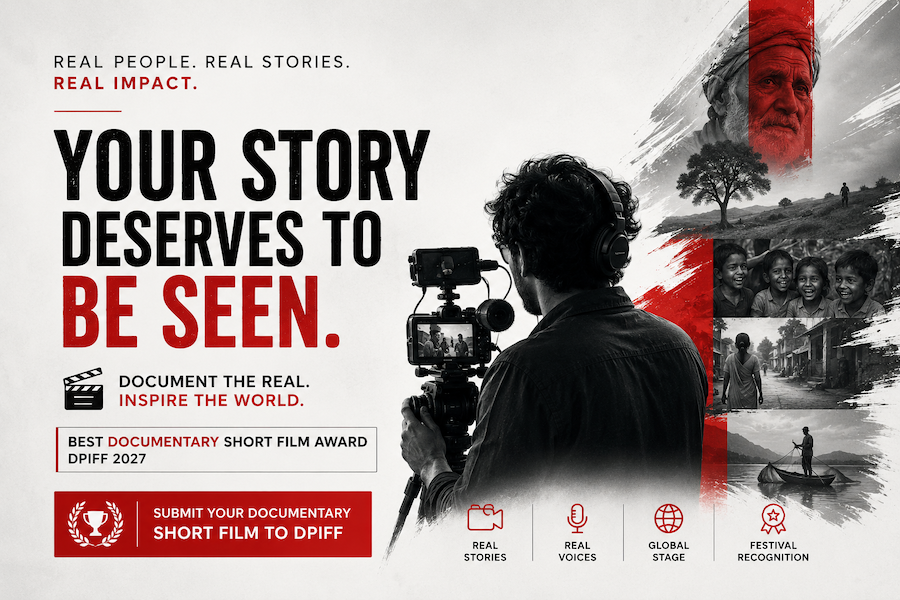
DPIFF Best Documentary Short Film Award
DPIFF 2027 includes a dedicated Best Documentary Short Film Award for filmmakers who use the short form to explore real people, real experiences and real worlds.
The current DPIFF nomination page lists a INR 10,000 cash prize for Best Documentary Short Film, along with an official DPIFF trophy, winner certificate, official festival laurels and global recognition.
The category sits within DPIFF’s five category Short Film Awards programme, alongside Best Short Film, Best Animated Short Film, Best Student Short Film and Best AI Short Film.
What DPIFF Looks For
A documentary does not need to look expensive to be meaningful.
The current DPIFF judging information identifies the following areas:
| Judging Area | What It Means for a Documentary |
|---|---|
| Originality | A distinctive subject, access, perspective or approach. |
| Storytelling | A narrative that gives the audience a reason to continue watching. |
| Direction | Clear creative decisions about observation, interviews, visuals and structure. |
| Screenplay | A coherent narrative framework, even when the story is based on reality. |
| Technical Execution | Competent image, editing, sound, subtitles and final presentation. |
| Creativity | A fresh way of making the audience see the subject. |
| Innovation | Meaningful experimentation with form, technology or storytelling. |
| Cinematic Impact | The lasting emotional, intellectual or visual impression of the finished film. |
These criteria are a useful reminder: do not spend all your energy trying to make the documentary look expensive.
Make it specific. Make it honest. Make it memorable.
A Smartphone Can Be the Beginning
If the story is happening today, you already have a reason to start.
A smartphone can record an interview.
It can capture a street before it changes.
It can document a family ritual.
It can follow a craftsperson through a working day.
It can record the sound of a place.
It can preserve a moment that might never happen again.
You can improve your camera, lighting and sound later.
Your first responsibility is not to own better equipment.
DPIFF 2027 Eligibility and Deadlines
The current DPIFF 2027 nomination page states that films completed between 1 January 2021 and 31 December 2026 are eligible, with a total runtime between 1 and 40 minutes including opening and closing credits. Films may be submitted in any language, while films not in English or Hindi must include accurate English subtitles.
| Requirement | Current Information |
|---|---|
| Category | Best Documentary Short Film |
| Production period | 1 January 2021 to 31 December 2026 |
| Runtime | 1 to 40 minutes including opening and closing credits |
| Language | Any language; English subtitles required for films not in English or Hindi |
| Submission | Online nomination through the official DPIFF nomination page |
| Cash prize | INR 10,000 |
Early Bird Deadline
31 August 2026
Regular Deadline
30 November 2026
Late Deadline
31 December 2026
The current DPIFF page lists selected filmmaker notifications for 10 February 2027, while the festival and awards ceremony date is to be announced.
Your Submission Checklist
Do not wait until the final day to discover that your submission materials are incomplete.
- Final film export is ready to screen.
- Film title and director information are correct.
- Poster is ready in an accepted format and readable at thumbnail size.
- Synopsis clearly explains the documentary without giving away everything.
- Private screening link works on another device.
- Password is available if the screening link requires one.
- Credits are complete and accurate.
- Music, archive, photographs and third party materials have the necessary permissions.
- English subtitles are accurate where required.
- Contact email and phone number are active and monitored.
The current nomination form asks applicants to select their category, provide filmmaker and film details, upload a poster and synopsis, and provide a screening link.
The Camera Is Not the Beginning. You Are.
There is always a reason to wait.
Wait for the better camera.
Wait for funding.
Wait for a bigger crew.
Wait for someone important to discover you.
But the story you want to tell may not wait.
The elderly artisan may stop working.
The old building may disappear.
The tradition may change.
The person may move away.
The moment may pass.
So look around you.
Who deserves to be heard?
What is changing?
What is disappearing?
What is being built?
What do people misunderstand?
What story is sitting in plain sight?
Then pick up the camera.
Find
Choose the story that keeps pulling your attention back.
Listen
Spend enough time with the people to discover the real story.
Film
Capture the people, places, details and moments that reveal it.
Edit
Remove everything that does not make the story stronger.
Finish
Complete the film instead of endlessly waiting for perfection.
Submit
Give the finished story the opportunity to travel beyond where it began.
Your Story Deserves to Travel
Your documentary does not need to change the entire world.
It needs to change the way one person sees something.
It needs to make an audience pause.
It needs to make someone remember a name.
It needs to make a forgotten tradition feel important.
It needs to make a local story feel universal.
That is where documentary cinema becomes powerful.
You are not only making a film about what happened.
You are deciding what deserves to be remembered.
Frequently Asked Questions
Can I submit a documentary short film to DPIFF 2027?
Yes. DPIFF 2027 has a dedicated Best Documentary Short Film Award and accepts eligible documentary submissions from filmmakers worldwide.
What is the Best Documentary Short Film Award at DPIFF?
It is one of the five DPIFF 2027 Short Film Awards categories. The current nomination page lists a INR 10,000 cash prize, official DPIFF trophy, winner certificate, official festival laurels and global recognition.
What is the maximum runtime for a documentary submitted to DPIFF?
The current DPIFF 2027 eligibility information states that eligible films must have a total runtime between 1 and 40 minutes, including opening and closing credits.
What production years are eligible for DPIFF 2027?
Films completed between 1 January 2021 and 31 December 2026 are currently eligible for submission.
Can I submit a documentary in any language?
Yes. Films may be submitted in any language. Films that are not in English or Hindi must include accurate English subtitles.
Who can submit a documentary short film to DPIFF?
Independent filmmakers, documentary creators, film students and other eligible creators from any country can submit through the current DPIFF 2027 nomination programme.
What does DPIFF look for in a documentary?
The current judging information includes originality, storytelling, direction, screenplay, technical execution, creativity, innovation and overall cinematic impact.
Do I need a professional camera to make a documentary?
No. Professional equipment can help, but it is not the foundation of documentary filmmaking. A smartphone can be enough to begin a project if the story, access, sound and storytelling are strong.
What should I prepare before submitting my documentary?
Prepare the final film, title and director details, poster, synopsis, screening link, required contact information and all necessary rights and permissions. Check the live nomination page for the latest submission requirements.
What are the current DPIFF 2027 nomination deadlines?
The current schedule lists 31 August 2026 as the Early Bird Deadline, 30 November 2026 as the Regular Deadline and 31 December 2026 as the Late Deadline. Always confirm the live nomination page before submitting.
Your Story Is Already There.
Now give it a voice, give it a frame and give it the opportunity to be discovered. Submit your documentary short film to DPIFF 2027.
Submit Your Documentary to DPIFF 2027Ready to take the next step? Visit the Official DPIFF 2027 Nomination Page to review the current categories, eligibility, deadlines and submission requirements.