

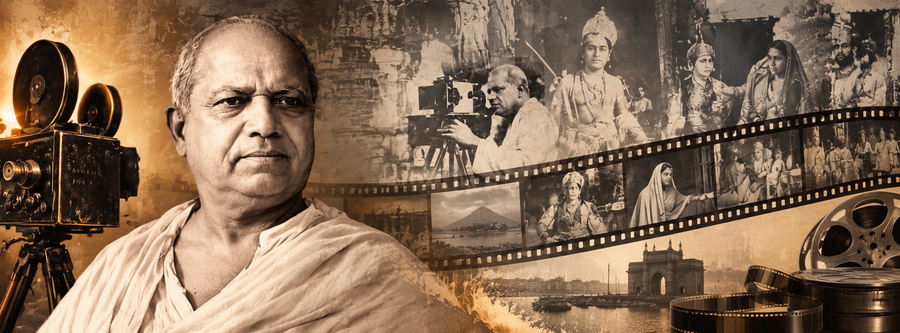
Dadasaheb Phalke
The Father of Indian Cinema. A definitive, research-led reference to Dhundiraj Govind Phalke — his life, artistic training, printing and photographic work, journey into filmmaking, Raja Harishchandra, major films, collaborators, techniques, institutions, legacy and the continuing story of his place in Indian cinema.
National Museum of Indian Cinema · National Book Trust · Wikimedia Commons archive
A filmmaker who built an Indian cinema from the ground up
Dadasaheb Phalke was not simply a director who made one pioneering film. He was an unusually versatile visual practitioner who moved through art, photography, lithography, printing, stage design, exhibition and technical experimentation before turning his attention to motion pictures.
The National Museum of Indian Cinema describes Phalke as the artist who introduced the world of motion pictures to Indian audiences and highlights his interests in photography, lithography, painting, theatrical set design and magic. His transition into filmmaking therefore grew out of a much wider visual and technical practice.
His 1913 film Raja Harishchandra is conventionally recognised by Indian government and museum sources as the first full-length Indian feature film. Its significance is not only that it was an early feature: it demonstrated that filmmaking could be conceived, produced, processed and exhibited as an indigenous creative enterprise.
The making of the filmmaker
Phalke’s cinema cannot be understood without understanding the disciplines that came before it. His visual education and practical work supplied many of the skills that early filmmaking demanded.
Art education
Historical biographies place Phalke’s education at the Sir J. J. School of Art in Bombay and later at Kala Bhavan in Baroda. His training encompassed drawing, painting, modelling and photography-related visual practice.
See the Wikimedia Commons creator archive and the National Book Trust biography for further research.
Photography & archaeology
Before filmmaking, Phalke worked in photography and related visual documentation. Biographical accounts also place him for a period as a photographer and draftsman with the Archaeological Survey of India.
This experience matters because early cinema required an ability to observe, frame, reproduce and technically process images — skills that sat naturally within his earlier career.
Printing & lithography
Phalke’s printing work connected him to photo-lithography, block-making, colour-printing processes and the visual culture surrounding Raja Ravi Varma’s images. He later established his own printing and engraving operations.
This technical background became crucial when film production demanded control over cameras, negatives, processing, printing and visual effects.
The printing press as a bridge to cinema
The transition from lithography to cinema was not a leap from one unrelated field to another. Both required the manipulation and reproduction of images. Phalke’s earlier work gave him experience with cameras, photographic negatives, printing machinery, image composition and colour processes.
In 1909 he travelled to Germany in connection with printing machinery. The experience reinforced a pattern that would define his later filmmaking: when the required technology was not readily available, Phalke sought to understand it, acquire it, adapt it and operate it himself.
The larger lesson
Phalke’s first cinema was the culmination of an interdisciplinary practice: art + photography + printing + theatre + mechanics + storytelling.
Seeing the Phalke era
The surviving visual record is part of the history. These archival images help place Phalke, his films and his working world in context.


From The Life of Christ to an Indian film industry
The decisive turning point came when Phalke encountered motion pictures as a medium capable of telling stories through images. The National Museum of Indian Cinema identifies his viewing of The Life of Christ in 1910 as a major catalyst.
1910 — the catalyst
After seeing The Life of Christ, Phalke became determined to learn how films were made and to create films rooted in Indian stories and visual culture.
The idea was bigger than importing films. It was about developing an indigenous production capability: camera, processing, performance, sets, costumes, editing, exhibition and distribution.
1912 — London
Phalke travelled to London in February 1912 to learn the practical side of filmmaking and investigate equipment. Accounts of the journey describe his contact with Bioscope Cine-Weekly editor Arthur Cabourn and filmmaker Cecil Hepworth at Walton Studios.
He returned to India with filmmaking equipment and technical knowledge, ready to build a production process rather than merely operate a projector.
The real innovation was the system
A camera alone could not create an Indian film. Phalke had to assemble an entire ecosystem around it — performers, craftsmen, sets, costumes, laboratory work, photography, processing, editing, publicity and exhibition.
This is why his legacy is best understood as film entrepreneurship and infrastructure building, not only direction.
Phalke Films
After returning to India in 1912, Phalke established the production base that became known as Phalke Films. His first major feature project was Raja Harishchandra.
For further reading, see the National Book Trust biography by Bapu Watve.
Raja Harishchandra: the foundational landmark
Raja Harishchandra is the central landmark of Phalke’s career and one of the defining starting points of Indian feature-film history.
The film was based on the story of the legendary king Harishchandra and was produced and directed by Phalke. It was publicly screened on 3 May 1913 at the Coronation Cinematograph in Bombay.
Government and museum sources commonly describe it as India’s first full-length Indian feature film. This wording is preferable to the broader claim that it was the first moving-image work ever shown or made in India, because the pre-1913 history includes earlier exhibitions and films such as Shree Pundalik (1912).
Ranchhodrai Udayram
D. D. Dabke is widely identified with the role of Raja Harishchandra in the surviving historical record.
Anna Salunke
Anna Salunke, a male actor, played Taramati. The absence of women performers in this early production is a crucial part of the film’s production history.
Women enter the frame
Phalke’s next major production, Mohini Bhasmasur, became an important landmark for women performers, with Durgabai Kamat and Kamlabai Gokhale associated with the film.
Phalke’s cinema was a family and workshop enterprise
Early filmmaking demanded labour well beyond the director. Phalke’s family and collaborators were involved in the practical running of the enterprise.
Saraswatibai Phalke
The National Museum of Indian Cinema specifically recognises Saraswatibai Phalke’s role in helping her husband manage his filmmaking business. Her contribution is therefore important to any modern account of Phalke that looks beyond the director’s chair.
For documentary research, her role should be treated as part of the production infrastructure surrounding Phalke rather than reduced to a biographical footnote.
Mandakini Phalke
Phalke’s daughter Mandakini played Krishna in Shri Krishna Janma (1918). This makes the Phalke family itself part of the screen history of the period.
Durgabai Kamat
Associated with Mohini Bhasmasur, she is widely remembered as one of the earliest women performers in Indian cinema.
Kamlabai Gokhale
Durgabai Kamat’s daughter Kamlabai Gokhale also appeared in the film, becoming part of the early history of women in Indian cinema.
Workshop culture
Sets, costumes, props, make-up, camera operation, laboratory work and performance all had to be coordinated. Phalke’s filmmaking was therefore closer to a complete production workshop than today’s narrowly defined director role.
How Dadasaheb Phalke made cinema
Phalke’s importance lies partly in the fact that he was forced to solve many filmmaking problems himself. His earlier experience in photography, printing, design and theatre became practical filmmaking tools.
Camera & cinematography
His London journey was partly about understanding cameras and film stock. Early production required precise control of exposure, framing, movement and photographic processing.
Laboratory & processing
Film production did not end after shooting. Negative processing, printing and preparation of material for exhibition were essential parts of the workflow.
Sets & visual design
Phalke’s artistic background informed the creation of theatrical environments, costumes, props and visual tableaux designed for the fixed frame of silent cinema.
Trick photography
The National Museum of Indian Cinema credits Phalke with innovative filmmaking techniques including trick photography and special effects. These techniques helped him turn mythological subjects into visual spectacles.
Editing & visual storytelling
In silent cinema, images had to carry narrative information without recorded dialogue. Poses, gestures, tableaux, intertitles and visual continuity performed the work that later sound cinema would distribute between image and speech.
Exhibition
A film became meaningful only when audiences could see it. Phalke’s enterprise therefore connected production with exhibition, publicity and the practical business of getting films before audiences.
Why the technique matters today
Contemporary filmmakers often work within specialised departments. Phalke worked in an era when many of those departments did not yet exist as separate professions in India. His contribution was therefore technological, organisational and creative at the same time.
Useful documentary angle
Reconstruct the filmmaking process as a chain: idea → design → performers → camera → processing → editing → exhibition.
Major films and milestones
Phalke’s filmography is extensive and historical catalogues do not always classify every production in exactly the same way. The titles below are selected landmarks rather than a claim to reproduce every short, topical film or production credit.

Raja Harishchandra
Phalke’s foundational feature and the film conventionally recognised as India’s first full-length Indian feature film.

Mohini Bhasmasur
An important early production associated with Durgabai Kamat and Kamlabai Gokhale as women performers.

Lanka Dahan
A major commercial success and one of the best-known surviving landmarks of the Phalke era. The archival image shows Anna Salunke in the film.

Shri Krishna Janma
Krishna story featuring Mandakini Phalke as Krishna; surviving archival material remains important to film historians.

Kaliya Mardan
A visually memorable Krishna film, represented by surviving footage and stills in public archival collections.

Setu Bandhan
Generally identified as Phalke’s final silent feature, arriving late in the transition toward sound cinema.
Gangavataran
Phalke’s final film and the only sound film he directed, marking the end of his filmmaking career.
Other significant titles
Selected filmographies also include Satyavan Savitri (1914) and Buddhadev (1923), among other features, shorts and topical works.
For a broader catalogue, consult the IMDb D. G. Phalke filmography alongside institutional and archival sources rather than relying on a single modern database.
Watch surviving material
Surviving fragments and later-preserved copies make it possible to study the visual language of Phalke’s cinema rather than relying only on written descriptions.
Public-domain archival video hosted by Wikimedia Commons. Open source record.
Public-domain archival video hosted by Wikimedia Commons. Open source record.
The Hindustan Film Company era
Phalke’s career also shows the difficult transition from a founder-led workshop to a larger commercial film organisation.
Scale created new pressures
The success of Lanka Dahan increased commercial interest in Phalke’s filmmaking enterprise. Capital, partnership structures and management became increasingly important as production expanded.
In 1918 the Phalke Films organisation was converted into the Hindustan Cinema Films Company, with Phalke as working partner and other partners supplying financial and managerial support.
The period is useful for understanding a recurring tension in cinema history: creative control, financing, production scale and organisational management do not always move together.
Why this matters
Phalke’s story is also an early case study in the business of Indian cinema: capital formation, studio organisation, labour, technology and audience demand.
1917
Lanka Dahan becomes a major commercial success.
1918
Phalke Films is reorganised into the Hindustan Cinema Films Company.
1919
Kaliya Mardan is released; later Phalke withdraws from the company amid internal differences.
Dadasaheb Phalke: a life in dates
A concise chronology for documentary development, academic research and editorial reference.
30 April — birth
Dhundiraj Govind Phalke is born in the Trimbakeshwar / Nashik region of present-day Maharashtra.
Art education
Studies in Bombay and later at Kala Bhavan, Baroda, developing the visual and technical skills that will shape his later career.
Photography, art & printing
Builds experience in photography, visual arts, lithography and printing, including work connected with the wider Raja Ravi Varma printing ecosystem.
Archaeological Survey & independent printing
Works as a photographer/draftsman with the Archaeological Survey of India, then leaves to pursue printing and engraving.
Germany & colour-printing technology
Travels to Germany in connection with printing machinery, reinforcing his practical knowledge of photographic reproduction.
The Life of Christ
Sees the film and becomes determined to create Indian motion pictures.
London filmmaking journey
Travels to London, studies production practices and acquires equipment and film stock before returning to India.
Raja Harishchandra
Publicly screened on 3 May at the Coronation Cinematograph in Bombay. It becomes the landmark first full-length Indian feature in the conventional national account.
Mohini Bhasmasur
Early landmark associated with women performers Durgabai Kamat and Kamlabai Gokhale.
Lanka Dahan
Becomes a major commercial success and strengthens the case for a larger organised film enterprise.
Shri Krishna Janma
Released with Mandakini Phalke playing Krishna; the production belongs to the expanding Hindustan Film Company era.
Kaliya Mardan
Released 3 May 1919 and remembered for its surviving footage and visual effects.
Continued production
Phalke continues working in the changing Indian film environment while the industry expands and new production centres emerge.
Setu Bandhan
Generally identified as his final silent feature.
Gangavataran
Final film and only sound film directed by Phalke.
16 February — death
Phalke dies in Nashik at the age of 73.
Dadasaheb Phalke Award instituted
The Government of India establishes the award in his memory; Devika Rani becomes its first recipient.
Commemorative stamp
India Post issues a commemorative stamp honouring Phalke.
From pioneer to national symbol
Phalke’s historical influence extends beyond the films that survive. His name became shorthand for India’s foundational cinema and was eventually attached to the country’s highest national film honour.
The Government of India’s Dadasaheb Phalke Award
The official Directorate of Film Festivals describes the Dadasaheb Phalke Award as the highest award in the field of Indian cinema. It was instituted in 1969 and first presented to Devika Rani.
The award recognises an individual’s outstanding contribution to the growth and development of Indian cinema.
Official award overviewDPIFF and Phalke’s legacy
The Dadasaheb Phalke International Film Festival carries Phalke’s name and celebrates filmmaking, storytellers and the continuing cultural importance of Indian cinema.
This page is intended as a historical reference resource and should not be confused with the Government of India’s separate Dadasaheb Phalke Award.
A legacy that belongs to more than one generation
Phalke’s greatest historical contribution may be the demonstration that cinema could be created as an Indian cultural and industrial practice — with Indian stories, Indian performers, Indian craftsmen, Indian entrepreneurs and an Indian audience at the centre of the enterprise.
How many films did Dadasaheb Phalke make?
This is one of the questions where a serious reference page should resist false precision.
The National Museum of Indian Cinema states that Phalke produced 95 feature films and 27 short films during a 19-year career.
Other government material has used 94 features and 27 short films, while older and contemporary catalogues can differ because of how shorts, documentaries, topical films, company productions and incomplete records are classified.
A 2023 Press Information Bureau report also recorded a family account that Phalke made 129 films. That figure should be presented as a family-reported total, not simply substituted for catalogue-based counts.
Best wording for documentaries
“Phalke’s surviving and catalogued output is commonly described as roughly 95 feature films and 26–27 short films, although published totals vary by classification.”
This formulation acknowledges the institutional variation without making a disputed number sound definitive.
How to use this page as a research starting point
This page is designed to help a future production team build a research file — not to replace archival verification.
01 · Build the chronology
Start with the timeline, then verify the dates you intend to use in narration, subtitles, graphics or screenplay dialogue against an institutional source.
02 · Separate fact from reconstruction
Historical films inevitably reconstruct private conversations and undocumented moments. Label those choices in production notes and do not present invented dialogue as archival fact.
03 · Preserve image provenance
Save the original archive URL, licence status, creator information and download date for every historical image or film clip used in a production.
High-value research questions
- Which catalogue best reconciles the 94/95 feature and 26/27 short-film counts?
- Which Phalke negatives, prints, scripts, photographs, correspondence and equipment survive?
- What proportion of each surviving film is complete, fragmented or reconstructed?
- How did Phalke’s printing and photographic practice influence his film aesthetics?
- What can be independently established about the role of Saraswatibai Phalke?
- How did studio organisation change after the formation of the Hindustan Film Company?
Where to continue the research
A permanent reference page should make its research trail visible. The sources below provide starting points for deeper verification, visual research and historical context.
Image and footage rights note
This page uses archival media from Wikimedia Commons and the DPIFF media library. Commons records may carry different rights or attribution requirements depending on the individual file. Always open the original file page before downloading, republishing or using an image or film clip in a commercial documentary, broadcast, book or campaign.
The DPIFF hero image used on this page is: Sepia Tribute to Indian Cinema’s Origins — DPIFF. Verify your organisation’s internal rights/ownership record before reuse outside DPIFF.
Dadasaheb Phalke FAQ
Who was Dadasaheb Phalke?
Dhundiraj Govind Phalke (1870–1944), popularly known as Dadasaheb Phalke, was an Indian filmmaker, producer, director, screenwriter and visual artist widely regarded as the Father of Indian Cinema.
What was Dadasaheb Phalke’s first film?
Raja Harishchandra (1913) is conventionally recognised as India’s first full-length Indian feature film and was produced and directed by Phalke.
When was Raja Harishchandra released?
It was publicly screened on 3 May 1913 at the Coronation Cinematograph in Bombay.
Was Raja Harishchandra the first Indian film ever made?
It is more precise to describe it as India’s first full-length Indian feature film in the conventional national film-history account. Earlier motion-picture works, including Shree Pundalik (1912), are part of the history of Indian cinema and should not be erased by an overly broad “first film” claim.
Who played Taramati in Raja Harishchandra?
Anna Salunke, a male actor, played Taramati. Phalke’s subsequent Mohini Bhasmasur became an early landmark for women performers, associated with Durgabai Kamat and Kamlabai Gokhale.
What are Dadasaheb Phalke’s most important films?
Raja Harishchandra, Mohini Bhasmasur, Satyavan Savitri, Lanka Dahan, Shri Krishna Janma, Kaliya Mardan, Setu Bandhan and Gangavataran are among the major titles used in historical accounts of his career.
What was Dadasaheb Phalke’s last film?
Gangavataran (1937) was his final film and the only sound film he directed. Setu Bandhan (1932) is generally identified as his final silent feature.
How many films did Dadasaheb Phalke make?
Published totals vary according to cataloguing. The National Museum of Indian Cinema states 95 feature films and 27 short films, while other government material has used 94 features and 27 shorts. A 2023 PIB report also recorded a family-reported total of 129 films. For serious research, state the source and classification rather than presenting one number as indisputable.
Why is Dadasaheb Phalke called the Father of Indian Cinema?
He is widely regarded as the Father of Indian Cinema because he pioneered indigenous feature-film production, directed Raja Harishchandra in 1913, developed production infrastructure and demonstrated that Indian stories could be produced as Indian motion pictures for Indian audiences.
What is the Dadasaheb Phalke Award?
The Government of India’s Dadasaheb Phalke Award is a National Film Awards honour instituted in 1969 to recognise outstanding contribution to the growth and development of Indian cinema. Devika Rani was its first recipient.
Is the Government of India’s Dadasaheb Phalke Award the same as DPIFF awards?
No. The Government of India’s Dadasaheb Phalke Award is a national honour. Dadasaheb Phalke International Film Festival (DPIFF) is a separate film festival with its own programmes, nominations and awards.
Phalke’s legacy belongs to the future of filmmaking too.
Explore DPIFF’s wider film-festival ecosystem, discover opportunities for filmmakers, and learn more about the continuing celebration of cinema inspired by India’s pioneering film tradition.
Explore DPIFF Film Nominations DPIFF News