


Leonardo DiCaprio’s Most Defining Performances Across Three Decades
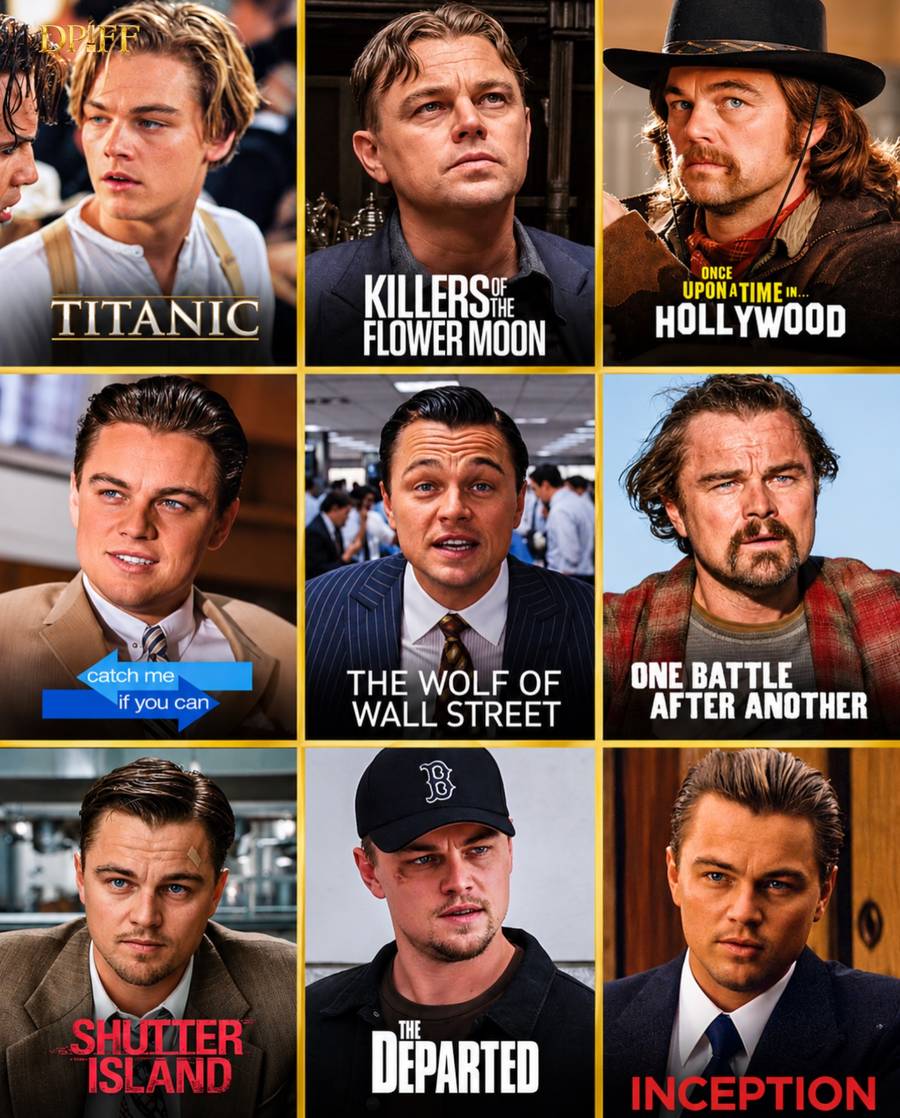
Leonardo DiCaprio’s filmography is remarkable not only for its list of acclaimed titles, but for the distance he has travelled between them. From the romantic idealism of Titanic to the moral uncertainty of Killers of the Flower Moon, DiCaprio has repeatedly chosen roles that place ambition, identity and obsession at the centre of the story.
A recent DPIFF Instagram post revisits some of the performances that have shaped his standing as one of contemporary cinema’s most closely watched actors. The selection spans blockbuster romance, crime drama, psychological thriller, satire, historical drama and character-driven filmmaking, reflecting a career built on both popular appeal and creative risk.
From teenage roles to global recognition
DiCaprio began attracting attention through television and supporting film roles before establishing himself as a major young actor in the 1990s. His performances in This Boy’s Life and What’s Eating Gilbert Grape demonstrated an intensity that was already visible well before worldwide stardom arrived.
His Oscar-nominated performance in What’s Eating Gilbert Grape remains an important early marker in his career. The role showed his ability to create emotional depth without relying on conventional leading-man traits, a quality that would continue to define his work in later decades. The Encyclopaedia Britannica profile of Leonardo DiCaprio also places these early performances within the broader arc of his rise from child actor to international star.
Titanic turned DiCaprio into a global star
James Cameron’s Titanic, released in 1997, transformed DiCaprio’s career. As Jack Dawson, he played a free-spirited young artist whose relationship with Rose, portrayed by Kate Winslet, became the emotional centre of the film. The performance balanced youthful charm with vulnerability, helping the film connect with audiences across generations.
Titanic was also significant because it made DiCaprio one of the defining faces of a new generation of Hollywood actors. Yet he did not follow that success with a series of identical romantic roles. Instead, his subsequent choices moved towards morally complicated characters and increasingly demanding material.
Range beyond the romantic lead
In Catch Me If You Can, DiCaprio played Frank Abagnale Jr., a young con artist pursued by an FBI agent played by Tom Hanks. Steven Spielberg’s film required him to move quickly between confidence, vulnerability and deception. Its lighter tone revealed a different side of the actor, while still retaining the emotional uncertainty present in many of his strongest performances.
Martin Scorsese’s The Departed offered another major shift. As undercover police officer Billy Costigan, DiCaprio portrayed a man living under sustained psychological pressure. The 2006 crime drama placed him within an ensemble led by Jack Nicholson, Matt Damon and Mark Wahlberg, but his character’s fear and isolation provided much of the film’s tension.
That interest in unstable identities continued in Christopher Nolan’s Inception, where DiCaprio played Dom Cobb, a specialist who enters the dreams of others while struggling with memories of his own past. The film’s science-fiction premise was ambitious, but Cobb’s grief and guilt gave the story its emotional foundation.
Ambition, excess and self-destruction
DiCaprio’s collaboration with Scorsese reached a provocative point with The Wolf of Wall Street. As stockbroker Jordan Belfort, he delivered a performance that was energetic, comic and deliberately excessive. The film examined financial fraud and unchecked consumption through a style that made the audience confront the seduction as well as the consequences of Belfort’s lifestyle.
The performance also demonstrated DiCaprio’s willingness to embrace unlikeable characters. Rather than soften Belfort, the film uses his charisma as part of its critique, creating a character who can dominate a room while revealing little moral restraint.
Recognition for The Revenant and mature dramatic work
DiCaprio won the Academy Award for Best Actor for Alejandro González Iñárritu’s The Revenant. His portrayal of frontiersman Hugh Glass depended heavily on physical expression, endurance and silence. The performance was part of a demanding survival drama in which the landscape and conditions became central to the character’s ordeal.
The award recognised a body of work that had already included several major performances, but it also highlighted DiCaprio’s preference for roles that require sustained commitment rather than a single dramatic scene. The Academy’s record of the 88th Oscars provides the official context for the honour.
His later work has continued to combine star power with challenging subject matter. In Quentin Tarantino’s Once Upon a Time in Hollywood, DiCaprio played Rick Dalton, an aging actor confronting professional insecurity and a changing industry. The performance moved between broad comedy, wounded pride and moments of unexpected tenderness.
In Scorsese’s Killers of the Flower Moon, DiCaprio took on the role of Ernest Burkhart, a man whose personal loyalties are shaped by greed, manipulation and family influence. The film’s historical setting and its account of violence against the Osage Nation gave the performance a larger social and moral context. It also marked another stage in DiCaprio’s move away from straightforward heroic roles.
Why DiCaprio’s filmography continues to matter
The significance of DiCaprio’s career lies in the relationship between accessibility and experimentation. His films often arrive as major cultural events, yet many of his performances are built around characters who are compromised, psychologically fractured or difficult to admire.
His choices also reveal a consistent interest in filmmakers with distinct visual and thematic identities, including Scorsese, Spielberg, Nolan, Iñárritu and Tarantino. Across these collaborations, DiCaprio has used his public image as a starting point and then complicated it through performances that resist easy categorisation.
For audiences, revisiting his filmography is therefore more than a list of popular films. It is a study of how a leading actor can move from youthful stardom to mature, risk-taking work without losing a connection with mainstream cinema.
DPIFF’s Instagram reference
Read the original DPIFF Instagram post highlighting Leonardo DiCaprio’s most memorable performances: https://www.instagram.com/p/Df7WeFkqrT6/
Recent Coverage from DPIFF
DPIFF’s official news archive carries the festival’s latest editorial updates, film-related features and entertainment coverage. Readers can visit the archive for the most recently published articles and continuing coverage from the festival’s editorial platform.
For more institutional information, the About DPIFF section explains the festival’s purpose and its engagement with cinema, while the festival’s broader website provides updates on its programmes and activities.
About Dadasaheb Phalke International Film Festival
Dadasaheb Phalke International Film Festival is an Indian film and entertainment platform named after Dadasaheb Phalke, widely regarded as the father of Indian cinema. DPIFF recognises creative achievement across the cinematic landscape and shares news, features and perspectives related to films, artists and the wider entertainment industry. Its editorial coverage aims to connect audiences with significant developments and enduring contributions to cinema.
Leonardo DiCaprio’s career remains compelling because it combines cultural visibility with a continuing willingness to change direction. From Jack Dawson to Ernest Burkhart, his most memorable characters have made that evolution visible on screen.


Share this link via



Share this link via

Share this link via