

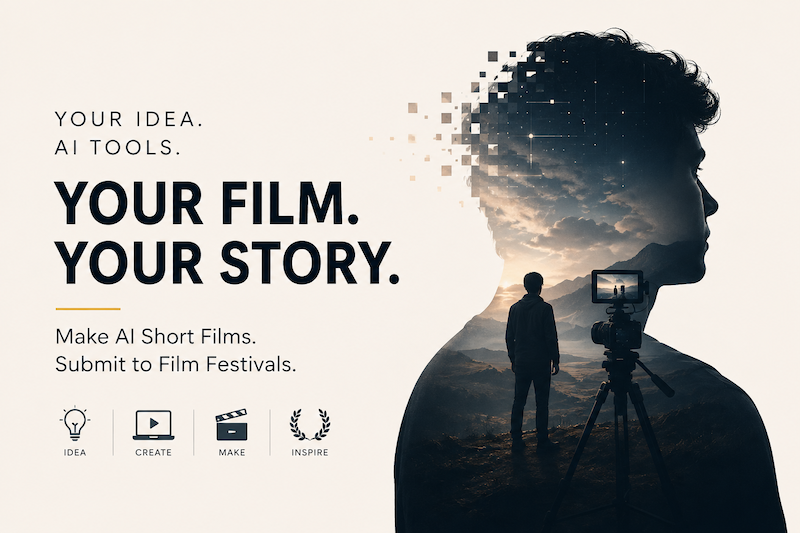
From Idea to Screen: How AI Is Opening the Door to a New Generation of Filmmakers
AI is changing how stories can be visualised, produced and finished. For creators with an idea but limited resources, the next step is not simply making an AI video. It is making a film worth submitting.
Submit Your Film to DPIFF Read the FAQsFor decades, making a film often meant having access to cameras, actors, locations, equipment, production crews and a budget large enough to bring an ambitious idea to life. That barrier is changing.
Today, a filmmaker with a strong idea, a laptop, a phone and access to modern creative tools can experiment with characters, environments, animation, visual development, storyboards, voices and cinematic sequences in ways that were previously difficult or expensive.
That does not mean filmmaking has become effortless. It means more people can attempt it.
And that creates an important opportunity for a new generation of creators: turn the idea into a finished short film, then put that film into the world.
The Barrier to Making a Film Is Changing
A great many aspiring filmmakers have stories they want to tell. The obstacle is often production.
One creator may have written a screenplay but have no camera. Another may have imagined an extraordinary science-fiction world but have no budget to build it. A student may have a powerful social story but no access to actors, locations or a full production crew.
AI-assisted filmmaking workflows can help reduce some of those barriers. Tools are increasingly being developed specifically for visual storytellers. Google introduced Flow as an AI filmmaking tool designed to help creatives develop cinematic clips, scenes and stories, while Runway’s AI Film Festival has created a dedicated showcase for artists experimenting with emerging AI tools.
The technology can assist with production. It cannot automatically decide what the audience should feel, why a scene exists, how a character changes or what the story ultimately wants to say.
That remains the filmmaker’s job.
Your First Film Does Not Have to Be a Feature
One of the most useful lessons for an emerging filmmaker is also one of the simplest: start small.
Your first film does not have to be two hours long. It could be three minutes. Five minutes. Ten minutes. It could be science fiction, drama, animation, documentary, experimental cinema, a social impact story or a completely new visual experience.
The objective is not to prove that AI can generate impressive visuals.
The objective is to prove that you can tell a story.
Story
Character
Visuals
Emotion
Editing
Sound
That difference can separate an impressive AI generated video from an impressive AI film.
AI Is Entering the Film Festival Conversation
AI assisted filmmaking is no longer limited to social media experiments. Film festivals and filmmaking institutions are actively exploring how emerging AI tools can fit into the creative process.
Runway’s AI Film Festival was established in 2022 and continues to showcase filmmakers using emerging AI tools. Its 2025 edition selected ten finalists for gala screenings in New York and Los Angeles, with Runway reporting more than 6,000 submissions for that edition.
Tribeca Studios and OpenAI also launched a year long collaboration supporting independent filmmakers in creating AI integrated short films. The resulting films premiered at the 2026 Tribeca Festival, demonstrating how AI can be explored as part of a broader filmmaking process rather than treated as a novelty by itself.
Sundance and the International Documentary Association have also introduced additional questions around generative AI in nonfiction filmmaking, with an emphasis on transparency, artistic intent and responsible disclosure.
DPIFF Has a Dedicated Best AI Short Film Category
DPIFF 2027 recognises this changing creative landscape with a dedicated Best AI Short Film Award within its Short Film Awards programme.
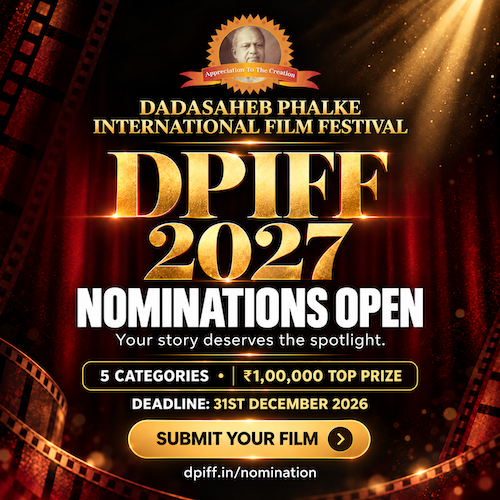
The current DPIFF nomination programme features five categories:
Best Short Film
Best Documentary Short Film
Best Animated Short Film
Best Student Short Film
Best AI Short Film
The current Best AI Short Film category carries a cash prize of INR 10,000, together with an official DPIFF trophy, winner certificate, official festival laurels and international recognition. The Best Short Film category currently carries a cash prize of INR 1,00,000, while the other four categories list INR 10,000 each.
The nomination form also asks AI category applicants to identify the AI tools and software used and the level of AI involvement. That makes transparency part of the submission process rather than an afterthought.
Do Not Make an AI Video. Make a Film.
This is where new AI filmmakers should be especially disciplined.
A collection of beautiful generated shots is not automatically a short film. A festival jury is not simply looking for the most spectacular image or the most advanced tool.
DPIFF states that its judging considers factors including originality, storytelling, direction, screenplay, technical execution, creativity, innovation and overall cinematic impact.
Start With the Story
Know what your film is about before deciding which AI tool, visual style or production workflow you want to use.
Give Characters a Purpose
A visually impressive character still needs motivation, conflict, choices and change.
Direct the Visual Language
Use AI to serve your cinematography, production design, animation or world building rather than letting the tool define the film.
Edit for Meaning
Good editing is not about collecting the best shots. It is about choosing the shots that move the story forward.
Before you make the film, ask yourself:
- What is my story?
- Who is the central character?
- What does the character want?
- What stands in the way?
- What changes by the end?
- What should the audience feel?
- What makes this film different from other AI generated videos?
If you can answer those questions, AI becomes a filmmaking tool rather than the entire film.
Why Submit Your AI Short Film to a Festival?
Putting a film online is easy. Getting it evaluated as a film is different.
A festival submission places the work into a formal competitive environment where the filmmaker can pursue selection, recognition and awards. For an emerging creator, that can be valuable because a completed festival entry is also evidence of discipline: you had an idea, finished the project and put your work forward for evaluation.
Turn the Idea Into a Finished Work
A submission deadline creates a clear finish line. It can turn an unfinished concept into a completed short film with a title, poster, synopsis and screening link.
Build a Professional Portfolio
Official selections, laurels and awards can become useful additions to a filmmaker’s portfolio, press kit, website and future festival submissions.
Put the Work Beyond Your Own Feed
Social media can generate attention, but a festival submission gives the work another context: a formal cinematic programme and a structured evaluation process.
Start a Festival Journey
Your first submission does not have to be the end goal. It can be the first entry in a longer journey of making, submitting, learning and improving.
Who Can Submit to DPIFF 2027?
The current DPIFF 2027 Short Film Awards programme welcomes independent filmmakers, documentary creators, animation artists, student filmmakers and AI storytellers from around the world. Films may be submitted in any language, but films not in English or Hindi must include accurate English subtitles.
The current eligibility information states that films completed between 1 January 2021 and 31 December 2026 are eligible, with a total runtime between 1 and 40 minutes including opening and closing credits.
| Requirement | Current DPIFF 2027 Information |
|---|---|
| Eligible production period | Films completed from 1 January 2021 to 31 December 2026 |
| Runtime | 1 to 40 minutes including opening and closing credits |
| Languages | Any language; English subtitles required for films not in English or Hindi |
| International entries | Filmmakers worldwide can submit |
| AI category | Best AI Short Film |
| AI disclosure | AI tools/software used and level of AI involvement are requested |
What to Prepare Before You Submit
A strong submission is easier when the filmmaker prepares the basic materials before opening the nomination form.
- Film title and director information.
- Film poster prepared in a professional, readable format.
- Short synopsis that communicates the central story without unnecessary detail.
- Private screening link through YouTube, Vimeo or Google Drive.
- Password if the screening link is protected.
- Contact information that you actively monitor.
- AI tools and software used if your project includes AI assisted production.
- Level of AI involvement as requested by the nomination form.
The current nomination form accepts film poster uploads and asks for a short synopsis and screening link. It also collects additional information for Student and AI categories.
The DPIFF 2027 Submission Window
If your film is ready, the strongest strategy is not to wait for the final deadline.
Early Bird Deadline
31 August 2026
Regular Deadline
30 November 2026
Late Deadline
31 December 2026
The current nomination page also lists selected filmmaker notification for 10 February 2027, with the festival and awards ceremony date to be announced.
If your film is already complete, submitting earlier can give you more time to focus on your next project instead of carrying one unfinished submission forward.
Copyright, AI and Responsible Filmmaking
AI filmmaking creates new creative possibilities, but it also makes rights management and transparency more important.
Creators should understand the terms associated with every AI tool, stock asset, music track, voice, image and other third party material used in their production.
DPIFF’s nomination terms state that applicants must own or have obtained the necessary rights, licences and permissions required to submit the film. The terms also state that submitting a film does not transfer copyright ownership to DPIFF. Selected film participation can involve limited, non exclusive rights for festival screening and promotion.
For AI filmmakers, transparency should be treated as part of the creative process. Keep records of the tools used, understand the permissions attached to your assets and disclose AI involvement where the submission requires it.
The Most Exciting Part: Nobody Knows Who the Next Filmmaker Will Be
The next great filmmaker may not come from a traditional film school.
They may be a student making a first short film from a bedroom. They may be a designer who has never operated a cinema camera. They may be a writer who finally found a way to visualise a story. They may be an animator experimenting with new techniques. They may be an independent creator discovering that AI can help turn an impossible production idea into a finished film.
Technology is lowering some barriers to entry. Festivals can provide the next step.
That creates a powerful opportunity for creators who are willing to move from experimentation to execution.
Your Story Is More Important Than Your Equipment
The temptation with AI is to focus on the technology.
Which model? Which generator? Which prompt? Which visual style? Which camera simulation? Which effect?
Those questions matter. But filmmaking has never ultimately been about equipment.
It has always been about stories.
A powerful story made with simple tools can stay with an audience longer than a technically perfect production without a soul.
AI gives today’s creators more ways to bring an idea to life. What they do with that opportunity is up to them.
So, If You Have an Idea, Make the Film
Do not wait for the perfect camera.
Do not wait for a huge production budget.
Do not wait until you have a crew of fifty people.
Start with the story.
Write
Plan
Create
Edit
Finish
Submit
Write the screenplay. Plan the shots. Experiment with AI. Edit relentlessly. Add sound. Watch the finished film. Improve it. And then submit it.
The future of cinema will not belong exclusively to people who had the biggest cameras or the biggest budgets. It will belong to creators with bold ideas, a clear point of view and the discipline to turn those ideas into finished work.
For today’s emerging AI filmmakers, that opportunity is already here.
Your idea can become a film. Your film can become a submission. And your submission can become the beginning of your filmmaking journey.
Frequently Asked Questions
Can I submit an AI generated short film to DPIFF 2027?
Yes. DPIFF 2027 has a dedicated Best AI Short Film category. The current nomination form asks applicants to provide the AI tools and software used and the level of AI involvement.
What is the Best AI Short Film Award?
It is one of the five current DPIFF 2027 Short Film Awards categories. The current page lists a cash prize of INR 10,000, an official DPIFF trophy, winner certificate, official festival laurels and international recognition.
Do I need to disclose which AI tools I used?
Yes. The current DPIFF nomination form specifically asks AI category applicants to provide the AI tools and software used and the level of AI involvement.
Who can submit a film to DPIFF?
Independent filmmakers, documentary creators, animation artists, student filmmakers and AI storytellers from around the world can submit to the current DPIFF 2027 Short Film Awards programme.
What is the maximum runtime for DPIFF 2027 short film entries?
The current nomination page states that eligible films must have a total runtime between 1 and 40 minutes, including opening and closing credits.
What production years are eligible for DPIFF 2027?
The current eligibility information states that films completed between 1 January 2021 and 31 December 2026 are eligible for submission.
Can I submit a film in a language other than English or Hindi?
Yes. Films may be submitted in any language. Films that are not in English or Hindi must include accurate English subtitles.
What do I need before submitting my film?
Prepare your film title, director details, poster, short synopsis, private screening link, password if required and contact information. Student and AI categories may require additional information.
What are the current DPIFF 2027 nomination deadlines?
The current schedule lists 31 August 2026 as the Early Bird Deadline, 30 November 2026 as the Regular Deadline and 31 December 2026 as the Late Deadline. Always confirm the live nomination page before submitting.
Your Film Is Waiting to Be Seen.
If you have a finished Short Film, Documentary, Animation, Student Film or AI Film, this is your opportunity to put your work forward for DPIFF 2027 and compete for official recognition.
Submit Your Film to DPIFF 2027Ready to take the next step? Visit the Official DPIFF 2027 Nomination Page to review eligibility, categories, deadlines and submission requirements.