

Best AI Short Film Award 2027: Submit Your AI Film to DPIFF
AI can generate images, voices and moving worlds. The filmmaker still has to decide what those images mean.
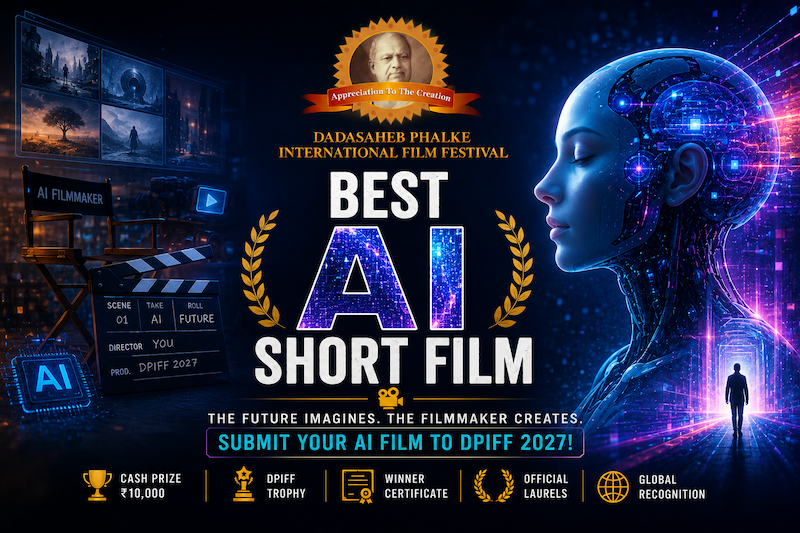
The Best AI Short Film Award is DPIFF’s dedicated category for eligible AI filmmaking. It is an opportunity to present a completed short where artificial intelligence forms part of the creative or production process, while the filmmaker remains responsible for the story, direction and finished cinematic work.
You can now describe a character, generate a visual world, explore a camera movement, transform an image, build a sequence, create a voice or prototype an entire scene with tools that did not exist in the same form a few years ago. But access to generation is not the same thing as authorship.
The interesting question is no longer simply whether a film uses artificial intelligence. It is what the filmmaker does with it.
A compelling AI short still needs a reason to exist. It needs a story, a point of view, characters or ideas worth following, deliberate visual choices, rhythm, sound and an ending that feels earned. Generative technology can expand the filmmaking workflow, but it does not automatically supply cinematic intent.
AI Can Generate Images. Filmmakers Create Meaning.
Generative AI is changing the economics and mechanics of visual experimentation. A creator can move from written idea to visual prototype quickly, test multiple aesthetics and explore concepts that might previously have required a larger production pipeline.
UNESCO’s current work on AI and culture describes generative AI as transforming cultural production, dissemination and participation while also raising questions around creativity, cultural rights, diversity, copyright and artistic agency. That is especially relevant to filmmakers: the technology is changing the workflow, but the creative responsibility does not disappear. Read UNESCO’s current discussion of AI and culture.
That distinction should shape your submission. Do not present the software as the achievement. Present the film as the achievement.
What Is DPIFF’s Best AI Short Film Award?
Best AI Short Film is one of the five categories in the DPIFF 2027 Short Film Awards programme, alongside Best Short Film Award, Best Documentary Short Film, Best Animated Short Film and Best Student Short Film.
The current DPIFF information confirms that AI-generated films can be submitted and that AI category applicants should disclose the AI Tools & Software Used and the Level of AI Involvement. The nomination form shows examples including Runway, Veo, Kling, Midjourney, ChatGPT and Pika. These are examples shown on the form, not a required tool list or DPIFF endorsement.
The award package includes an INR 10,000 cash prize, Official DPIFF Trophy, Winner Certificate, Official Festival Laurels and Global Recognition. The winner is announced during the DPIFF Awards Ceremony. The Festival and Awards Ceremony date is currently listed as To Be Announced.
Transparency is part of the submission
Be precise about how AI was used. A filmmaker who used AI for visual development, image generation, video generation, voice work, compositing or other stages should describe the involvement accurately rather than hiding it or exaggerating it.
Why AI Filmmaking Is Changing Short Cinema
Short filmmaking has always been a laboratory for new techniques. AI adds another layer to that experimentation by bringing generation, iteration and transformation into parts of the filmmaking process.
Rapid Visual Prototyping
Ideas can be visualised early, allowing filmmakers to test tone, composition and world-building before committing to a larger production plan.
New Visual Languages
Generative systems can produce combinations of texture, movement and imagery that invite filmmakers to rethink conventional production methods.
Hybrid Production
AI can sit alongside live action, animation, VFX, practical photography, motion design and traditional post-production.
Accessible Experimentation
Creators can explore visual ideas without needing every conventional production resource at the earliest stage.
That does not mean every AI film is innovative. The technology is becoming easier to access, which makes creative judgment even more important.
Who Should Submit?
The category can be relevant to independent filmmakers, AI-native creators, directors, VFX artists, animation creators, experimental filmmakers, students and hybrid filmmakers whose completed work meets the current DPIFF requirements.
You may have created the film almost entirely through generative systems, used AI for specific stages, combined AI-generated material with live action, or built an experimental work around synthetic imagery. What matters is that the submitted film is complete, eligible and accurately described.
If you are unsure whether your particular workflow fits the category, use the official DPIFF nomination process to confirm category suitability rather than assuming that a specific tool or technique is automatically eligible.
What Can an AI Short Film Look Like?
Fully AI-Generated
A film in which generative systems play a substantial role in creating visual or audiovisual material, with the filmmaker directing the overall narrative and final work.
AI-Assisted
AI may support ideation, visual development, image generation, editing assistance, sound or another defined part of the workflow while other filmmaking processes remain conventional.
Hybrid AI + Live Action
Live-action photography can coexist with generated environments, characters, extensions, transformations or other AI-assisted visual elements.
AI-Assisted Animation
Animation workflows may combine conventional animation, motion design or compositing with generative systems for selected elements.
Experimental AI Cinema
The film itself can investigate perception, identity, synthetic media, memory, technology or other subjects through an AI-led visual language.
Something More Hybrid
The most interesting workflow may not fit a neat label. Describe what you actually did, what AI contributed and what you directed yourself.
AI Tool vs Filmmaker: Who Is Actually Telling the Story?
A prompt is not a screenplay. A generated image is not a scene. A beautiful sequence is not automatically a narrative.
The filmmaker’s role becomes especially visible in the choices surrounding the generated material: what to keep, what to reject, how to connect shots, how to shape a character, when to cut, what the audience should understand and what should remain ambiguous.
The Academy’s current 99th Oscars rules provide a useful industry reference point: its rules state that generative AI and other digital tools neither help nor harm nomination chances and that the Academy considers the degree to which a human was at the heart of creative authorship. This is Academy policy, not a DPIFF rule, but it illustrates why human creative judgment remains an important part of the wider industry conversation. Read the Academy’s current awards rules update.
What Makes a Strong AI Short Film?
Start with the same question you would ask of any strong short film: what is this film trying to make the audience experience?
- Originality: Find a point of view rather than relying on the novelty of the technology.
- Story: Give the audience a reason to continue watching beyond visual curiosity.
- Direction: Make choices about framing, pacing, performance, movement and visual emphasis.
- Character: If the film has characters, give them wants, obstacles, contradictions or emotional stakes.
- Visual language: Establish rules for colour, texture, movement, lens behaviour, scale and visual continuity.
- Sound: Build an intentional sonic world rather than placing generic music under generated visuals.
- Editing: Use cuts to create meaning, rhythm and progression.
- Innovation: Let technology serve the concept instead of becoming the concept by itself.
Story First: Avoid the AI Demo Trap
The easiest AI film to make is often a montage of impressive images. It can look spectacular and still feel empty.
A film becomes more interesting when the visuals are necessary to the story. If a sequence can be removed without changing what the audience understands or feels, ask whether it belongs.
The three-layer test
Layer 1: Premise
Can you explain the central idea in one or two sentences without mentioning the AI tool?
Layer 2: Progression
Does something change from the beginning to the end? A decision, relationship, discovery, threat, belief or emotional state?
Layer 3: Necessity
Does the chosen visual approach deepen the idea? If AI is removed from the description, does the film still sound like a film worth watching?
Character, Emotion and Narrative
AI-generated imagery can create a character’s face in seconds. Characterisation takes longer.
If your film contains people, think beyond appearance. What does the character want? What are they afraid of? What changes? What do they refuse to say? What visual detail tells us something the dialogue does not?
For non-narrative or experimental films, the equivalent question is: what is the viewer’s journey? A sequence can be abstract while still having progression, tension, contrast, rhythm and emotional direction.
Visual Consistency and World-Building
One of the most common weaknesses in generative filmmaking is visual inconsistency. Characters change proportions. Props disappear. Lighting shifts without narrative reason. Camera movement feels disconnected from shot to shot.
Build a visual bible before generating large amounts of material. Define the character appearance, environment, time of day, palette, camera language, aspect ratio, movement style and important recurring objects.
Then review every shot against those rules. Do not assume the software will preserve continuity automatically.
A practical continuity pass
- Compare character identity across every appearance.
- Check costume, props and environmental details.
- Check light direction and apparent time of day.
- Check camera height, lens feel and movement.
- Check spatial geography between cuts.
- Remove shots that look impressive but break the film’s visual logic.
Editing, Sound Design and Music
The final film is not the generated material. It is the assembled experience.
Editing gives the images meaning through order, duration and contrast. Sound can make a generated world feel intimate, physical, threatening or human. Silence can be more effective than another layer of music.
Listen to your film without looking at the screen. Does the sound create a coherent emotional progression? Then watch it without sound. Does the visual structure still communicate? The two tests can reveal weaknesses that are easy to miss when everything is playing together.
For music and sound effects, make sure you have the necessary rights or licences for the material you submit. Do not assume that because a file is easy to download or generated by a tool it is automatically cleared for every intended use.
How to Disclose AI Involvement Professionally
DPIFF’s current AI nomination form asks for AI Tools & Software Used and Level of AI Involvement. Treat those fields as an opportunity to make your production process understandable.
Name the tools actually used
List the tools that materially contributed to the film. Do not add popular tools simply because they are associated with AI filmmaking.
Describe the stage
Explain whether AI was used for ideation, image generation, video generation, voice, music, editing assistance, compositing, character development or another stage.
Describe the level of involvement
Use clear language such as substantial, partial or limited only when it accurately reflects the production. The form’s own wording should take priority.
Keep evidence of your workflow
Where appropriate, retain project files, prompts, source assets, licences and production notes. This is useful for your own records and for answering questions about how the work was made.
Copyright, Permissions and Rights
AI filmmaking creates a complicated rights environment. Do not treat a tool’s ability to generate an output as a universal statement about ownership or clearance.
The U.S. Copyright Office’s ongoing work on copyright and artificial intelligence shows that questions around human contribution, generated expression, training and protected material remain active areas of legal and policy analysis. Its Part 2 report specifically examines copyrightability and the role of human contribution in AI-assisted outputs. Read the U.S. Copyright Office report on AI and copyrightability.
For a festival submission, the practical rule is simple: submit only work for which you have the necessary rights, licences and permissions, in accordance with DPIFF’s official nomination terms. That can include music, voices, photographs, footage, trademarks, likenesses, third-party assets and other protected material.
This article does not provide legal advice, and copyright rules vary by jurisdiction. If your production contains complex third-party or synthetic-media issues, obtain appropriate professional advice before submission.
What DPIFF Evaluates
DPIFF’s current judging areas apply to the Best AI Short Film category as follows:
- Originality – Does the film have a distinctive creative idea or perspective?
- Storytelling – Does the film communicate a compelling experience?
- Direction – Are the creative decisions coherent and intentional?
- Screenplay – Does the written structure support the finished work?
- Technical execution – Is the film competently finished?
- Creativity – Does the filmmaker use the medium thoughtfully?
- Innovation – Does the approach explore new possibilities with purpose?
- Overall cinematic impact – What remains with the viewer after the film ends?
These are evaluation areas, not a formula and not a guarantee of selection or winning.
How to Prepare Your AI Film for Festival Submission
Lock the story
Make sure the narrative, structure or conceptual progression works before spending time polishing individual generated shots.
Lock the visual language
Define your recurring visual rules and remove shots that contradict them.
Finish sound and music
Dialogue, ambience, effects and music should be mixed as part of the final cinematic experience.
Check every frame
Look for malformed hands, faces, text, objects, flicker, unwanted movement, inconsistent geometry and other artefacts that distract from the story.
Check rights
Review music, voices, source imagery, footage, likenesses and other third-party materials. Keep licences or permissions where relevant.
Prepare disclosure
Record the AI tools and level of involvement requested by the DPIFF nomination form.
Test the screening link
The current submission information accepts YouTube, Vimeo or Google Drive screening links. Test access and any password before submitting.
AI Filmmaking Workflow: Idea to Festival Submission
Concept
Define the story, emotional objective or central question before opening a generation tool.
Script and Structure
Build the narrative beats, scenes, transitions and ending. AI can assist ideation, but the filmmaker owns the creative decisions.
Visual Development
Establish character references, environments, camera language and visual rules.
Generation and Production
Generate, capture, animate, shoot or combine material while maintaining a consistent creative direction.
Edit and Sound
Shape the film through rhythm, sound design, music, dialogue and final mix.
Rights and Disclosure
Confirm permissions and document the AI tools and level of involvement requested by the nomination form.
Festival Delivery
Prepare the synopsis, poster, contact details and screening link, then submit through the official nomination process.
How to Submit to DPIFF 2027 – Step by Step
Review the Best AI Short Film category
Read the current nomination information and confirm that your film is appropriate for the AI category.
Check eligibility
Confirm the completion period, runtime, language and subtitle requirements.
Prepare AI disclosure
Have your AI Tools & Software Used and Level of AI Involvement information ready.
Prepare the film package
Finalise your film title, director details, synopsis, poster, contact information and screening link.
Test access
Check the YouTube, Vimeo or Google Drive link from a separate account or device and verify any password.
Submit the nomination
Complete the official form and applicable nomination fee. Multiple films can be submitted separately, with each film requiring its own nomination.
Ready to submit?
Use the official DPIFF nomination page for the current form and requirements.
SUBMIT YOUR AI FILM TO DPIFFDPIFF 2027 Eligibility Requirements
| Requirement | Current DPIFF requirement |
|---|---|
| Completion period | Film completed from 1 January 2021 through 31 December 2026 |
| Runtime | 1 to 40 minutes including opening and closing credits |
| Language | Any language accepted. Films not in English or Hindi must include accurate English subtitles |
| International submissions | International filmmakers accepted |
| Multiple films | Multiple films can be entered separately |
| AI disclosure | Current AI category form asks for AI Tools & Software Used and Level of AI Involvement |
Examples displayed on the current AI form include Runway, Veo, Kling, Midjourney, ChatGPT and Pika. These examples should not be interpreted as a required tool list or endorsement. Confirm current requirements through the official nomination page.
DPIFF 2027 Deadlines
| Stage | Date | Current status |
|---|---|---|
| Nomination Entries Opened | 10 January 2026 | Current cycle opened |
| Early Bird Deadline | 31 August 2026 | Passed when this article is published on 3 September 2026 |
| Regular Deadline | 30 November 2026 | Current regular deadline |
| Late Deadline | 31 December 2026 | Final listed deadline |
| Selected Filmmakers Notified | 10 February 2027 | Current listed notification date |
| Official Selection Announcement | TBA | No date currently listed |
| Festival and Awards Ceremony | To Be Announced | No date currently listed |
| Winner Announcement | During DPIFF Awards Ceremony | Winner announced during ceremony |
The Regular Deadline is 30 November 2026.
The Early Bird window has closed. Use the remaining submission window to improve the film, check rights, document AI involvement and test the screening link.
Best AI Short Film Award and Recognition
INR 10,000 Cash Prize
The current listed cash prize for the Best AI Short Film Award winner.
Official DPIFF Trophy
Official trophy associated with the award.
Winner Certificate
Official certificate recognising the winning achievement.
Official Festival Laurels
Official laurels that can become part of the film’s documented recognition.
DPIFF also lists Global Recognition as part of the award package. Recognition does not guarantee distribution, employment, funding, representation, screening or future festival acceptance.
5 Mistakes AI Filmmakers Should Avoid
Making a demo instead of a film
A collection of impressive generations is not automatically a narrative. Give the audience progression and purpose.
Hiding AI involvement
DPIFF’s current AI form explicitly asks for tools and level of involvement. Answer accurately.
Ignoring continuity
Visual inconsistencies can pull viewers out of the story. Build references and perform a dedicated continuity pass.
Assuming generated means cleared
Review rights and permissions for every material component of the finished work.
Letting technology replace direction
Do not surrender the film’s creative decisions to whatever the generator happens to produce. Select, revise and direct.
10-Point AI Short Film Quality Checklist
Explore the Other DPIFF 2027 Short Film Categories
The strongest category choice should reflect the film itself. These editorial guides can help you compare the broader DPIFF short-film programme before submitting.
Best Short Film Award 2027
For filmmakers preparing a narrative or general short-film submission.
Read the Best Short Film guideBest Documentary Short Film Award 2027
Explore nonfiction storytelling, documentary preparation and festival submission.
Read the Documentary guideBest Animated Short Film Award 2027
Explore animation as a filmmaking language and prepare an animated short.
Read the Animation guideBest Student Short Film Award 2027
Learn how student filmmakers can turn a completed project into a professional submission.
Read the Student guideAI Filmmaking Is Still Filmmaking
The technology will change. Tools will improve. Models will become faster, more controllable and more integrated into production. The fundamental challenge of cinema will remain: making the audience care.
A good AI short does not need to prove that it used AI in every frame. It needs to show why the chosen technology helped the filmmaker make this particular film.
That is where the opportunity lies. Use generative systems to expand your visual vocabulary, accelerate experimentation or build worlds that serve the story. Then return to the traditional disciplines that make a film work: writing, direction, editing, sound, performance, rhythm and point of view.
For broader festival information, explore the DPIFF About Us page, the DPIFF Awards section and the DPIFF News archive. You can also explore the wider DPIFF editorial library for filmmaking and festival resources.
FAQs
What is the Best AI Short Film Award 2027 at DPIFF?
It is DPIFF’s dedicated category for eligible AI short films within the 2027 Short Film Awards programme. The current award package includes an INR 10,000 cash prize, Official DPIFF Trophy, Winner Certificate, Official Festival Laurels and Global Recognition.
What qualifies as an AI short film for DPIFF?
The current DPIFF information confirms that AI-generated films can be submitted and that AI category applicants should disclose the AI tools or software used and the level of AI involvement. A film may use AI substantially or as part of a hybrid workflow. Filmmakers should confirm category suitability through the official nomination process.
Which AI tools can be used for a DPIFF AI film submission?
The current DPIFF nomination form shows examples including Runway, Veo, Kling, Midjourney, ChatGPT and Pika. These are examples shown on the form, not a mandatory tool list or DPIFF endorsement.
What is the runtime requirement for the DPIFF AI Short Film Award?
The current requirement is 1 to 40 minutes including opening and closing credits.
What completion dates are eligible for DPIFF 2027?
Films completed from 1 January 2021 through 31 December 2026 are currently eligible.
Can international filmmakers submit an AI film to DPIFF?
Yes. International filmmakers are accepted under the current DPIFF information. Films can be submitted in any language, but films not in English or Hindi must include accurate English subtitles.
What is the Regular Deadline for the DPIFF AI Short Film Award 2027?
The Regular Deadline is 30 November 2026. The Late Deadline is 31 December 2026. The Early Bird Deadline was 31 August 2026.
Does DPIFF guarantee selection or screening for AI films?
No guarantee should be inferred. Selection, screening and winning are not guaranteed. Filmmakers should rely on the current official nomination terms for the applicable process.
Your Film Can Use AI. Your Story Still Needs You.
The Early Bird deadline has passed, but the DPIFF 2027 cycle remains open. If your AI short meets the current requirements, use the time before 30 November 2026 to refine the film, document your AI workflow and submit it professionally.
SUBMIT TO BEST AI SHORT FILM 2027