

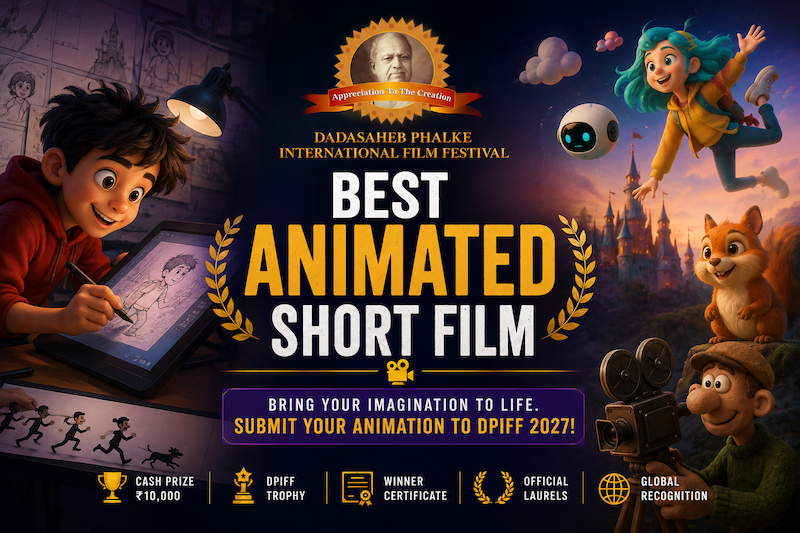
Best Animated Short Film Award 2027: Submit Your Animation to DPIFF
You do not animate because reality is enough. You animate because the story needs a world that only you can create.
The Best Animated Short Film Award is DPIFF’s dedicated category for eligible animation-led short-form cinema. For filmmakers working in animation, the short can be a complete cinematic statement: a story, a visual language, a character journey and a world built frame by frame.
Animation can make a memory visible. It can turn an emotion into a landscape, give a voice to an impossible character, bend time, change scale, invent a universe or make an ordinary object feel alive. That freedom is not a substitute for filmmaking. It is filmmaking.
If you have spent months drawing, modelling, rigging, sculpting, compositing, animating, editing and refining a short film, the finished render is not the end of the journey. It is the moment when the film can leave the workstation and meet an audience.
The Best Animated Short Film Award 2027 at Dadasaheb Phalke International Film Festival is focused specifically on eligible animated short-form cinema. The current DPIFF information allows films completed between 1 January 2021 and 31 December 2026, with a runtime of 1 to 40 minutes including opening and closing credits.
Animation Can Make the Impossible Feel Real
Live action begins with a world that exists in front of a camera. Animation begins with possibility. The filmmaker can design the world before the audience ever sees it.
That makes animation an unusually flexible cinematic language. A 2D drawing can carry a character’s inner state. A stop-motion object can acquire personality through movement and texture. A 3D environment can create a scale or physics that would be difficult to capture practically. Mixed-media work can deliberately combine different visual realities.
ASIFA, the International Animated Film Association, describes animation as a field spanning a wide variety of production methods, formats, techniques and genres. Its International Animation Day programme also highlights animation as an art form that develops through shorts, multimedia and feature films made by independent artists, students and creators around the world. Explore ASIFA’s perspective on animation as an art form.
The important question, therefore, is not simply whether an animated short looks impressive. It is whether the chosen form gives the story something that another filmmaking approach could not give it as effectively.
What Is DPIFF’s Best Animated Short Film Award?
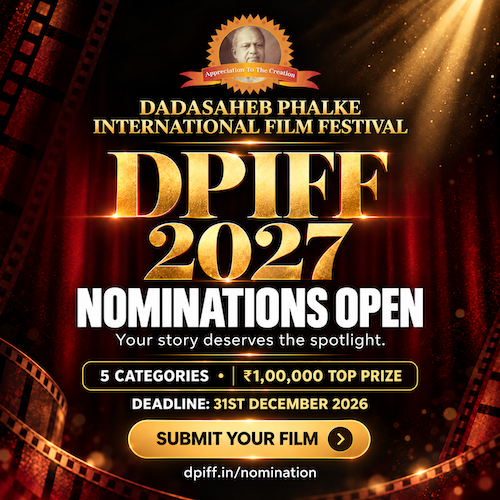
Best Animated Short Film is one of the five categories in the DPIFF 2027 Short Film Awards programme. The other categories are Best Short Film Award, Best Documentary Short Film, Best Student Short Film and Best AI Short Film.
For animation filmmakers, this category provides a dedicated place to submit eligible animation-led cinematic storytelling. The current DPIFF information does not prescribe a single animation technique. Forms such as 2D animation, 3D animation, stop motion, mixed media and experimental animation may be relevant examples, but filmmakers should confirm category suitability through the official nomination process.
The current award package includes an INR 10,000 cash prize, Official DPIFF Trophy, Winner Certificate, Official Festival Laurels and Global Recognition. The winner is announced during the DPIFF Awards Ceremony. The Festival and Awards Ceremony date is currently listed as To Be Announced.
Use the live nomination page as your final source
Deadlines, eligibility and form requirements should always be checked immediately before submission. Review the current DPIFF nomination page before entering your film.
Why Animated Shorts Are Powerful Cinema
A short animated film can compress an entire emotional journey into a few minutes. It can move between reality and imagination without changing locations. It can exaggerate a gesture, transform an object into a character or use colour, shape and rhythm as part of the narrative itself.
UNESCO has also used animation and digital storytelling to help communicate cultural stories and experiences to contemporary audiences. One recent UNESCO project combined archival research, oral histories, animation and creative visual storytelling to make complex histories more accessible. Read UNESCO’s example of animation combined with heritage storytelling.
For independent animators, this matters because the short form is not merely a smaller version of a feature. It is a form with its own rhythm. The strongest short films understand exactly how much story the available time can carry.
Who Should Submit?
The category can be relevant to creators at very different stages of their careers. What matters first is that the completed film meets the current DPIFF requirements.
2D Animators
Hand-drawn, digital 2D and stylised animation can use line, shape, colour and movement as expressive storytelling tools.
3D Artists and Directors
3D filmmakers can build characters, environments, camera movement and visual worlds entirely around the needs of the story.
Stop-Motion Filmmakers
Physical materials, puppets, miniatures and frame-by-frame movement can give a short a distinctive tactile identity.
Independent Studios and Students
Small teams, student filmmakers and emerging studios can submit completed eligible work and present their animation as cinema.
Mixed-media creators and experimental animators can also consider the category where animation is central to the film’s cinematic language. When the classification is unclear, use the official nomination process to confirm suitability.
What Types of Animated Shorts Can Enter?
Animation is not one look. A useful way to think about the category is through the role animation plays in the finished film.
Experimental animation may use abstraction, unusual materials, transformation, collage, procedural methods or unconventional editing. The technique is only the starting point. The finished work still needs a cinematic reason for its choices.
For comparison, the Academy’s current Animated Short Film rules define animation through the creation and manipulation of movement and imagery rather than the capture of live-action movement, while also applying specific eligibility rules for Academy consideration. Those rules are separate from DPIFF eligibility and should not be treated as DPIFF requirements. Review the Academy’s current animation rules.
What Makes an Award-Worthy Animated Short?
There is no formula for winning. But there are useful questions an animator can ask before pressing export.
Does the story need animation?
Could the same emotional experience be created just as effectively through live action? If yes, ask what your animation adds. The answer may be visual metaphor, impossible movement, design, transformation, abstraction or complete world control.
Does every visual choice have purpose?
Colour, camera movement, character design, lighting, texture and effects should contribute to the film’s tone or narrative rather than exist only because the technology makes them possible.
Can the audience follow the emotional journey?
Even experimental films benefit from some form of progression. The audience should understand what is changing, even if the film does not explain everything literally.
Does the ending earn its final frame?
A strong final image can reframe everything that came before. Avoid ending simply because the planned runtime has been reached.
Story vs Visuals: What Should Come First?
Story should lead. Visual design should make the story more powerful.
That does not mean every animated short needs a conventional plot. A film can be abstract, poetic, atmospheric or experimental. But the audience should still have an experience that feels intentional.
Start by identifying the film’s core: a character wants something, an idea evolves, a relationship changes, an image transforms, a question becomes more complicated or an emotional state moves from one place to another.
Then ask what animation can do with that core. If a character is dealing with grief, perhaps the world physically changes as memories surface. If the story is about repetition, perhaps the animation language itself repeats and gradually breaks. If it is about freedom, perhaps the frame, gravity or physical rules evolve.
Character, World-Building and Visual Language
Character is more than design
A beautifully designed character can still feel empty. Give the audience behaviour to observe. A small hesitation, repeated gesture, change in posture or relationship with an object can tell the audience who the character is without dialogue.
World-building is selective
You do not need to design every corner of a universe if the audience only needs to understand one room. Spend production time where it supports the story. A single memorable location can be stronger than ten generic environments.
Build a visual grammar
Think about the rules of the film. What does a close-up mean? What does red mean? When does the camera move? When does the frame become crowded? When does the image simplify? Consistent visual decisions can make an animated short feel authored rather than assembled.
ASIFA’s academic work on animation repeatedly considers animation as a distinct image-making practice rather than simply a technical substitute for live action. That distinction is useful for filmmakers: the medium itself can become part of the meaning. Explore ASIFA’s animation research and academic publications.
Animation Quality vs Storytelling Quality
Technical quality matters. But technical complexity is not automatically cinematic quality.
- Perfectly rendered but emotionally empty is still an empty film.
- Simple design with strong timing can become deeply expressive.
- Complex camera movement without narrative purpose can distract from the story.
- Limited animation used intentionally can create style, rhythm and focus.
- Strong sound and editing can make relatively simple imagery feel dramatically complete.
The practical question is not “How much animation did we create?” It is “How effectively did we use animation to make the audience experience this story?”
Sound Design, Music and Editing
Animation is often visually dominant, but the soundtrack can determine whether the film feels cinematic. Footsteps, cloth movement, room tone, impacts, breathing, silence and environmental sound can make an invented world feel inhabited.
Music should not be used simply to tell the audience what emotion to have. Consider whether the score creates contrast, rhythm, anticipation or release. Sometimes the most powerful moment is the absence of music.
Editing also deserves attention. Animation can tempt filmmakers to keep every beautiful shot they spent weeks producing. Do not let production effort dictate the final cut. If a shot is beautiful but slows the story, it may need to go.
The hardest edit may be the right edit
Ask whether every shot changes something. If removing a shot changes nothing about the audience’s understanding or feeling, test the film without it.
How to Prepare an Animated Short for Festival Submission
Lock the final film
Check the picture, credits, audio, subtitles, titles and final frame. Watch the exported file outside the editing or animation software.
Review the first 30 seconds
Make sure the film establishes its tone, world or question quickly enough to invite the audience in.
Check every credit
Verify director, producer, studio, voice cast, music, copyright notices and other credits. Small errors look avoidable once the film is submitted.
Check language and subtitles
Films can be submitted in any language under the current DPIFF information. Films not in English or Hindi must include accurate English subtitles.
Test the screening link
The submission information accepts YouTube, Vimeo or Google Drive screening links. Test access on another device and verify any password.
Prepare the synopsis and poster
Write a concise synopsis that communicates the film without explaining every scene. Make sure the poster and film title are consistent.
How DPIFF Evaluates Films
The current DPIFF judging areas provide a useful self-review framework:
- Originality: Is there a distinctive idea, perspective or treatment?
- Storytelling: Does the film create a meaningful audience journey?
- Direction: Do the creative choices work together with purpose?
- Screenplay: Where written structure or dialogue is used, does it support the cinematic experience?
- Technical execution: Are animation, editing, sound, compositing and other technical elements competently finished?
- Creativity: Does the film use animation as an expressive filmmaking language?
- Innovation: Does it explore form, technique or narrative in a thoughtful way?
- Overall cinematic impact: Does something remain with the viewer after the film ends?
These are evaluation areas, not a guaranteed formula for selection or winning.
Already preparing a DPIFF submission?
Review the official nomination requirements and submit through the live DPIFF nomination page.
SUBMIT YOUR FILM TO DPIFF 2027How to Submit Your Animation to DPIFF 2027
Choose Best Animated Short Film
Confirm that animation is central to your film and that the category is appropriate. When in doubt, confirm category suitability through the official nomination process.
Confirm the completion date and runtime
Your film must currently fall within the 1 January 2021 to 31 December 2026 completion period and the 1 to 40 minute runtime requirement including credits.
Prepare your screening link
Use a working YouTube, Vimeo or Google Drive screening link and provide a password if required.
Prepare your application materials
Have the film title, director details, synopsis, poster, contact information and other information requested by the nomination form ready.
Complete the nomination
Submit the official form and applicable nomination fee. Multiple films may be entered separately, with each film submitted through its own nomination.
Save your submission record
Keep your final film link, password, submitted information and confirmation details for your records.
DPIFF 2027 Eligibility Requirements
| Requirement | Current DPIFF requirement |
|---|---|
| Completion period | Film completed from 1 January 2021 through 31 December 2026 |
| Runtime | 1 to 40 minutes including opening and closing credits |
| Language | Any language accepted. Films not in English or Hindi must include accurate English subtitles |
| International submissions | International filmmakers accepted |
| Multiple films | Multiple films can be entered separately |
Always verify the live DPIFF nomination page before submission because the official form and terms are the controlling source for current requirements.
DPIFF 2027 Animated Short Film Deadlines
| Stage | Date | Status |
|---|---|---|
| Nomination Entries Opened | 10 January 2026 | Submissions opened for the current cycle |
| Early Bird Deadline | 31 August 2026 | Passed when this article is published on 1 September 2026 |
| Regular Deadline | 30 November 2026 | Current regular submission deadline |
| Late Deadline | 31 December 2026 | Final listed deadline under the current schedule |
| Selected Filmmakers Notified | 10 February 2027 | Current listed notification date |
| Official Selection Announcement | TBA | No date currently listed |
| Festival and Awards Ceremony | To Be Announced | No ceremony date currently listed |
| Winner Announcement | During DPIFF Awards Ceremony | Winner announced during the ceremony |
Early Bird has closed. The Regular Deadline is 30 November 2026.
If your animation is ready, do not wait until the final week to discover a broken screening link, incorrect subtitle file or missing application detail. Use the additional time to polish the submission, not to postpone it.
Prize and Recognition
The current DPIFF 2027 award package for Best Animated Short Film includes:
INR 10,000 Cash Prize
The listed cash prize for the Best Animated Short Film Award winner.
Official DPIFF Trophy
Official festival trophy associated with the award.
Winner Certificate
Official certificate recognising the winning achievement.
Official Festival Laurels
Festival laurels that can become part of the film’s professional recognition record.
DPIFF also lists Global Recognition as part of the award package. Recognition is not a guarantee of distribution, employment, funding, representation or future festival acceptance. For an animator, the more durable value may be the opportunity to add a recognised film to a growing body of work.
Common Animation Festival Submission Mistakes
- Choosing visuals over story. A beautiful render cannot compensate for a film that does not know what it wants the audience to experience.
- Keeping shots because they took too long to make. Production effort should not determine the final edit.
- Overloading the opening. Too much exposition, text or world-building can delay the actual film.
- Ignoring sound. A visually sophisticated film can feel unfinished when sound design is treated as an afterthought.
- Using effects without narrative purpose. Effects should support the world, character or emotional rhythm.
- Weak subtitles. Translation errors can change meaning and distract from the film.
- Broken screening links. Test the exact link you submit.
- Incorrect credits or poster information. Check names and titles before submission.
- Submitting the wrong category. Review the category and confirm suitability if your film crosses forms.
- Waiting for the deadline. Give yourself time for administrative and technical corrections.
7 Things to Check Before Submitting an Animated Short
Animation Festival Submission Checklist
Before clicking submit, treat your application as the final production department of the film.
- Film: Final exported version checked from beginning to end.
- Runtime: Between 1 and 40 minutes including opening and closing credits.
- Completion date: Between 1 January 2021 and 31 December 2026.
- Language: English subtitles included where required.
- Screening link: YouTube, Vimeo or Google Drive link works correctly.
- Password: Supplied where applicable and tested.
- Poster: Correct title and final artwork.
- Synopsis: Short, accurate and audience-facing.
- Director details: Correct name and contact information.
- Rights: Music, artwork, archive and third-party materials reviewed.
- Nomination: Correct category, form and applicable fee.
- Records: Confirmation and submitted materials saved.
FAQs
What is the Best Animated Short Film Award 2027 at DPIFF?
It is DPIFF’s dedicated category for eligible animated short films within the 2027 Short Film Awards programme. The current award package includes an INR 10,000 cash prize, Official DPIFF Trophy, Winner Certificate, Official Festival Laurels and Global Recognition.
Who can submit an animated short film to DPIFF 2027?
International filmmakers are accepted under the current DPIFF information. The category can be relevant to independent animators, directors, students, studios and emerging filmmakers whose completed films meet the current requirements.
What animation techniques can be submitted?
DPIFF’s current information does not prescribe a single animation technique. 2D, 3D, stop motion, mixed media and experimental animation are examples of forms that may fit an animation-led short, but filmmakers should confirm category suitability through the official nomination process.
What is the runtime requirement for DPIFF Animated Short Film?
The current requirement is 1 to 40 minutes including opening and closing credits.
What completion dates are eligible for DPIFF 2027?
Films completed from 1 January 2021 through 31 December 2026 are currently eligible.
Can international animators submit to DPIFF?
Yes. International filmmakers are accepted under the current DPIFF information. Films can be submitted in any language, with accurate English subtitles required for films not in English or Hindi.
What is the regular deadline for the DPIFF Animated Short Film Award 2027?
The Regular Deadline is 30 November 2026. The Late Deadline is 31 December 2026. The Early Bird Deadline was 31 August 2026.
What materials are needed for a DPIFF animation submission?
The current submission information asks for the film title, director details, synopsis, poster, screening link, password if applicable, contact details and the applicable nomination fee, along with other information requested by the nomination form.
Can I submit more than one animated film?
Yes. Multiple films can be entered separately, with each film submitted through its own nomination.
Continue Exploring DPIFF’s 2027 Short Film Categories
If you are deciding which DPIFF category best fits your film, the other category guides can help you compare the focus of the programme before submitting.
Best Short Film Award 2027
Explore the main Best Short Film category, eligibility, judging areas, submission process and practical advice for filmmakers.
Read the Best Short Film Award 2027 guideBest Documentary Short Film Award 2027
Explore documentary storytelling, ethics, preparation, eligibility and submission guidance for nonfiction filmmakers.
Read the Documentary Short Film Award 2027 guideYour Animation Took Time to Build. Now Let It Be Seen.
The Early Bird window has closed, but the 2027 cycle is still open. If your animated short meets the current requirements, use the time before 30 November 2026 to make the submission as finished as the film itself.
SUBMIT TO BEST ANIMATED SHORT FILM 2027