

Best Documentary Short Film Award 2027: Submit Your Documentary to DPIFF
Some stories are not invented. They are found, witnessed, protected and shaped into films so that someone else can see them.
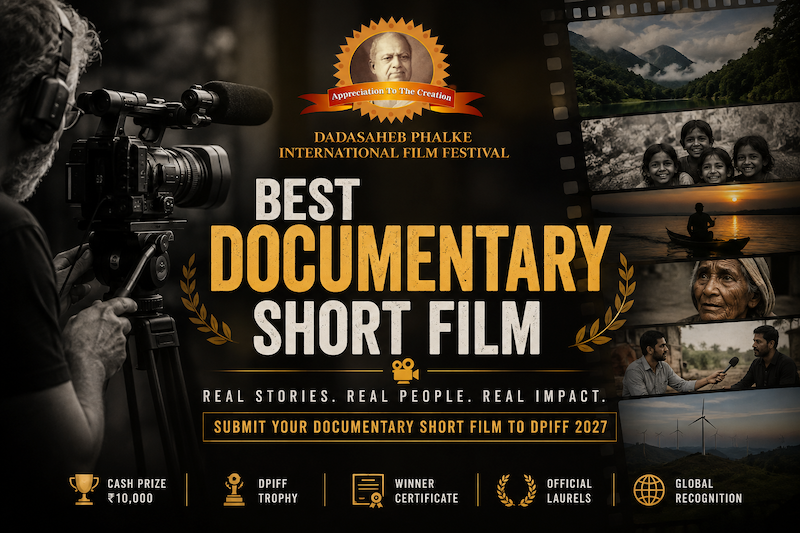
The Best Documentary Short Film Award is DPIFF’s dedicated category for eligible nonfiction short films. It gives documentary filmmakers an opportunity to place real stories, people, communities, histories, cultures, places and issues into a formal festival consideration process.
A documentary begins with attention. Someone notices a person, a place, a memory, a conflict, a tradition, a question or a change that deserves closer looking. The camera becomes a way of listening, observing and preserving. The edit then turns that material into a cinematic experience without losing sight of the people and realities that made it possible.
If you have already completed a documentary short, the next question is not simply where to upload it. It is where the film can be considered, discovered and remembered as a piece of cinema.
The Best Documentary Short Film Award 2027 at Dadasaheb Phalke International Film Festival is specifically focused on documentary short-form work. Under the current DPIFF information, eligible films can come from India or abroad, can be in any language, and must run between 1 and 40 minutes including opening and closing credits.
The Stories That Deserve to Be Seen
Documentary filmmaking can preserve a moment that would otherwise disappear. It can introduce audiences to a community they have never encountered, make a local issue visible, preserve a tradition, investigate a question, document a changing landscape or spend time with a person whose experience says something larger about the world around them.
UNESCO’s documentary and audiovisual archives demonstrate how short documentary works can help document cultural practices and living heritage. Its recent work on intangible cultural heritage also describes documentary and digital storytelling as tools for public awareness, cultural identity and engagement with communities. Explore UNESCO’s work on documentary storytelling and living heritage.
That is one reason the short documentary form matters. A film does not need feature length to preserve a voice or create a meaningful encounter. It needs a subject, a point of view and enough craft to make the audience stay.
What Is the DPIFF Best Documentary Short Film Award?
The Best Documentary Short Film Award is one of five categories in the DPIFF 2027 Short Film Awards programme. The other categories are Best Short Film Award, Best Animated Short Film, Best Student Short Film and Best AI Short Film.
This category is intended for eligible documentary storytelling. If the film’s primary form is nonfiction and its purpose is to explore real people, experiences, places, events, cultures, questions or issues through documentary filmmaking, this is the category to consider.
The current award package includes an INR 10,000 cash prize, Official DPIFF Trophy, Winner Certificate, Official Festival Laurels and Global Recognition. The winner is announced during the DPIFF Awards Ceremony. The ceremony date is currently listed as to be announced, so filmmakers should not rely on unofficial dates.
Start with the official nomination information
Category definitions, eligibility, deadlines and submission requirements can change. Before submitting, review the current DPIFF nomination page and use it as the final source for your application.
Why Documentary Shorts Matter
Documentaries can work at the scale of a life, a neighbourhood, a profession, a historical memory or a single unresolved question. The short format forces the filmmaker to decide what the audience genuinely needs to see and hear.
That constraint can be productive. A 5 to 15 minute documentary can feel complete when it has a clear subject, a meaningful progression and a final emotional or intellectual landing. Completeness does not require answering every possible question. It means the film has fulfilled the journey it promised at the beginning.
The Academy’s documentary short film category also demonstrates that documentary shorts are treated as a distinct cinematic form within major awards structures, with their own rules and submission requirements. See the Academy’s current documentary short film rules and eligibility resources.
Who Should Submit?
The current DPIFF information accepts submissions from international filmmakers and allows multiple eligible films to be entered separately. That makes the category relevant to a wide range of nonfiction creators.
Independent Documentary Filmmakers
Creators working independently can submit completed nonfiction films that meet the current category and eligibility requirements.
Journalists and Researchers
Reporters, researchers and subject specialists who have translated real-world investigation into cinematic documentary form can consider the category.
Student and Emerging Creators
Filmmakers early in their careers can use documentary work to develop a distinct voice and build a professional body of work.
Production Houses
Production companies with eligible documentary shorts can submit individual films, with each film requiring its own nomination.
What Counts as a Documentary Short?
There is no single visual style that defines documentary filmmaking. A documentary may be observational, interview-led, investigative, archival, participatory, essayistic, biographical, cultural or built from several approaches.
The important distinction is that the film is rooted in nonfiction material and presents real-world subject matter through the filmmaker’s documentary perspective. A staged sequence, reconstruction, animation or stylised device can sometimes be part of nonfiction storytelling, but filmmakers should be especially careful that such techniques do not mislead audiences about what is presented as factual.
Documentary Story Ideas That Can Become Films
A strong documentary idea is not simply a topic. “Climate change”, “a village”, “an artist” or “education” may be starting points, but they are too broad to become a compelling short without a specific human or dramatic question.
Follow one person through change
Choose a subject whose present situation contains movement, uncertainty, pressure or transformation. The person becomes the audience’s route into the larger issue.
Preserve a disappearing practice
Document a craft, performance, language, ritual or community practice while focusing on the people who keep it alive rather than treating culture as scenery.
Investigate one focused question
A short documentary can be powerful when it pursues one question deeply instead of trying to explain an entire subject.
Capture a place in transition
Look at what is changing in a neighbourhood, workplace, landscape or institution, and let the people experiencing that change lead the story.
The strongest idea is often the one where access gives you something audiences could not get from a general article or social post: a person speaking in their own environment, a process unfolding over time, an archive being rediscovered or an experience that becomes visible through observation.
What Makes a Powerful Documentary?
Documentary quality is not simply about having an important subject. A powerful documentary makes the subject cinematic. It creates a relationship between information and experience.
Specificity
Choose details that reveal the larger story. One room, gesture, object, routine or conversation can carry more weight than a paragraph of general explanation.
Access
The audience should feel that the camera has reached somewhere meaningful. Access creates intimacy, evidence and texture.
Point of view
Documentary is not neutral simply because its subjects are real. Your choices of framing, sequence, sound and context create a point of view. Be conscious of it.
Character
Even issue-driven films benefit from people the audience can understand, follow and care about.
Evidence and context
Give viewers enough information to understand what they are seeing without turning the film into an information dump.
Restraint
Let images, pauses and behaviour carry meaning. Not every emotional moment needs music, narration or explanation.
How to Structure a Documentary Short
A documentary short does not have to follow a rigid three-act formula, but the audience still needs a reason to continue watching. Think in terms of movement: what changes between the beginning and the end?
Open with a reason to look closer
Begin with a striking moment, question, person, image or situation that establishes the film’s world. Avoid spending the first minute explaining everything before the story begins.
Establish the central question
Give the audience a reason to follow. What are we trying to understand, witness, discover or feel?
Build through scenes, not only information
Let events unfold. A conversation, journey, workday, performance, preparation or conflict can create progression more naturally than a sequence of disconnected facts.
Introduce complexity
A documentary becomes more interesting when the subject is not reduced to one easy conclusion. Let contradictions and different perspectives remain visible where they matter.
End with consequence
Return to the central question, reveal what has changed or leave the audience with a meaningful final image, statement or action.
How to make a 5 to 15 minute documentary feel complete
Give the film one primary promise. If you have three major subjects and five different themes, the result may feel like a trailer for a longer film. Choose the strongest thread and let supporting material serve it.
Use the edit to create progression. If the audience understands the subject at minute two exactly as they understand it at minute ten, the film may need a stronger middle. Look for new information, changed circumstances, emotional development, visual discoveries or a shift in perspective.
Interviews, Observation, Archive and Visual Storytelling
What makes an interview work on screen?
A good interview is not simply a person answering questions correctly. It reveals personality, conflict, memory, uncertainty or insight. Ask questions that invite stories rather than yes-or-no answers.
Instead of asking only, “What happened?”, ask for the specific moment: “What did you see?”, “What did you do next?”, “What do you remember about that room?”, or “When did you realise something had changed?” The best question is often the one that makes the subject pause and think.
Then listen. Avoid planning your next question while the subject is still answering. A follow-up built from what they just said can produce a more intimate and truthful conversation.
Observation gives the audience a place to stand
Interviews explain. Observation lets audiences experience. Film the subject doing something rather than only describing it. Capture hands, spaces, routines, interruptions, silence, movement and small details that reveal character.
Archive needs context
Photographs, documents, recordings and historical footage can add depth, but audiences need to understand what the material is and how it relates to the story. Verify dates, names, sources and rights before using archival material.
Visual storytelling should carry its share
If a fact can be communicated through an image, action or sound, consider whether the narration needs to say it as well. The strongest documentaries create a conversation between what we hear and what we see.
Ethics: Telling Real People’s Stories Responsibly
Documentary filmmaking involves a relationship between filmmaker, subject and audience. The person in front of the camera is not simply raw material. They have a life that continues after the film ends.
The International Documentary Association’s long-running discussion of documentary ethics highlights questions around consent, power, representation, distortion and the filmmaker’s responsibility to subjects and viewers. Read the International Documentary Association’s discussion of documentary ethics.
- Understand who holds power. A filmmaker with editorial control may have very different power from a vulnerable subject being filmed during a difficult period.
- Consider informed participation. People should understand, as far as reasonably possible, the nature and intended use of the project and what participation means.
- Do not manufacture harm for drama. Avoid manipulating circumstances simply to create a more dramatic scene.
- Protect vulnerable people. Extra care may be needed when filming children, survivors, people facing legal or social risks, or subjects who cannot fully assess potential consequences.
- Preserve context. A technically accurate sentence can become misleading if editing removes the context that gave it meaning.
- Be honest with the audience. If you use reenactments, reconstructions or significant creative devices, consider whether the presentation could cause viewers to mistake them for observed events.
Five questions to ask before submitting your documentary
1. Have I represented my subjects fairly within the film’s purpose?
2. Would my subjects understand the context in which their material appears?
3. Have I checked factual claims, names, dates and archival context?
4. Could any scene create avoidable harm or risk for someone involved?
5. Can I defend my editorial choices if a viewer asks why the film presents events this way?
Permissions, Copyright and Authenticity
Documentary filmmakers often work with photographs, music, recordings, artwork, locations, documents, interviews and archival footage that may belong to other people or organisations. Keep a record of what you created, what you licensed, what you received permission to use and any restrictions attached to the material.
Copyright questions can vary by country and by the specific material involved. A festival submission does not automatically give you permission to use third-party content. When in doubt, verify the rights status or obtain appropriate professional legal advice.
Authenticity also has an editorial dimension. A documentary can be shaped and constructed without pretending that construction did not happen. The goal is not to eliminate filmmaking. It is to make creative choices without misleading the audience about the reality being represented.
Rights are part of finishing the film
The U.S. Copyright Office provides general educational resources about copyright ownership, registration and protection. For country-specific legal questions, consult the applicable local law and qualified counsel.
Explore U.S. Copyright Office copyright guidanceUnder the current DPIFF information supplied for this award, filmmakers retain ownership and copyright of submitted work, subject to the limited, non-exclusive rights granted under the official DPIFF nomination terms for review, festival screening and promotional or publicity purposes. Read the current terms before submitting.
What DPIFF Looks For
The current DPIFF judging areas for the Short Film Awards include the following. Use them as a practical self-review framework rather than a formula for predicting selection:
- Originality: Does the documentary bring a distinctive subject, access, perspective or treatment?
- Storytelling: Does the film create a clear journey for the audience?
- Direction: Do the creative and editorial decisions work together with purpose?
- Screenplay: Where scripted narration or written structure is used, does it serve the documentary rather than over-explain it?
- Technical execution: Are cinematography, editing, sound, subtitles and other technical elements competently finished?
- Creativity: Does the filmmaker find an expressive way into the material?
- Innovation: Does the film explore form, access, structure or technique thoughtfully?
- Overall cinematic impact: Does the finished documentary leave a meaningful impression?
A documentary can be technically modest and still be powerful. Conversely, excellent production value cannot replace a weak central story. The craft should make the reality more vivid, not hide the absence of a story.
How to Prepare Your Documentary for Festival Submission
Lock the correct final version
Do not submit a draft with temporary music, unfinished graphics, placeholder captions or unresolved sound. Watch the exported file from beginning to end outside your editing software.
Check factual details
Verify names, dates, locations, titles, quotations, archival descriptions and on-screen facts. A documentary’s credibility depends on these details.
Review the subtitles
If the film is not in English or Hindi, accurate English subtitles are required under the current DPIFF information. Check spelling, timing, readability and meaning.
Test your screening link
The current submission information accepts YouTube, Vimeo or Google Drive screening links. Test access from another device and confirm the password if one is required.
Write a focused synopsis
Describe the central subject and story without turning the synopsis into a transcript. Make it clear why this particular story is worth watching.
Prepare the poster and details
Keep the title, director information, contact details and poster consistent across your submission materials.
Watch it once as a stranger
After spending months with a documentary, you know the backstory that the audience does not. Watch the final film without your production notes. Does the film still make sense? Does each section earn its place? Is the ending satisfying without requiring outside explanation?
How to Submit Your Documentary to DPIFF 2027
Choose Best Documentary Short Film
Confirm that the project is an eligible documentary and that this category best represents the work.
Confirm eligibility
Check the completion period, runtime and language requirements before preparing the form.
Prepare your screening link
Use a working YouTube, Vimeo or Google Drive link and provide the password if required.
Prepare the submission information
Have the film title, director details, synopsis, poster and contact information ready, along with any additional information requested by the form.
Complete the nomination
Submit the official nomination form and applicable nomination fee. If entering multiple films, submit each film separately.
Save your submission record
Keep a copy of the submitted information, film link, password and confirmation details for your records.
Ready to submit?
Use the official DPIFF nomination page for the live category, form, deadlines, eligibility and submission requirements.
SUBMIT YOUR DOCUMENTARY TO DPIFFDPIFF 2027 Eligibility Requirements
| Requirement | Current DPIFF requirement |
|---|---|
| Completion period | Film completed between 1 January 2021 and 31 December 2026 |
| Runtime | 1 to 40 minutes including opening and closing credits |
| Language | Any language accepted. Films not in English or Hindi must include accurate English subtitles |
| International submissions | International filmmakers can submit |
| Multiple films | Multiple films can be submitted separately, with each film entered through its own nomination |
Always verify the live DPIFF nomination page before submission because the official form and terms are the controlling source for current requirements.
DPIFF 2027 Documentary Short Film Deadlines
| Stage | Date | What it means |
|---|---|---|
| Nomination Entries Opened | 10 January 2026 | Submissions opened for the current cycle. |
| Early Bird Deadline | 31 August 2026 | Early Bird submission window closes. |
| Regular Deadline | 30 November 2026 | Regular submission window closes. |
| Late Deadline | 31 December 2026 | Final listed deadline under the current schedule. |
| Selected Filmmakers Notified | 10 February 2027 | Current listed notification date. |
| Official Selection Announcement | TBA | No date is currently listed. |
| Festival and Awards Ceremony | To Be Announced | No ceremony date is currently listed. |
| Winner Announcement | During DPIFF Awards Ceremony | Winners are announced during the ceremony. |
Give the film time to breathe
Do not treat the deadline as the day to discover that the subtitle file is wrong, the screening link is private or the poster has an incorrect title. Submit early enough to resolve technical and administrative problems calmly.
Award, Trophy, Certificate and Laurels
The current DPIFF 2027 recognition package for Best Documentary Short Film includes:
INR 10,000 Cash Prize
The listed cash prize for the Best Documentary Short Film Award winner.
Official DPIFF Trophy
Official festival trophy associated with the award.
Winner Certificate
Official certificate recognising the winning achievement.
Official Festival Laurels
Festival laurels that can become part of the film’s recognition record.
DPIFF also lists Global Recognition as part of the award package. Recognition should be understood as part of a filmmaker’s professional record, not as a guarantee of distribution, employment, funding, industry representation or future festival acceptance.
Why Festival Recognition Can Matter
A documentary’s journey does not end when the final export is complete. Festival recognition can give a finished film a clearer context when the filmmaker presents it to audiences, collaborators, institutions or future programming opportunities.
Laurels and certificates can help communicate that a film has been considered or recognised within a festival environment. More importantly, festival participation can place filmmakers alongside other documentary voices and create opportunities for audiences to encounter work they might not otherwise find.
There is no guaranteed career outcome. The value of recognition depends on the film, the filmmaker’s goals and what they do with the work afterwards. A documentary award is best viewed as one chapter in a larger body of work.
Common Documentary Submission Mistakes
- Making the topic bigger than the film. A broad issue needs a specific story, character or question to become a compelling short.
- Overusing narration. If the image already communicates the point, let the audience experience it.
- Using interviews as information dumps. Look for emotion, contradiction, memory and character rather than only facts.
- Skipping rights checks. Music, photographs, archival footage and artwork may require permission or licensing.
- Ignoring ethical consequences. Ask what the film could mean for the people who appear in it after release.
- Leaving subtitles until the end. Translation and timing require careful review, not a final-minute export.
- Submitting a broken link. A festival cannot meaningfully review a film it cannot access.
- Confusing importance with impact. A serious subject does not automatically create a strong film. Storytelling still matters.
- Trying to explain everything. A short documentary becomes stronger when it knows what to leave outside the frame.
- Waiting unnecessarily. Early preparation leaves room for technical, editorial and administrative corrections.
Documentary Festival Submission Checklist
The final five-minute test
Turn off your phone. Watch the film without notes. When it ends, write down the one thing you remember first. If that answer is close to the film’s intended emotional or intellectual centre, you are likely communicating clearly. If it is not, consider whether the cut needs another look.
Frequently Asked Questions
What is the Best Documentary Short Film Award 2027 at DPIFF?
It is DPIFF’s dedicated category for eligible documentary short films within the 2027 Short Film Awards programme. The current award package includes an INR 10,000 cash prize, Official DPIFF Trophy, Winner Certificate, Official Festival Laurels and Global Recognition.
Who can submit a documentary to DPIFF 2027?
International filmmakers can submit under the current DPIFF information, and multiple eligible films can be submitted separately. Documentary filmmakers, independent creators, production houses, students and other nonfiction storytellers can consider the category if their film meets the requirements.
What is the runtime for the DPIFF Documentary Short Film Award?
The current requirement is 1 to 40 minutes, including opening and closing credits.
What years are eligible for DPIFF Documentary Short Film 2027?
Films completed between 1 January 2021 and 31 December 2026 are currently eligible.
Can international documentary filmmakers submit to DPIFF?
Yes. International submissions are accepted under the current DPIFF information. Films can be in any language, but films not in English or Hindi must include accurate English subtitles.
What are the DPIFF 2027 documentary submission deadlines?
The current schedule lists 31 August 2026 as the Early Bird Deadline, 30 November 2026 as the Regular Deadline and 31 December 2026 as the Late Deadline. Selected filmmakers are currently listed to be notified on 10 February 2027.
What materials are required for a documentary submission?
The current submission information asks for the film title, director details, synopsis, poster, contact information, a YouTube, Vimeo or Google Drive screening link, a password if applicable and the applicable nomination fee. The form may request additional information.
Does DPIFF take ownership of my documentary?
Under the current DPIFF information supplied for this article, filmmakers retain ownership and copyright, subject to the limited, non-exclusive rights granted under the official nomination terms for review, festival screening and promotional or publicity purposes.
Your Documentary Has a Story. Now Give It a Stage.
If your documentary meets the current DPIFF 2027 requirements, prepare the final film, verify your rights and screening materials, choose the correct category and submit before the relevant deadline.
SUBMIT TO BEST DOCUMENTARY SHORT FILM 2027