


Salman Khan’s Maatrubhumi Brings Army-Themed Cinema Back Into Focus
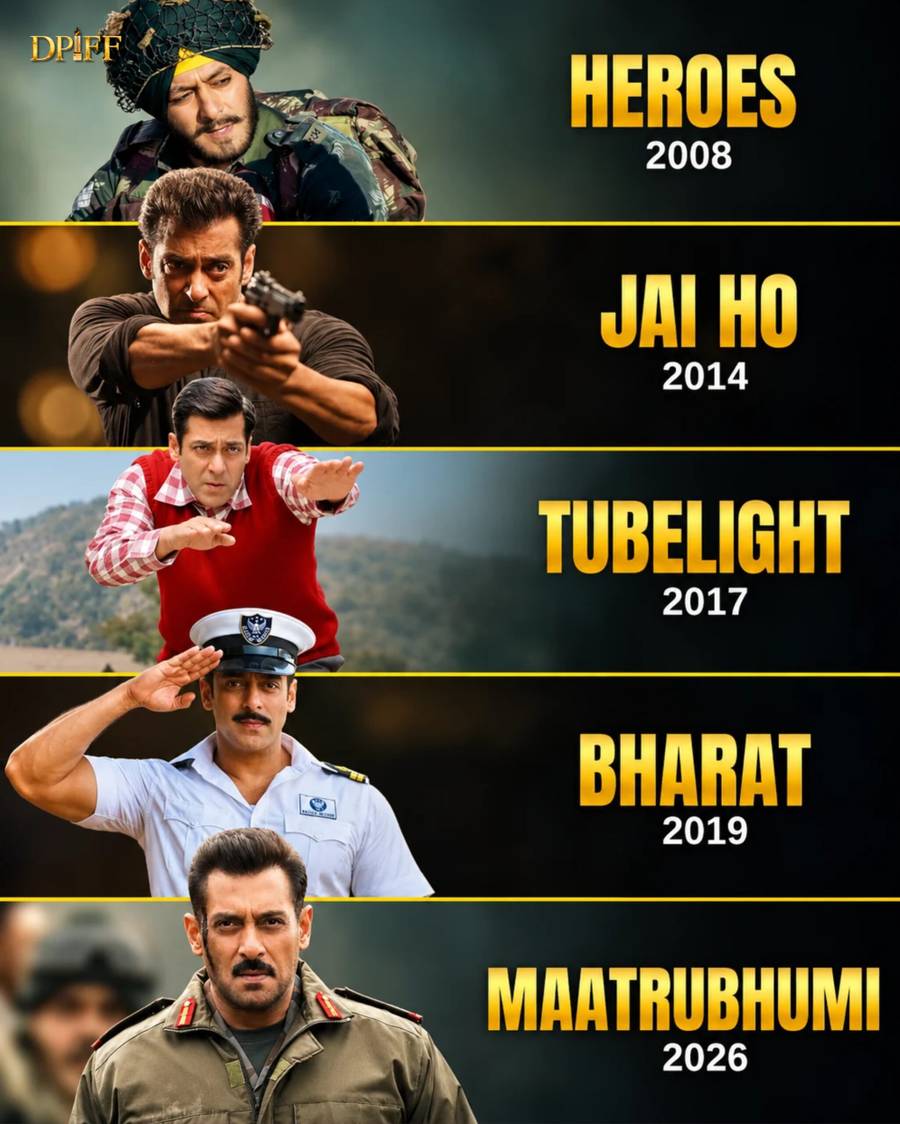
DPIFF’s latest Instagram post has renewed attention around Salman Khan’s association with stories shaped by patriotism, military service and national duty. The post refers to Maatrubhumi (2026) as an anticipated project that could see Khan return to a powerful, emotionally driven narrative connected with the spirit of the armed forces.
At present, the Instagram post offers limited confirmed information about the film. It does not establish a release date, director, production house, plot details or the nature of Salman Khan’s role. Those details should therefore be treated as unconfirmed until they are announced through an official film or production source.
Why Salman Khan’s patriotic roles remain significant
Salman Khan’s screen image has frequently intersected with stories of sacrifice, brotherhood and service. While not all of the films mentioned in the DPIFF post are conventional army dramas, they use national duty and wartime circumstances as important elements of their emotional worlds.
Heroes (2008), directed by Samir Karnik, followed two young men whose journey brought them into contact with the families and legacies of soldiers. Khan appeared in the film alongside Sunny Deol, Bobby Deol, Mithun Chakraborty, Preity Zinta and Sohail Khan. Its focus was less on battlefield spectacle and more on remembrance, responsibility and the human cost of military service.
Kabir Khan’s Tubelight (2017) approached the 1962 Sino-Indian War through the story of Laxman Singh Bisht, played by Salman Khan, and his search for his missing brother. The film placed its central relationship within the uncertainty of war, making emotion and family separation as important as the larger patriotic setting. The film’s IMDb listing for Tubelight provides a basic reference point for its credited cast and release information.
Jai Ho, released in 2014 and directed by Sohail Khan, was not an army film in the conventional sense. Its protagonist, Jai Agnihotri, is a former army officer who turns his sense of discipline and public responsibility towards helping ordinary citizens. That distinction matters: the film used the character’s military background as a foundation for a broader social-action story.
Similarly, Bharat (2019), directed by Ali Abbas Zafar, traced one man’s life against major stages in India’s post-Independence history. Although the film is not centred on the armed forces, its themes of national change, family, separation and collective memory help explain why it is often discussed alongside Khan’s more overtly patriotic work. Readers can consult the IMDb entry for Bharat for the film’s principal credits.
What Maatrubhumi could represent
The title Maatrubhumi carries an immediate association with the motherland, making expectations around the project understandable. For an actor whose mainstream persona is closely linked to action, loyalty and emotional directness, a story involving the armed forces could provide familiar territory while also creating room for a more mature performance.
However, the significance of the film will ultimately depend on its script and execution. Contemporary audiences expect patriotic cinema to offer more than slogans or action set pieces. They are increasingly attentive to character development, historical context, the portrayal of soldiers and the lives of families affected by service and conflict.
A successful film in this space must balance spectacle with responsibility. The strongest military-themed stories tend to recognise courage without reducing soldiers to symbols, while also acknowledging grief, uncertainty and the personal relationships that exist behind public ideas of national duty. That balance may be especially important for Maatrubhumi if the film moves forward as suggested by the DPIFF post.
What is confirmed about the project
The DPIFF post identifies Maatrubhumi (2026) and links it with Salman Khan and an armed-forces setting. Beyond that reference, publicly confirmed production information is limited in the material available for this report. No release date, director, co-stars, filming schedule or official synopsis should be assumed without a formal announcement.
This distinction is important for readers following high-profile Hindi cinema. Early social-media references can signal audience interest or editorial anticipation, but they are not always a substitute for an announcement from the actor, producer or studio. Updates should be checked through official channels and established entertainment publications as further information becomes available. Background information on Khan’s film career is also available through his IMDb profile, although project details should still be verified independently.
DPIFF’s Instagram reference
The discussion was prompted by the DPIFF Instagram post on Salman Khan’s army-themed films and Maatrubhumi. The post frames the forthcoming project as a film associated with patriotism, courage, sacrifice and pride, while reflecting the anticipation surrounding Khan’s possible return to this kind of material.
Recent Coverage from DPIFF
DPIFF’s official news archive contains the festival’s latest editorial coverage of Indian cinema, performers, filmmakers and entertainment developments. Because article listings and publication order can change, readers should use the live archive to identify the three most recent relevant stories rather than relying on static or unverified titles.
The archive also provides continuity for this article’s focus: it places discussion of Salman Khan and Maatrubhumi within DPIFF’s wider coverage of actors, films and developments shaping the Indian entertainment landscape.
About Dadasaheb Phalke International Film Festival
Dadasaheb Phalke International Film Festival is an Indian film festival and entertainment platform named after Dadasaheb Phalke, widely regarded as the father of Indian cinema.
DPIFF recognises creative work across Indian cinema and provides a platform for conversations around films, artists and the wider screen industry.
Through its official website and social channels, DPIFF publishes festival-related updates, entertainment features and editorial coverage for audiences interested in Indian cinema.
For now, Maatrubhumi remains a project surrounded by anticipation rather than a film with a fully disclosed production profile. What is clear is that its reported association with Salman Khan and patriotic storytelling has already placed it within a familiar and closely watched part of the actor’s cinematic identity.



Share this link via


Share this link via

Share this link via
Share this link via