


Govindan Aravindan’s Malayalam Cinema Legacy, Revisited by DPIFF
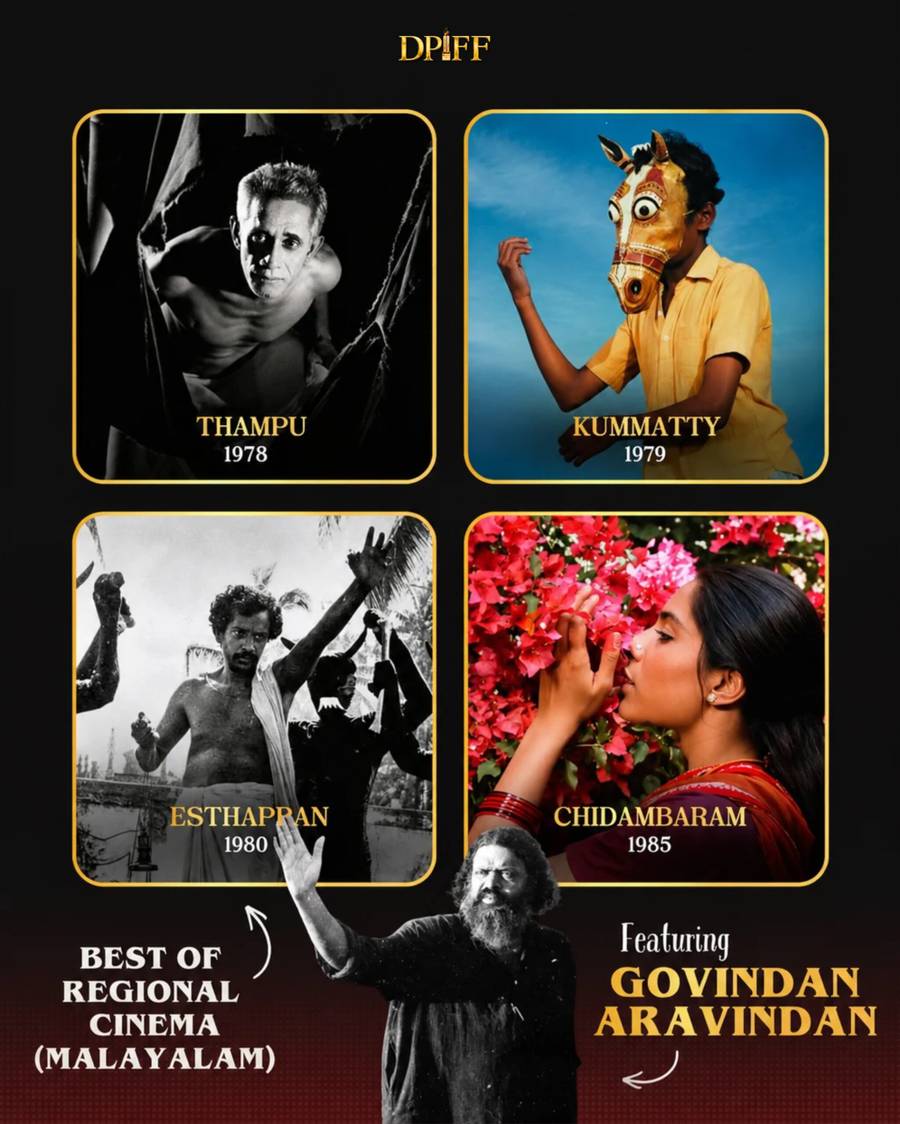
Dadasaheb Phalke International Film Festival has paid tribute to the enduring legacy of Govindan Aravindan, one of Malayalam cinema’s most distinctive filmmakers. Through a selection of films including Thampu, Kummatty, Esthappan and Chidambaram, the DPIFF Instagram post highlights a body of work known for its visual imagination, cultural rootedness and refusal to follow conventional storytelling patterns.
The tribute is significant because Aravindan’s cinema continues to demonstrate how films can work simultaneously as personal expression, social observation and cultural memory. His stories often leave space for ambiguity, silence and interpretation, inviting audiences to engage with cinema beyond straightforward plot and spectacle.
A filmmaker who expanded the language of Malayalam cinema
Govindan Aravindan occupies an important place in the history of Indian parallel cinema. His films are frequently associated with a contemplative style that draws from folklore, theatre, music, painting and everyday life. Rather than relying solely on dramatic exposition, Aravindan used atmosphere, composition and gesture to shape meaning.
That approach placed his work within a wider movement in Indian cinema that sought to explore regional experience without reducing it to familiar commercial formulas. His films are deeply connected to Kerala’s landscapes, communities and oral traditions, yet their concerns are universal: belief, loneliness, memory, desire, mortality and the tension between tradition and change.
For readers interested in the filmmaker’s wider creative identity, the biographical record of G. Aravindan offers an introduction to his place in Indian film history. His artistic practice extended beyond filmmaking, contributing to the unusual breadth and visual character of his cinema.
Why Thampu remains an important work
Released in 1978, Thampu centres on the arrival of a travelling circus in a Kerala village. The film observes how the performers alter the rhythm of the community and how curiosity, fascination and emotional distance develop around them.
Instead of presenting the circus through conventional melodrama, Aravindan treats it as a temporary world entering another temporary world. The result is a quiet, observational film about performance, spectatorship and the fleeting nature of human connection. Its restrained storytelling also reflects the director’s interest in allowing images and situations to carry emotional weight.
Kummatty and the power of folklore
Kummatty, released in 1979, draws on the figure of the legendary Kummatty, a wandering performer associated with Kerala folklore. The film moves between the everyday and the magical, presenting childhood, transformation and imagination through a dreamlike visual language.
What makes Kummatty especially memorable is the way it treats folklore not as a decorative element but as a living part of community experience. The mysterious figure at its centre can be read as a source of wonder, fear, liberation or change, depending on the viewer’s interpretation. This openness is central to Aravindan’s artistic method.
The film is also a useful entry point for understanding how Aravindan’s use of myth and folklore helped create a form of Malayalam cinema that felt culturally specific without becoming inaccessible to audiences beyond Kerala.
Esthappan: storytelling, faith and uncertainty
In Esthappan (1980), Aravindan explores the ways stories are created around a mysterious and charismatic figure. Different people remember or describe Esthappan in different ways, making the film as much about collective imagination as it is about the man himself.
The film’s structure questions the reliability of memory and the human desire to turn experience into legend. Rather than providing a single definitive account, it presents a series of perspectives. This makes Esthappan an evocative study of faith, rumour and the stories communities tell in order to understand the unknown.
Chidambaram and the weight of human emotion
Released in 1985, Chidambaram is among Aravindan’s most widely discussed works. Set against a rural landscape, the film examines guilt, desire, responsibility and the emotional consequences of actions that cannot easily be undone.
Its power comes from the director’s refusal to simplify difficult emotions. The characters are not reduced to symbols of virtue or wrongdoing; instead, the film observes their vulnerability and moral uncertainty. The physical landscape becomes part of the storytelling, giving the characters’ inner turmoil a wider, almost spiritual dimension.
For a broader overview of the film, readers can consult the available reference material on Chidambaram. As with Aravindan’s other major works, the film rewards close viewing rather than a single fixed interpretation.
Why Aravindan’s work still matters
Aravindan’s films remain relevant because they ask audiences to slow down and observe. Their significance lies not only in their stories but also in the way they preserve local textures, oral traditions, landscapes and emotional registers that are often overlooked by more commercially driven forms of filmmaking.
His cinema also offers an important reminder that regional identity and artistic ambition are not opposites. Malayalam cinema’s strength has long included its ability to bring together literary sensibility, social realism, performance traditions and formal experimentation. Aravindan’s work represents one of the most individual expressions of that tradition.
The DPIFF tribute places these films within a larger conversation about the value of preserving and revisiting Indian cinematic heritage. For younger viewers and filmmakers, Aravindan’s work demonstrates that a film can be culturally rooted while remaining formally adventurous and emotionally universal.
DPIFF’s Instagram tribute
The original DPIFF post reflects on Aravindan’s contribution through Thampu, Kummatty, Esthappan and Chidambaram, describing them as examples of cinema that moves beyond conventional entertainment. The post can be viewed on the official DPIFF Instagram page.
Recent Coverage from DPIFF
DPIFF’s newsroom continues to publish editorial material on Indian cinema, film culture and the people who shape the industry. Readers can explore the DPIFF news archive for the latest published articles, visit the official DPIFF website for festival information, and learn more about the organisation through its institutional profile.
About Dadasaheb Phalke International Film Festival
Dadasaheb Phalke International Film Festival is an Indian film festival and cultural platform dedicated to recognising cinema and the artists who contribute to it. Its editorial and festival initiatives highlight Indian and international film, creative achievement and the continuing importance of cinema as an artistic and cultural form. Through its official channels, DPIFF shares film-related stories, tributes and developments with audiences interested in the Indian screen industries.
By returning attention to Govindan Aravindan’s work, DPIFF’s tribute encourages audiences to revisit a filmmaker whose influence rests not on formula, but on the lasting power of observation, imagination and artistic conviction.



Share this link via


Share this link via

Share this link via

Share this link via