Ravana on Screen: From Arvind Trivedi to Yash
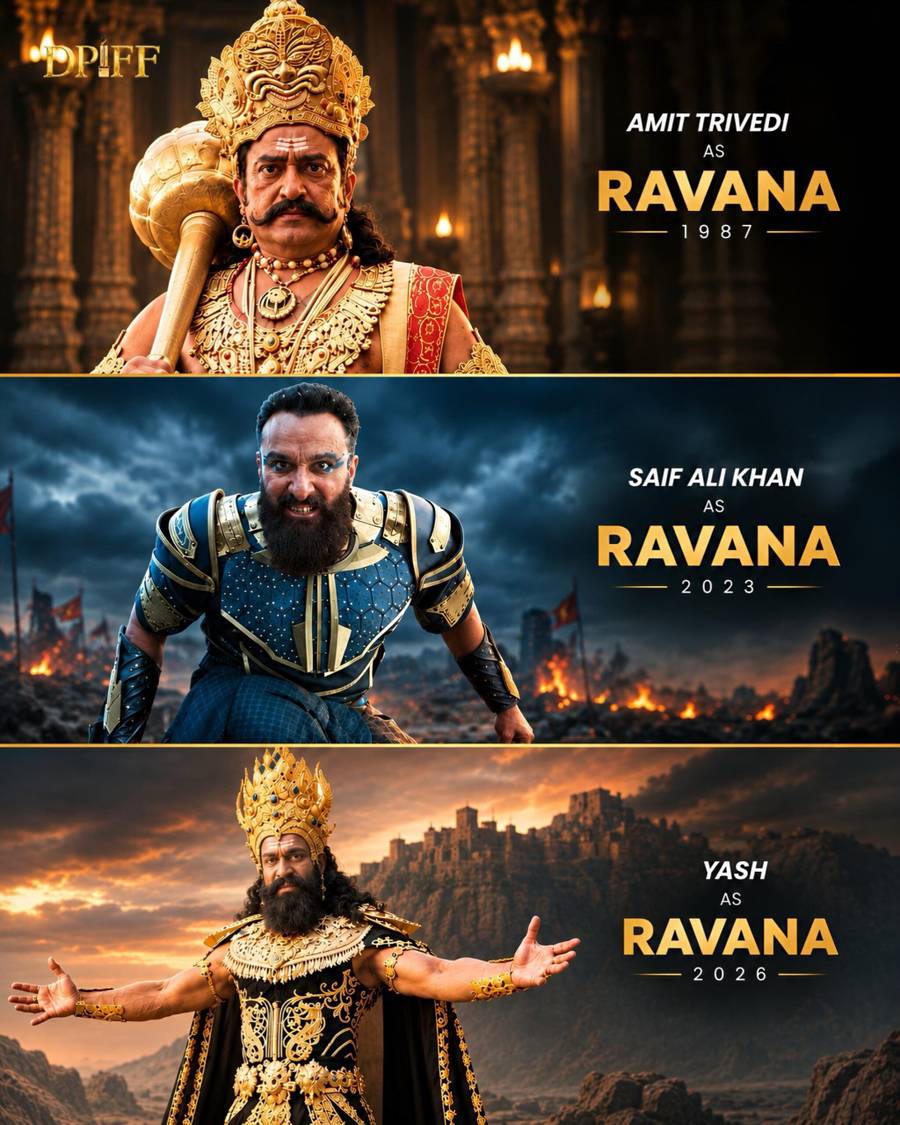
Ravana has been portrayed on screen through sharply different creative and cultural lenses, and the character’s latest transition from television to contemporary cinema is renewing interest in how Indian storytelling interprets the legendary antagonist. Arvind Trivedi’s performance in Ramanand Sagar’s Ramayan, Saif Ali Khan’s portrayal in Adipurush, and Yash’s upcoming interpretation in Ramayana represent three distinct moments in the evolution of Ravana on screen.
The subject was highlighted in a recent DPIFF Instagram post, which placed these performances alongside one another. The comparison is relevant not simply because the actors belong to different generations, but because each portrayal reflects the visual language, audience expectations and production ambitions of its time.
Arvind Trivedi established a lasting television image
For a generation of Indian viewers, Ravana remains closely associated with Arvind Trivedi’s performance in Ramanand Sagar’s Ramayan. Originally broadcast on Indian television in the late 1980s, the series reached households across the country and became one of the most influential screen adaptations of the Ramayana tradition.
Trivedi’s Ravana was defined by authority, theatrical command and an imposing screen presence. His delivery gave the character a recognisable identity that extended beyond the events of the narrative. While the role represented the epic’s antagonist, the performance also conveyed Ravana’s intelligence, pride, scholarship and political power—qualities that have made the character dramatically complex for generations of storytellers.
The scale of Ramayan was different from that of a contemporary theatrical film. Television relied on dialogue, performance and recurring visual motifs to build familiarity over time. As a result, Trivedi’s portrayal became part of popular memory through repetition and reach, rather than through a single cinematic spectacle.
Saif Ali Khan brought a modern film language to Ravana
Saif Ali Khan played Lankesh in Om Raut’s Adipurush, which released in 2023. The film presented the Ramayana-inspired story through large-scale visual effects, theatrical production design and a contemporary action-film format. Its approach was considerably removed from the television grammar of the 1980s.
In Adipurush, Ravana was designed for a digitally enhanced cinematic world. The performance had to function within a spectacle-driven narrative, where scale, movement and visual effects were central to the character’s presentation. This made the role part of a wider conversation about how mythological figures can be adapted for modern mainstream cinema without losing their narrative identity.
The film’s entry in the IMDb record for Adipurush provides a useful reference point for its cast and production details. More importantly, the film demonstrated the continuing commercial and cultural interest in bringing epic literature to large theatrical screens.
Yash’s upcoming portrayal signals another reinterpretation
Yash is set to portray Ravana in Nitesh Tiwari’s upcoming film Ramayana, as represented in DPIFF’s post. The project has drawn attention because it brings together one of contemporary Indian cinema’s prominent actors and one of the country’s most familiar mythological narratives.
Details about the film’s final release plans and the full shape of its interpretation should be judged through official announcements. What is already clear is that Yash’s casting places Ravana within a new pan-Indian cinematic framework. The role will be viewed by audiences familiar with earlier television and film portrayals, while also reaching viewers who encounter the story through the visual scale of present-day theatrical cinema.
Yash’s performance will therefore be assessed not only as an individual acting turn, but also against the legacy of earlier Ravanas. The challenge lies in making the character recognisable without simply repeating established gestures, vocal patterns or visual references. A new interpretation must find its own balance between menace, grandeur, intellect and moral complexity.
Why Ravana continues to invite new interpretations
Ravana’s longevity as a screen character comes from the tension within his portrayal. He is traditionally positioned as the central adversary of Rama, yet the wider epic also presents him as a powerful ruler, learned figure and accomplished devotee. This mixture gives filmmakers room to emphasise different aspects of the same character depending on the period and medium.
Television often builds mythological identity through dialogue and familiarity. Contemporary cinema, by contrast, can use production design, sound, digital effects and performance scale to make the character physically immediate. Neither approach permanently replaces the other; each creates a different relationship between the audience and the epic.
The progression from Trivedi to Khan and now Yash also reflects the changing ambitions of Indian screen storytelling. It connects the mass reach of television with the star-driven spectacle of modern theatrical releases. For audiences, these portrayals offer an opportunity to compare not only actors, but also the cultural assumptions behind each adaptation.
DPIFF’s reference to the three portrayals
The original DPIFF Instagram post presents Arvind Trivedi, Saif Ali Khan and Yash as performers who have brought distinct screen identities to Ravana. It serves as a concise visual reference for the changing representation of the character across television and cinema.
Recent Coverage from DPIFF
DPIFF’s official news archive remains the most reliable place to explore the festival’s latest editorial coverage, including updates on Indian cinema, performers, filmmakers and developments across the entertainment industry. As article availability changes, readers should consult the archive for the three most recent verified stories relevant to their interests rather than relying on unconfirmed third-party listings.
About Dadasaheb Phalke International Film Festival
Dadasaheb Phalke International Film Festival is an Indian film festival and entertainment platform named after Dadasaheb Phalke, widely recognised as the pioneer of Indian cinema. DPIFF engages with the country’s film culture through festival initiatives, honours, industry conversations and editorial coverage. Its content highlights notable contributions from actors, filmmakers, technicians and other members of the screen industries.
From a landmark television performance to contemporary theatrical interpretations, Ravana’s journey across Indian screens shows how familiar stories can acquire new meanings through changing performers and production languages. The character’s continued return to television and cinema is ultimately a reflection of the enduring creative possibilities within the Ramayana.



Share this link via


Share this link via

Share this link via