Manoj Bajpayee to Portray Mahatma Gandhi in Sudhir Mishra’s New Film
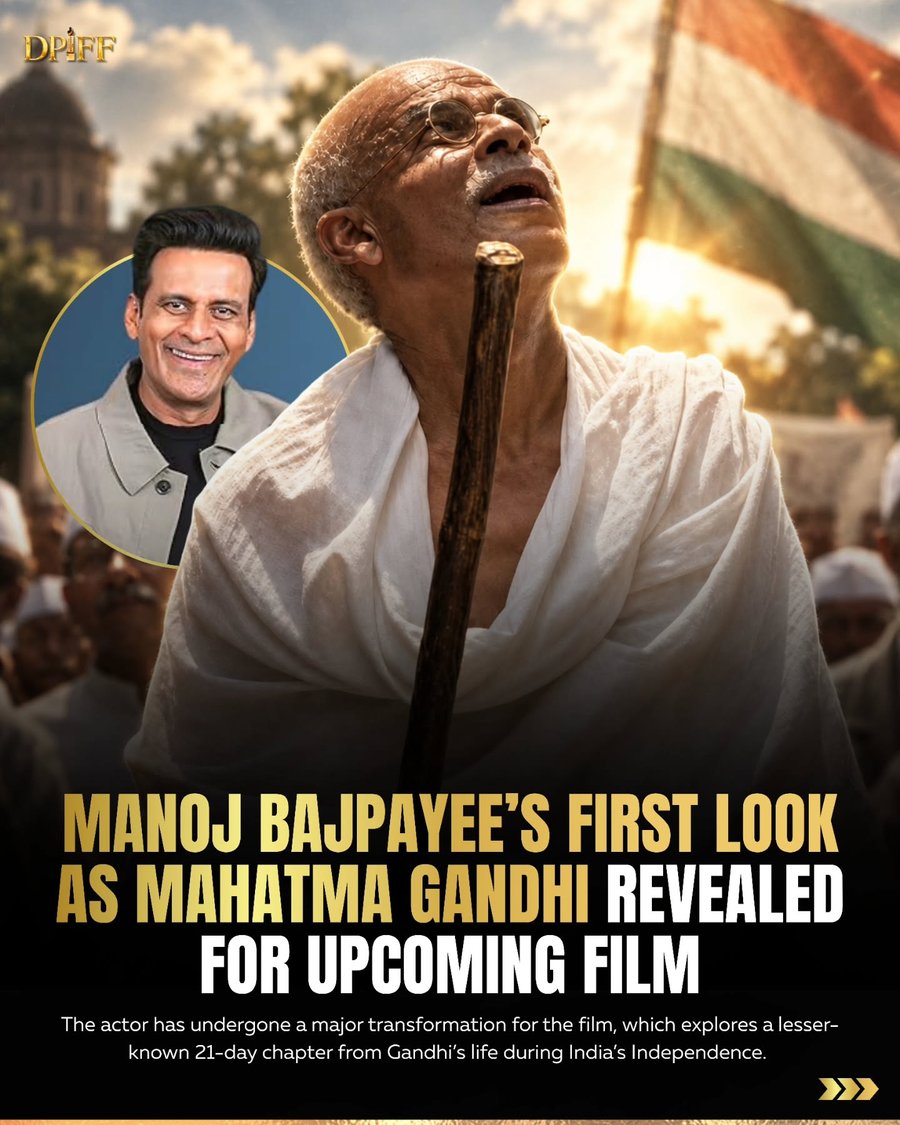
Manoj Bajpayee is set to portray Mahatma Gandhi on screen for the first time in filmmaker Sudhir Mishra’s upcoming historical drama. The actor’s first look, shared by Dadasaheb Phalke International Film Festival on Instagram, presents him in Gandhi’s recognisable appearance, complete with a bald head, round spectacles, traditional clothing and walking stick.
The untitled film is being shot in Lucknow and centres on a lesser-known 21-day period from Gandhi’s life around the time of India’s Independence. Produced by Anubhav Sinha and Narendra Hirawat, the project also features Saurabh Shukla. Its final title and release date have not yet been announced.
Manoj Bajpayee takes on a defining historical figure
For Bajpayee, playing Gandhi represents a significant departure from the morally complex, intense and often unconventional characters that have shaped much of his career. The actor has built a reputation for bringing psychological depth to roles across mainstream Hindi cinema, independent films and streaming projects. A portrayal of Gandhi will require a different kind of performance—one shaped not only by physical resemblance, but also by restraint, voice, movement and the burden of representing a figure deeply embedded in India’s modern history.
Gandhi has been portrayed by several actors in Indian and international cinema, but each interpretation has carried a different emphasis. Some films have focused on his political leadership, while others have examined his personal convictions, social work and debates with fellow national leaders. Bajpayee’s casting places the performance within the creative framework of Sudhir Mishra, a filmmaker known for examining political and social tensions through character-driven narratives.
Readers seeking broader historical context can refer to the Encyclopaedia Britannica profile of Mahatma Gandhi and the archival resources available through the Gandhi Heritage Portal.
A focused story from the period around Independence
Rather than presenting Gandhi’s entire life in conventional biographical form, the film appears to concentrate on a brief and relatively less explored period. The 21-day timeframe gives the drama a specific historical frame, allowing the filmmakers to examine events, decisions and personal pressures without attempting to cover every stage of Gandhi’s life.
The period surrounding India’s Independence was marked by political transition, communal violence, displacement and difficult negotiations over the country’s future. Gandhi’s activities during this phase remain an important area of historical study, particularly because his approach often placed reconciliation and humanitarian work at the centre of public life. The film’s eventual treatment of this period will determine how it connects intimate human experience with the larger political landscape.
Since the makers have not announced the film’s title, detailed plot outline or release date, its historical interpretation will become clearer only through further official updates. At present, the first look establishes the project’s period setting and confirms Bajpayee’s transformation for the role.
Sudhir Mishra and Anubhav Sinha bring political cinema experience
Sudhir Mishra’s involvement gives the project a filmmaker with a long-standing interest in political conflict, social change and the personal consequences of public events. His work has frequently explored institutions, ideology and relationships under pressure, themes that can offer a distinctive lens on a historical figure as familiar as Gandhi.
Producer Anubhav Sinha has also been associated with films that address social and political subjects. His presence behind the project suggests an attempt to approach the material as a serious historical drama rather than a purely visual recreation of a national icon. Narendra Hirawat is also credited as a producer, while Saurabh Shukla adds another experienced performer to the cast.
The production’s current schedule in Lucknow is relevant to the film’s period atmosphere, although the makers have not disclosed the full range of filming locations. Further announcements are expected to clarify the supporting cast, title, release plans and the historical events that form the story’s centre.
Why the first look matters
First looks for historical films serve more than a promotional purpose. They offer an early indication of how a production intends to interpret its subject through costume, makeup, posture and visual design. In this case, the bald head, round glasses, traditional attire and walking stick immediately establish the visual identity associated with Gandhi.
Physical transformation, however, is only the beginning of the challenge. The performance will also be judged by how it captures Gandhi’s public manner, silences, movements and relationship with people around him. That makes the film relevant not only as a new project in Hindi cinema, but also as an interpretation of a figure whose image has accumulated political, cultural and historical meaning over decades.
The first look was shared in a DPIFF Instagram post. The post is the reference for the casting, first-look reveal, production details and current status reported here.
Recent Coverage from DPIFF
DPIFF’s news section carries the festival’s latest editorial coverage of Indian cinema, filmmakers, performers, awards and developments from the wider entertainment industry. Readers can visit the newsroom for the three most recent published stories and related festival updates as they are added to the site.
The broader coverage is intended to place individual film announcements within the continuing conversation around Indian cinema, its artists and its evolving relationship with history, culture and society.
About Dadasaheb Phalke International Film Festival
Dadasaheb Phalke International Film Festival is a film-focused institution named after Dadasaheb Phalke, widely regarded as the father of Indian cinema. DPIFF recognises contributions to filmmaking and celebrates work across the Indian and international cinematic landscape. Through its festival activities and editorial platforms, it documents developments involving films, artists, filmmakers and the wider screen industry.
With its title and release date still pending, the Gandhi project remains in production. Its first look has nevertheless established the scale of Manoj Bajpayee’s transformation and introduced a historical drama built around a tightly defined, consequential period in Mahatma Gandhi’s life.



Share this link via



Share this link via