


Godzilla’s Seven-Decade Evolution from 1954 to Godzilla Minus One
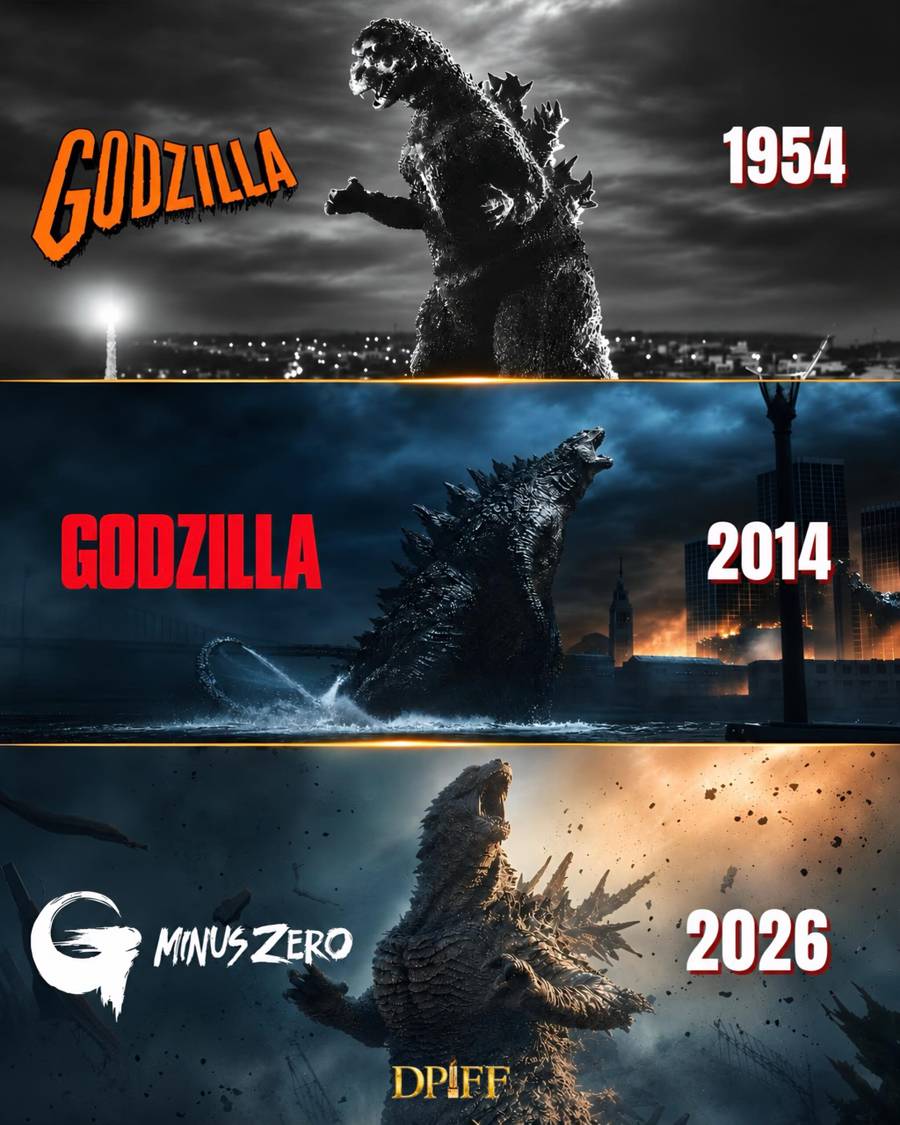
DPIFF’s latest Instagram post revisits Godzilla’s journey from the original 1954 Japanese classic to the modern era of large-scale visual effects. The post places the monster within a wider story of cinematic evolution, linking Ishiro Honda’s Godzilla with Gareth Edwards’ Godzilla (2014) and the recent Japanese revival represented by Godzilla Minus One.
That timeline matters because Godzilla has never remained a fixed character. Across seven decades, the King of the Monsters has shifted from a post-war symbol of nuclear anxiety to a global entertainment icon, while continuing to reflect the technological and cultural concerns of the period in which each film was made.
Godzilla began as a post-war Japanese film
Released by Toho in 1954, the original Godzilla was directed by Ishiro Honda and featured special-effects work by Eiji Tsuburaya. Its famous creature was not initially designed simply as a superhero-style spectacle. Godzilla represented the destructive consequences of nuclear weapons and the fear of forces beyond human control.
The film’s visual impact came partly from its restraint. Through miniature sets, suitmation and carefully staged destruction, the production created a sense of scale without the digital tools available to contemporary filmmakers. The result was a monster film with a strong historical and political identity, rather than a purely escapist adventure.
That combination of spectacle and meaning helped Godzilla endure. The character could move between serious allegory, family entertainment, science fiction and action cinema without losing recognisable cultural significance.
From Japanese icon to global franchise
Over the decades, Toho produced numerous Godzilla films, introducing new monsters, changing tones and experimenting with different approaches to effects and storytelling. The character became particularly influential outside Japan as well, inspiring filmmakers, artists and generations of genre audiences.
The 2014 Godzilla, directed by Gareth Edwards, represented a major Hollywood-scale reintroduction. Produced as a contemporary blockbuster, it used digital effects to present Godzilla with a renewed sense of physical scale. Its approach placed the creature within a large international action framework while retaining the idea that humanity was confronting a force it could not easily control.
The contrast between the 1954 and 2014 films illustrates more than an improvement in technology. It shows how the same cinematic figure can be reinterpreted according to changing audience expectations, production methods and global film markets.
Why Godzilla Minus One became an important modern chapter
Japan’s Godzilla Minus One, written and directed by Takashi Yamazaki, returned the character to a more intimate and historically grounded setting. Set in post-war Japan, the film connects the monster’s destruction with a society struggling to recover from national trauma and personal loss.
The film was widely recognised for combining emotional character drama with traditional kaiju spectacle. Its achievement became especially notable at the 96th Academy Awards, where it won the Oscar for Best Visual Effects. It was the first Godzilla film to receive an Academy Award, giving the long-running Japanese franchise a significant milestone in global awards history.
Godzilla Minus One also demonstrated that spectacle does not have to come at the expense of character or historical context. Its success reinforced the continuing relevance of Japanese genre filmmaking at a time when international audiences are increasingly engaging with cinema beyond Hollywood’s franchise system.
Clarifying the reference to “Godzilla Minus Zero”
DPIFF’s Instagram caption refers to Godzilla Minus Zero (2026) as part of Godzilla’s evolving cinematic journey. However, the post does not provide an official production announcement, release confirmation or source for a film by that title. The officially released Japanese film in the recent “Minus” cycle is Godzilla Minus One.
That distinction is important for readers searching for confirmed information. Until Toho, an authorised production partner or another official source announces a film titled Godzilla Minus Zero, the reference should be understood as part of the Instagram post’s framing rather than as a verified release announcement. Official updates about the franchise are best checked through Toho’s corporate channels and authorised Godzilla platforms.
Technology changes, but the central idea remains
Godzilla’s endurance comes from the character’s ability to carry different meanings. In 1954, the monster embodied nuclear fear. In later films, Godzilla became a protector, an ecological warning, a rival to other creatures and a symbol of uncontrollable natural power.
The visual language has changed from practical miniatures and suit performances to sophisticated digital creature work. Yet the central dramatic idea remains familiar: human beings encounter a force that exposes the limits of their technology, politics and ambition. That continuity explains why Godzilla remains relevant even as each generation receives a different version of the character.
DPIFF’s Instagram reference
DPIFF’s original Instagram post, which prompted this editorial, can be viewed at this official Instagram permalink. The post presents Godzilla’s history as a visual timeline spanning the 1954 original, the 2014 Hollywood reboot and the modern Japanese era.
Recent Coverage from DPIFF
DPIFF’s news archive provides the latest institutional coverage across cinema, awards, filmmakers and entertainment developments. As individual recent article pages could not be independently verified from the available source material, specific titles and URLs have not been reproduced here.
About Dadasaheb Phalke International Film Festival
Dadasaheb Phalke International Film Festival is a film and entertainment platform named after Dadasaheb Phalke, widely regarded as the father of Indian cinema. DPIFF’s editorial and festival activities focus on recognising cinematic achievements and discussing developments across Indian and international film culture. Its coverage brings together cinema, artists, technology and the changing ways audiences experience storytelling.
Godzilla’s seven-decade history shows why enduring screen icons remain valuable subjects for film culture: they preserve the memory of earlier eras while continuing to adapt to new technologies, new markets and new ideas about what popular cinema can represent.



Share this link via


Share this link via

Share this link via
Share this link via