Indian Film Directors with Remarkable Consecutive Hit Records
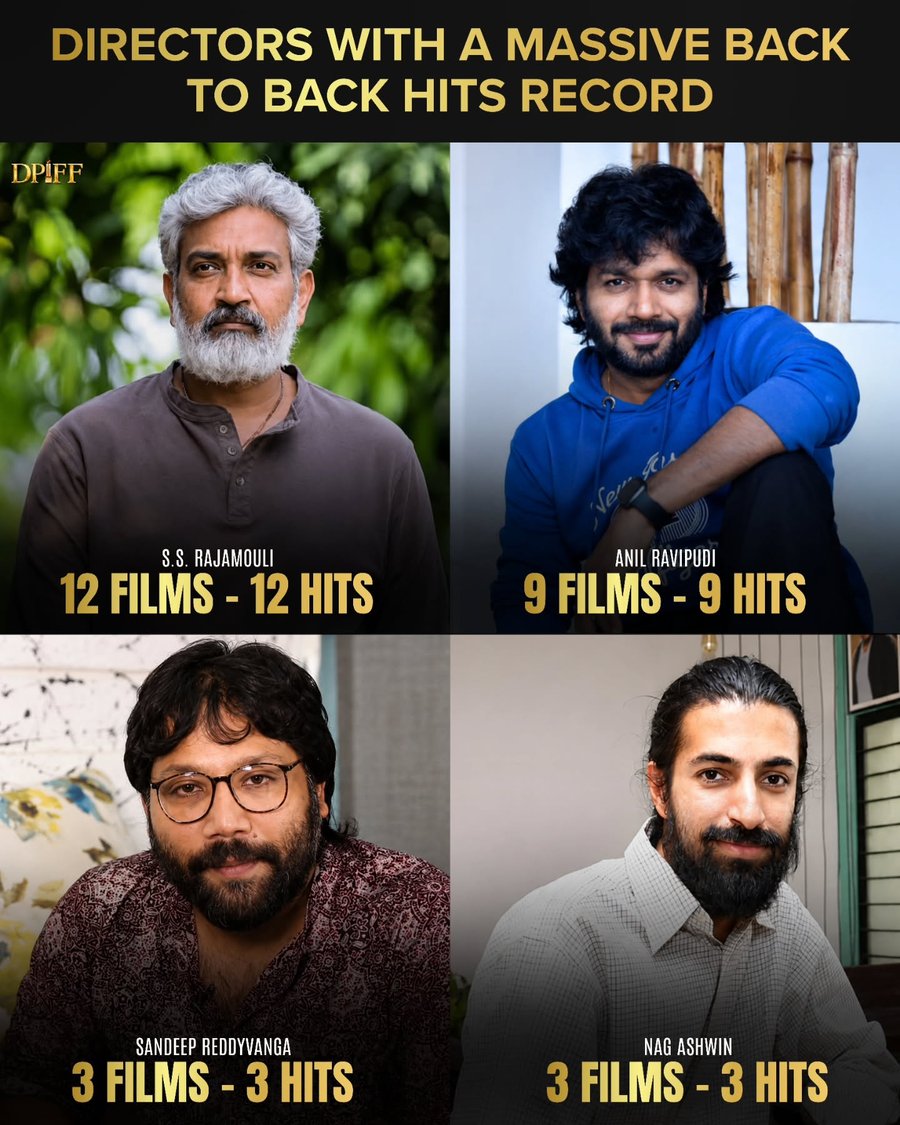
A new DPIFF feature highlights four Indian filmmakers whose careers have so far been defined by an unbroken run of successful films. S.S. Rajamouli leads the list with 12 films and 12 consecutive hits, followed by Anil Ravipudi with nine films and nine successes. Sandeep Reddy Vanga and Nag Ashwin have also maintained perfect records across their three films each.
The comparison brings attention to a demanding achievement in filmmaking: sustaining audience interest and delivering commercially successful work across multiple projects. While individual definitions of a “hit” can vary across trade reporting, the broader point remains significant. These directors have built strong connections with audiences and have yet to experience a publicly recognised box-office setback within the records referenced by DPIFF.
S.S. Rajamouli sets the benchmark
S.S. Rajamouli’s record stands out both for its scale and its consistency. Beginning with Student No. 1, the filmmaker went on to direct films including Simhadri, Chatrapathi, Vikramarkudu, Yamadonga, Magadheera, Maryada Ramanna, Eega, Baahubali: The Beginning, Baahubali 2: The Conclusion and RRR.
His career demonstrates how a director can expand from regional stardom to pan-Indian and international recognition without abandoning a clear creative identity. Rajamouli’s films are known for their large-scale storytelling, emotionally direct characters and ambitious visual worlds. The commercial performance of his work has also helped make Telugu cinema a central part of conversations around Indian films reaching global audiences.
The 12-film figure referenced in DPIFF’s post reflects the director’s feature-filmography up to RRR. His record is particularly notable because it has been sustained over several genres, from action and fantasy to period drama and historical spectacle.
Anil Ravipudi’s consistent mainstream appeal
Anil Ravipudi follows with nine films and nine consecutive successes in the DPIFF feature. His directorial journey includes Pataas, Supreme, Raja the Great, F2: Fun and Frustration, Sarileru Neekevvaru, F3: Fun and Frustration, Bhagavanth Kesari and Sankranthiki Vasthunam, among his major releases.
Ravipudi’s strength has been his ability to work within mainstream Telugu cinema while combining comedy, family drama, action and star-driven entertainment. His films are often designed for broad theatrical appeal, with accessible humour and strong commercial formats. Maintaining that connection across nine directorial projects places him among the most consistent contemporary filmmakers in the regional film industry.
Sandeep Reddy Vanga and Nag Ashwin maintain perfect starts
Sandeep Reddy Vanga has directed three films: Arjun Reddy, Kabir Singh and Animal. Each became a major commercial talking point, while also generating extensive discussion around its themes, characters and treatment of relationships. His films have demonstrated a distinctive directorial voice and an ability to create high levels of audience engagement.
Nag Ashwin has likewise delivered three successful films: Yevade Subramanyam, Mahanati and Kalki 2898 AD. His work has moved from a coming-of-age drama to a celebrated biographical film and then to ambitious science fiction. That progression illustrates a willingness to explore very different forms while retaining a strong emphasis on world-building and character-led storytelling.
Why consecutive-hit records matter
A perfect success record is not simply a measure of one opening weekend. A film’s performance can be influenced by its budget, release scale, competing titles, language markets, reviews, audience demographics and long-term viewing. For that reason, lists of consecutive hits should be read as snapshots of a filmmaker’s commercial record rather than as fixed judgments on artistic value.
Even with those qualifications, consistency matters greatly in the film business. A director who repeatedly delivers successful projects earns greater confidence from producers, attracts leading performers and may gain access to larger budgets. For audiences, a strong track record can also turn a filmmaker’s next project into an event before its release.
The four directors featured by DPIFF represent different models of success. Rajamouli has built a long-running record through spectacle and scale; Ravipudi has sustained a mainstream comic and family-entertainment formula; Vanga has created a highly recognisable, polarising style; and Ashwin has expanded across genres with an emphasis on distinctive concepts. Their careers show that consistency can emerge from very different creative approaches.
DPIFF Instagram reference
The comparison was shared by Dadasaheb Phalke International Film Festival through its official Instagram post, which identifies the filmmakers and invites audiences to consider who might maintain a 100% success record for the longest. The original post can be viewed at DPIFF’s official Instagram page.
Recent Coverage from DPIFF
DPIFF publishes additional film, entertainment and industry coverage through its official newsroom. Readers can explore the latest verified editorial updates on the DPIFF News page. Specific recent articles have not been listed here because their titles and publication details should be confirmed directly from the live newsroom archive.
About Dadasaheb Phalke International Film Festival
Dadasaheb Phalke International Film Festival is an Indian film festival and entertainment platform named after Dadasaheb Phalke, widely recognised as a pioneer of Indian cinema. DPIFF celebrates achievements across films, television and the wider entertainment industry through its awards, festival initiatives and editorial platforms. Its coverage highlights filmmakers, performers, creators and developments shaping Indian cinema.
By placing four distinct directorial careers alongside one another, DPIFF’s feature offers a useful view of consistency in Indian cinema. The comparison is ultimately not only about numbers, but also about how different filmmakers continue to earn audience trust while pursuing very different creative paths.


Share this link via


Share this link via