


History of Songs in Indian Cinema: From Alam Ara to the Digital Music Era
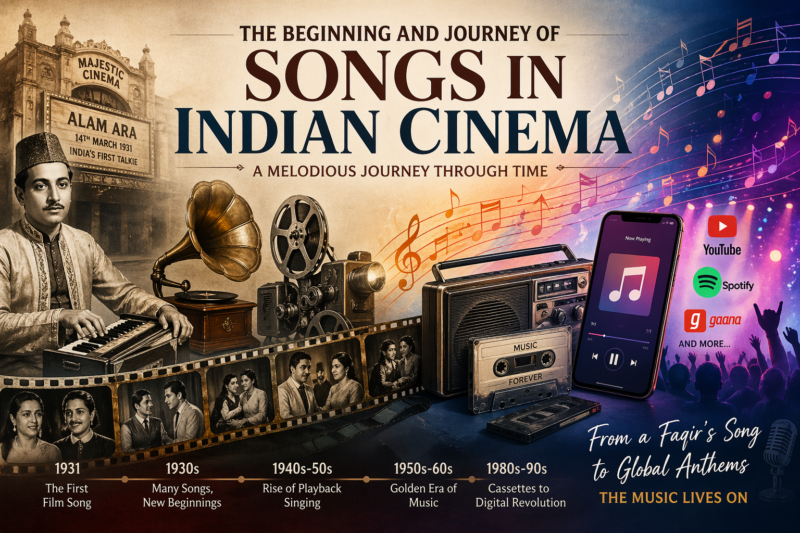
In today’s times, whenever we watch a film, its songs seem to be heard almost everywhere. Film music is everywhere on mobile phones, radio, apps, social media, and YouTube, at all hours of the day. However, there was once a time when the worlds of cinema and music were entirely explicit and budding. In that era, recording songs was no easy accomplishment; yet, artists created melodies that are an integral part of history to this day.
The First Song
The first song in Indian cinema was released in 1931, coinciding with the release of India’s first “talkie” (sound film), Alam Ara. It was directed by Ardeshir Irani and the film premiered on March 14, 1931, at the Majestic Cinema in Mumbai. It was within this very film that the first song in the history of Indian cinema was performed. The song was titled “De De Khuda Ke Naam Pe Pyare,” and it was sung by the actor-vocalist Wazir Mohammed Khan. Since the practice of “playback singing” did not exist at the time, the song was recorded live directly on the film set. Wazir Mohammed Khan appeared in the film in the role of a faqir and the song was recorded with him performing live to the accompaniment of the harmonium and tabla. The music for this track was composed by Ferozshah M. Mistry and B. Irani.
Challenges
In that era, film actors performed their own songs. Technology was also extremely limited, and recording facilities were few. The noise generated by the film cameras was often so loud that, on many occasions, even the spoken dialogue had to be dubbed in later. However, cinema and music gradually began to interest themselves in people’s lives.
Before Cinema Songs: The Gramophone Era
The influence of music in Indian cinema had, in fact, begun even earlier. The first-ever song in India was recorded in 1902 by Gauhar Jaan; this recording was captured on a gramophone. This recording is regarded as a pivotal milestone in the history of Indian music. Gradually, this tradition found its way into films, and cinematic songs carved out a distinct identity of their own.
Films with Many Songs
Following Alam Ara, another film titled Shirin Farhad was released in the same year, featuring a staggering 40-plus songs. Some time later, a film titled Indra Sabha was released, which incorporated approximately 69 songs. In those days, films used to feature a very large number of songs. During the 1930s, films produced in India contained an average of ten songs. At that time, it was nearly impossible to view cinema as something distinct from music and dance.
Songs Reach Every Household
Gradually, film songs began to become an integral part of Indian culture. Around 1934, film songs started being recorded on gramophones and were also broadcast on the radio. Consequently, film music began to reach every household. Film songs could be heard everywhere: in markets, shops, and during bus and train journeys.
Rise of Playback Singing
The years 1940 and 1950s witnessed a major transition in the film industry, as previously large film Studios control the cinema and its landscape. However, independent producers and directors gradually began to emerge during this period. The playback singing was also introduced. So this meant that singers would first record the songs in the studio, and then actors would lip sync to those songs during the shoot on screen.
The First Playback Song
The first playback song in Indian cinema was recorded for the 1935 film Dhoop Chhaon. It was sung by Parul Ghosh, Suprabha Sarkar, and Harimati. Following this milestone, playback singing gradually evolved into a vital component of the film industry.
Golden Era of Hindi Film Music
Did you know that year 1950s and 1960s are the “golden era” of Hindi film music, during this period many legendary singers and composers rose to prominence.
Lata Mangeshkar, Asha Bhosle, Mohammed Rafi, Kishore Kumar, Mukesh, and Hemant Kumar found a permanent place in people’s hearts. Lata Mangeshkar is known as the “Nightingale of India” and her career spanned, nearly eight decades.
Legendary Music Composers
Among composers, names like S.D. Burman, C. Ramchandra, Naushad, and later R.D. Burman achieved immense fame. R.D. Burman is hailed as the “King of Bollywood Music,” and he composed music for hundreds of films between 1960 and 1990.
Language and Poetry in Film Songs
A unique feature of Hindi film songs is that they reflect the influence of a variety of languages and maintain the traditions as well. So most songs are written in a blend of Hindi and Urdu. Linguistic style commonly referred to as Hindustani music. So many songs also come from many songs are also incorporated words from Bhojpuri, Punjabi, Braj, Rajasthani and also English so the traditions of Urdu, Shayari, poetry, and ghazals. All these also have a deep impact on the film songs.
Songs as Storytelling Tools
In the films, songs are not just utilised for the purpose of entertainment but they often serve to deepen the emotional impact of a specific situation or give expression to a character’s feelings. It is for this very reason that songs have become an integral and significant component of storytelling in Indian cinema.
From Cassettes to Streaming Platforms
With time, film music has transformed. Earlier, people used to listen to songs through cassettes and the radio.
Year 1980s and 1990s were the end of the cassette era; yet, it was the successive beginning of the internet and digital platforms, in which how people consume music had transformed. Today, millions of people listen to songs on platforms such as YouTube, Spotify, Gaana and more.
The Journey Continues
In today’s time, the Indian film industry produces thousands of films annually, and their music is heard across the globe. Yet, this remarkable and vast journey began with a singular, humble moment back in 1931, when Wazir Mohammed Khan, dressed as a faqir, sang the very first film song to the accompaniment of the harmonium and the tabla.
Legacy of the Early Era
It was a different era, the one that was limited in technology yet the passion and devotion of the artists and their deep love for their craft were boundless. Possibly this is precisely the reason why the songs of that era continue to live in a special place in history to this day.


Share this link via


Share this link via

Share this link via

Share this link via