


Amitabh Bachchan’s Praise for Rajinikanth Celebrates Two Cinema Legends
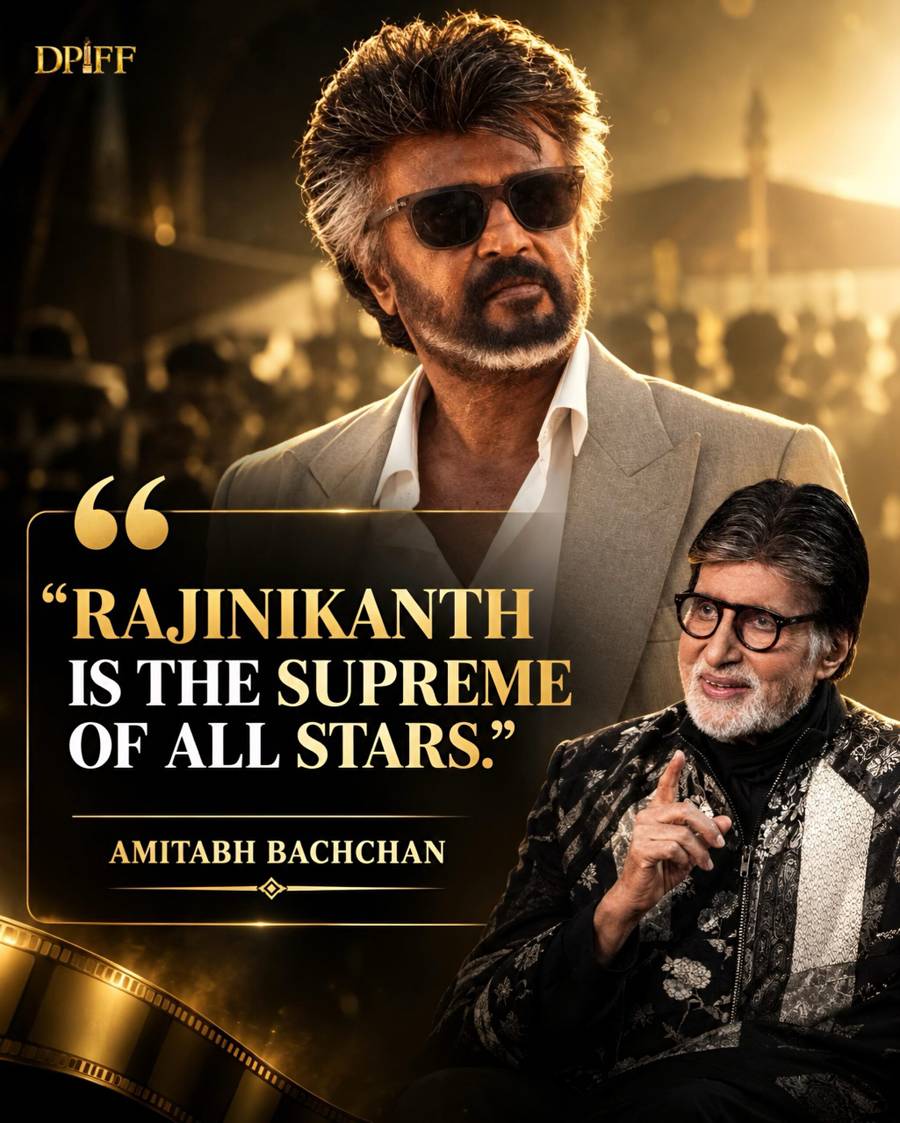
Amitabh Bachchan’s description of Rajinikanth as the “Supreme of All Stars” has brought renewed attention to the rare stature shared by two of Indian cinema’s most enduring performers. In a recent post, Dadasaheb Phalke International Film Festival highlighted Bachchan’s words as a tribute to Rajinikanth’s screen presence, distinctive style and decades-long contribution to Indian cinema.
The post is a celebration rather than a new film announcement. Its significance lies in the stature of the artists involved: Amitabh Bachchan and Rajinikanth have each built careers that extend across languages, generations and major shifts in the way Indian films are made, distributed and watched. Praise from one icon for another therefore carries a cultural resonance that reaches well beyond a social-media caption.
Amitabh Bachchan and Rajinikanth: two defining screen identities
Bachchan and Rajinikanth represent different performance traditions, yet both have achieved an unusually strong connection with audiences. Bachchan became one of Hindi cinema’s defining leading men through performances that combined intensity, restraint and a commanding voice. Rajinikanth, whose career has been closely associated with Tamil cinema, developed a highly recognisable screen language built on timing, movement, style and direct audience engagement.
Their stardom has never depended solely on conventional ideas of acting or celebrity. Both performers have created screen identities that audiences can recognise instantly, while continuing to work across changing genres and industry conditions. Their influence can be seen in the way dialogue delivery, entrances, gestures and character archetypes are remembered long after a film’s release.
Background on both careers is available through established reference sources, including the Encyclopaedia Britannica profile of Amitabh Bachchan and its biographical overview of Rajinikanth.
Why the recognition matters
Celebrity endorsements are common, but recognition between peers of this stature has a particular importance. Bachchan’s praise places Rajinikanth within a shared tradition of pan-Indian screen legends—artists whose appeal is not limited to one market, language or period.
Rajinikanth’s career has also helped demonstrate the international reach of Tamil cinema. His films have travelled widely through theatrical releases, television, dubbed versions and digital platforms. At the same time, Bachchan’s work has remained central to the history of Hindi cinema and has introduced his performances to audiences well beyond India.
Their parallel journeys also reflect the broader evolution of Indian cinema. Both began their careers in an era when theatrical exhibition and television were the principal routes to mass visibility. They later remained relevant as multiplexes, satellite rights, digital distribution and global streaming changed the relationship between films and audiences.
Legacies recognised through national honours
The cultural importance of both actors is also reflected in India’s national honours. Amitabh Bachchan received the Padma Vibhushan in 2015, while Rajinikanth received the same honour in 2016. These recognitions followed decades of work that made each actor an important figure in the history of Indian popular cinema.
Bachchan was also honoured with the Dadasaheb Phalke Award for 2018, presented in recognition of his outstanding contribution to Indian cinema. Rajinikanth received the Dadasaheb Phalke Award for 2019. The official Press Information Bureau announcement on Rajinikanth’s award described the honour as a recognition of his contribution as an actor, producer and screenwriter.
These honours do not reduce either career to a list of awards. Instead, they offer an official record of the place both artists occupy in India’s cinematic heritage. Their most lasting achievement remains the ability to create performances and moments that audiences continue to revisit, quote and celebrate.
From individual stardom to shared cinematic heritage
The phrase “Supreme of All Stars,” as presented in DPIFF’s post, works because Rajinikanth’s appeal has always combined mass popularity with an unmistakable personal style. His performances often turn a character’s entrance, gesture or line reading into a memorable event. That quality has influenced the grammar of mainstream Indian filmmaking and shaped expectations around the idea of a superstar.
Bachchan’s recognition also underlines the value of intergenerational admiration in Indian cinema. The two actors belong to different linguistic and industrial traditions, but their careers have often been discussed together because they represent the highest level of sustained public recognition. Their journeys show how a performer can become not merely successful, but part of the cultural vocabulary of cinema.
DPIFF’s tribute to Rajinikanth
The original DPIFF post can be viewed on Dadasaheb Phalke International Film Festival’s official Instagram page. The post presents Bachchan’s words as a celebration of Rajinikanth’s enduring screen impact and of the larger legacy created by two of Indian cinema’s most influential figures.
A legend recognising a legend. When Amitabh Bachchan calls Rajinikanth the “Supreme of All Stars,” it reflects the extraordinary impact of a superstar whose screen presence, iconic style and decades of cinematic excellence have transcended generations.
Recent Coverage from DPIFF
DPIFF’s news and editorial archive provides the latest institutional coverage of cinema, artists, awards and film-industry developments. Readers can visit the archive for current articles and festival updates published by DPIFF.
Because the present story is focused on a tribute shared through DPIFF’s Instagram channel, the archive is the most reliable place to follow the festival’s latest editorial coverage rather than treating unrelated reports as part of this development.
About Dadasaheb Phalke International Film Festival
Dadasaheb Phalke International Film Festival is a film-focused cultural platform that celebrates Indian cinema and recognises creative contributions across the entertainment industry. Its work includes festival-led honours, artist recognition and editorial engagement with developments in Indian and international film. DPIFF’s coverage aims to connect audiences with the people, performances and milestones shaping cinema.
By bringing Bachchan’s words into focus, the tribute offers a concise reminder of Rajinikanth’s exceptional place in Indian cinema—and of the shared respect that continues to define the legacies of both stars.



Share this link via


Share this link via

Share this link via
Share this link via