How Tom Hardy Used Charles Bronson’s Moustache for Bronson
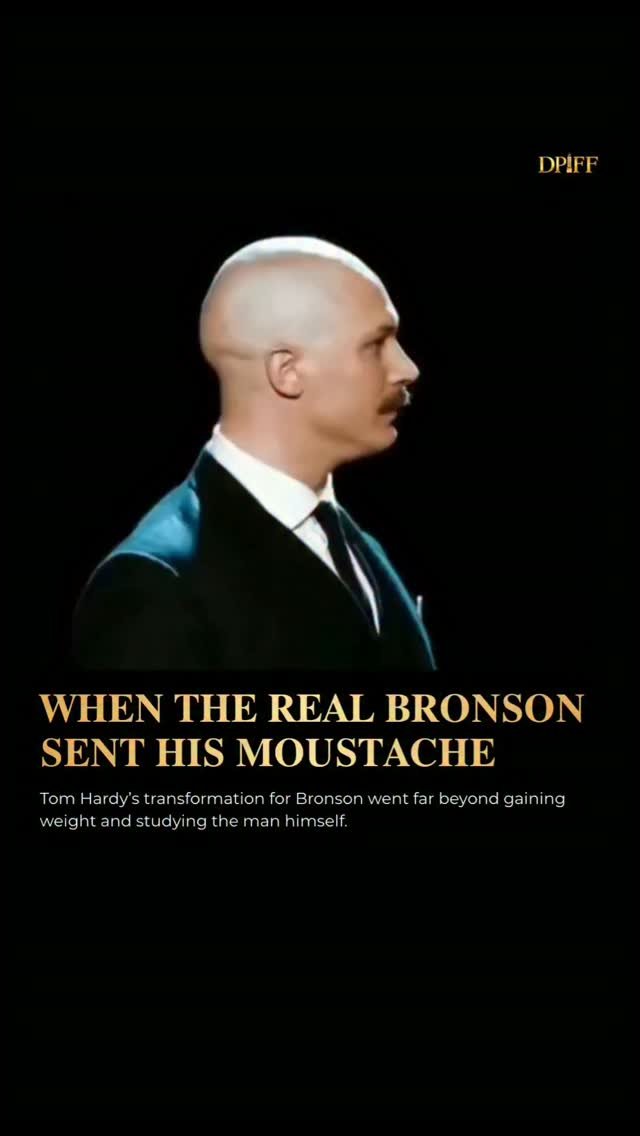
Tom Hardy’s performance in Bronson (2008) demanded more than a physical transformation. To portray Britain’s most notorious prisoner, Hardy studied Charles Bronson’s distinctive mannerisms, changed his physique and built a screen presence that was deliberately unsettling, theatrical and unpredictable. The production’s commitment to authenticity reportedly went as far as using pieces of Bronson’s real moustache in Hardy’s appearance.
The detail was highlighted in a recent Dadasaheb Phalke International Film Festival Instagram post, which recalls the unusual connection between the actor and the man he portrayed. According to the post, Bronson was sufficiently impressed by Hardy’s preparation that he shaved off his trademark moustache and sent it to the actor, hoping it could be incorporated into the film’s make-up and styling.
Tom Hardy’s transformation for Bronson
Directed by Nicolas Winding Refn, Bronson is an unconventional biographical crime film inspired by the life of Charles Bronson, the pseudonym adopted by Michael Gordon Peterson. Rather than presenting a conventional prison-life drama, Refn’s film uses stylised production design, dark humour, theatrical staging and abrupt shifts in tone to explore the mythology surrounding its central figure.
Hardy’s work was central to that approach. The actor did not simply reproduce Bronson’s appearance; he studied his posture, facial expressions, speech patterns and physical aggression. The result was a performance that treated Bronson as both a real individual and a self-created public persona—one who had turned violence, performance and notoriety into a kind of identity.
That distinction is important. Bronson is not structured as a straightforward factual reconstruction of every stage of Peterson’s life. Refn’s film is closer to a stylised character study, with Hardy’s performance carrying much of its energy. His exaggerated physicality and volatile shifts between menace and showmanship reflect the film’s interest in the way Bronson presented himself to the world.
Why the moustache story matters
In an era when digital effects can reproduce almost any visual detail, the story of Bronson sending his moustache to Hardy offers a revealing glimpse into the practical and personal side of film-making. A small piece of real hair may appear insignificant, but it represents the unusual level of involvement surrounding a performance based on a living person with a highly recognisable image.
Director Nicolas Winding Refn later confirmed that pieces of Bronson’s actual moustache were used in Hardy’s on-screen look. The decision added a physical link between the subject and the actor, while also reinforcing the film’s fascination with Bronson’s carefully cultivated persona.
At the same time, the anecdote should be understood as part of the film’s production history rather than as proof that every element of Hardy’s portrayal was approved by Bronson. The performance remained an interpretation shaped by Refn’s direction, Hardy’s research and the film’s deliberately stylised tone.
Nicolas Winding Refn’s distinctive approach
Refn’s direction gave Bronson a visual and dramatic identity that separated it from more conventional prison films. The director frames Bronson’s life through stylised tableaux and performance spaces, allowing the character to address the audience directly and turn his own story into a spectacle.
This approach also creates distance between the film and the idea of a traditional prison biopic. The audience is not asked to view Bronson only as a criminal figure or only as a victim of circumstance. Instead, the film examines the construction of a notorious identity and the uneasy relationship between violence, fame and entertainment.
For Hardy, the role became an important early demonstration of his ability to disappear into physically and psychologically demanding characters. His portrayal helped establish a screen persona built around transformation, intensity and a willingness to embrace unconventional material. The performance remains a useful reference point when considering later roles in which the actor altered his voice, movement or physical appearance to serve a character.
Readers interested in the film can consult its IMDb listing for Bronson for core production information, while the British Board of Film Classification entry provides regulatory and content context. The film is also frequently discussed within the broader body of work associated with Refn’s stylised crime cinema.
Watch the DPIFF reference
The original DPIFF video reference is available below. It highlights the moustache anecdote and the preparation behind Hardy’s portrayal without reducing the performance to a single behind-the-scenes detail.
View the original DPIFF Instagram post about Tom Hardy and Bronson
Recent Coverage from DPIFF
DPIFF’s editorial work regularly explores film performances, landmark production stories and the people who shape cinema. For the latest verified articles and updates, readers can browse the DPIFF news archive, which serves as the festival’s central editorial hub.
Readers can also learn more about the festival’s work through the official DPIFF website and its institutional information about cinema, recognition and film culture. These channels provide the most reliable source for newly published DPIFF coverage and official announcements.
About Dadasaheb Phalke International Film Festival
Dadasaheb Phalke International Film Festival is a film-focused cultural platform named after Dadasaheb Phalke, widely recognised as the pioneer of Indian cinema. DPIFF celebrates creative work across acting, direction, music and other areas of film-making. Through its awards, festival initiatives and editorial platforms, it connects audiences with significant stories from Indian and international cinema.
The moustache anecdote endures because it captures the unusual seriousness with which Bronson approached its central performance. Hardy’s transformation was not created by appearance alone; it emerged from research, physical discipline, directorial style and a rare material connection to the man at the centre of the film.



Share this link via



Share this link via

Share this link via