


Scam 2010: The Subrata Roy Saga Expands Hansal Mehta’s Financial Drama Universe
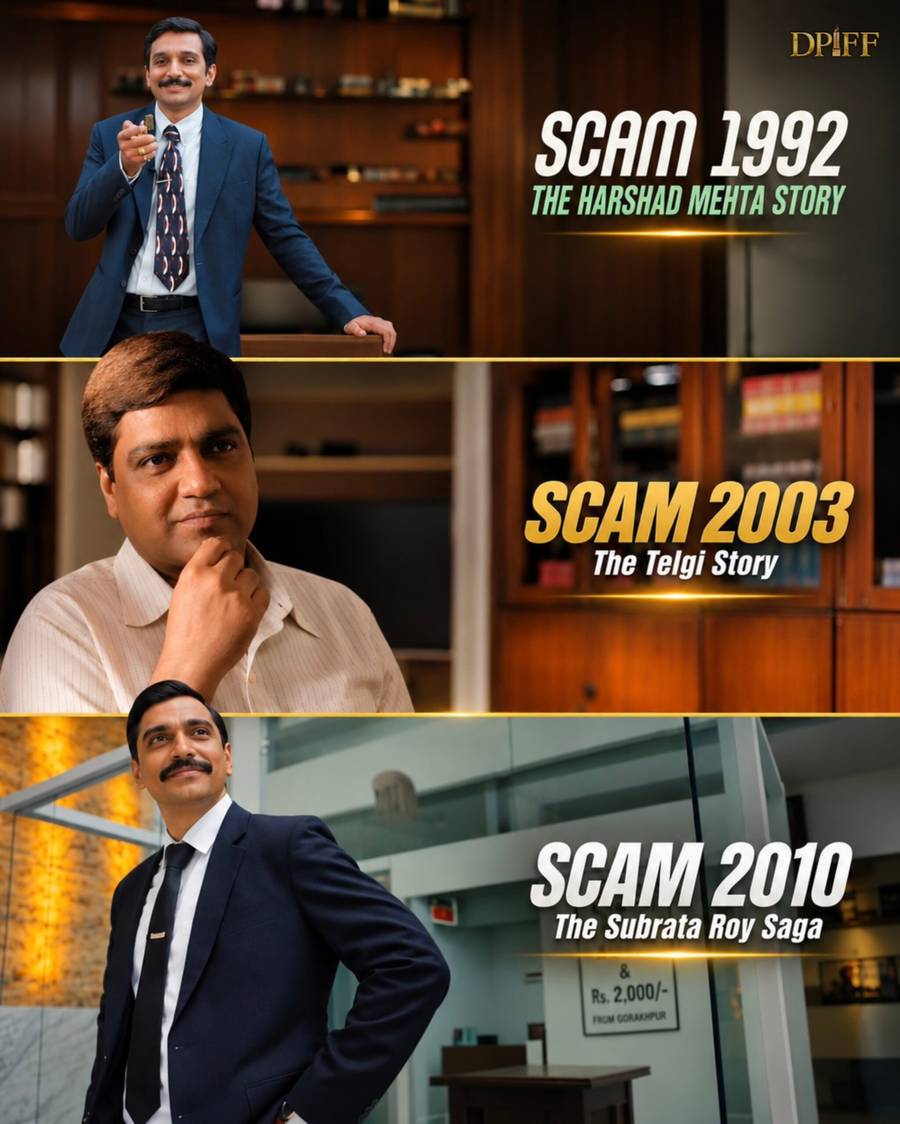
Scam 2010: The Subrata Roy Saga marks the third chapter in the franchise that has turned major financial controversies from India’s recent history into ambitious screen narratives. The upcoming series will focus on Sahara Group founder Subrata Roy, following earlier instalments centred on stockbroker Harshad Mehta and stamp-paper counterfeiter Abdul Karim Telgi.
Directed by Hansal Mehta and led by Siddharth Bodke, the series is produced by Birla Studios and Applause Entertainment. It is based on journalist Tamal Bandyopadhyay’s book Sahara: The Untold Story. The project was highlighted in a recent DPIFF Instagram post tracing the evolution of the Scam franchise across three different periods of India’s financial history.
From the securities market to the Sahara empire
The first series, Scam 1992: The Harshad Mehta Story, revisited the securities scam that shook India’s financial markets in the early 1990s. Starring Pratik Gandhi, the series drew from Sucheta Dalal and Debashis Basu’s book The Scam: Who Won, Who Lost, Who Got Away. Hansal Mehta served as director, with the production mounted by Applause Entertainment in association with Studio NEXT.
The second instalment, Scam 2003: The Telgi Story, moved away from the stock market and into the nationwide stamp-paper counterfeiting scandal associated with Abdul Karim Telgi. Gagan Dev Riar played the central character, while Tushar Hiranandani directed the series and Hansal Mehta served as showrunner. The adaptation was based on journalist Sanjay Singh’s Reporter Ki Diary.
With Scam 2010, the franchise turns to the rise of the Sahara Group and the controversies and legal battles surrounding its business empire. The story’s subject places the series at the intersection of corporate ambition, mass-market finance, regulatory scrutiny and the public image of one of India’s most recognisable business figures.
Why Scam 2010 is a significant next step
The Scam franchise has established a clear narrative approach: it uses a real financial controversy as the foundation for a character-driven drama. Rather than treating financial wrongdoing as an isolated event, the format examines the systems, personalities and institutional gaps that allow such stories to become national talking points.
That approach also gives each season a distinct social and economic setting. Scam 1992 reflected a period when India’s securities markets were changing rapidly. Scam 2003 explored how an illegal printing and distribution network could operate across states. The third season will examine the expansion of a large business group, its appeal to ordinary investors and the regulatory and legal questions that followed.
Subrata Roy’s public career offers the series a different kind of central figure from its predecessors. The story is not limited to a single market event or a criminal network; it concerns the building of a broad business empire and the complicated relationship between enterprise, public trust, financial regulation and accountability.
Hansal Mehta returns to a world of real-life financial stories
For Hansal Mehta, Scam 2010 continues an association with investigative, socially grounded storytelling. His work on the earlier Scam series helped establish the franchise’s visual and dramatic language, balancing research-led detail with the personal journeys of its central characters.
The involvement of journalist-authored source material remains important to the format. The first series drew on the reporting of Sucheta Dalal and Debashis Basu, the second was adapted from Sanjay Singh’s account, and the third is based on Tamal Bandyopadhyay’s book. These sources provide a documented foundation while leaving room for the screen adaptation to explore character, atmosphere and institutional context.
Details such as the series’ release date, streaming platform and full ensemble cast should be awaited through official announcements. At present, the confirmed creative information identifies Siddharth Bodke as the lead, Hansal Mehta as director, and Birla Studios and Applause Entertainment as producers.
Real events, dramatic interpretation and audience context
Projects based on financial controversies carry a particular responsibility. They must make complex subjects accessible without reducing them to simple stories of heroes and villains. For viewers, Scam 2010 may offer an accessible entry point into questions about financial regulation, investor confidence and the consequences of rapid corporate expansion.
The series also arrives at a time when Indian streaming dramas are increasingly using journalism, court records and public investigations as source material. Its eventual impact will depend on how carefully it distinguishes established events from dramatic reconstruction. The relevance of the story lies not only in the personality at its centre, but also in what it reveals about money, influence and accountability.
Readers seeking broader institutional context can consult the Securities and Exchange Board of India, while information about the franchise’s production house is available through the Applause Entertainment official website. Previous instalments of the franchise are also available through their authorised streaming and distribution channels.
DPIFF Instagram reference
The development was highlighted by DPIFF in its Instagram post, which presents the three Scam titles as connected stories about money, ambition, power and accountability in India. View the original post on the DPIFF Instagram page.
Recent Coverage from DPIFF
DPIFF’s latest editorial updates and film-industry reports are published through the festival’s official News section. Readers can also visit the DPIFF official website for information about the festival, its initiatives and its wider entertainment coverage. The festival’s verified social channels, including its official Instagram account, provide continuing updates on film, television and industry developments.
About Dadasaheb Phalke International Film Festival
Dadasaheb Phalke International Film Festival is an Indian film and entertainment platform that celebrates cinematic and creative achievements. Its editorial coverage spans films, streaming series, performers, filmmakers, awards and developments across the entertainment industry. Through its digital platforms, DPIFF connects audiences with stories shaping Indian cinema and popular culture.
By placing Scam 2010: The Subrata Roy Saga alongside its two predecessors, the franchise is building a continuing screen record of how financial controversies have reflected wider changes in Indian society and business. The series’ focus on the Sahara empire gives that record a new scale and a distinctly different institutional story to examine.



Share this link via



Share this link via


Share this link via