


Salman Khan’s 2011–2017 Film Journey: The Blockbusters That Defined an Era
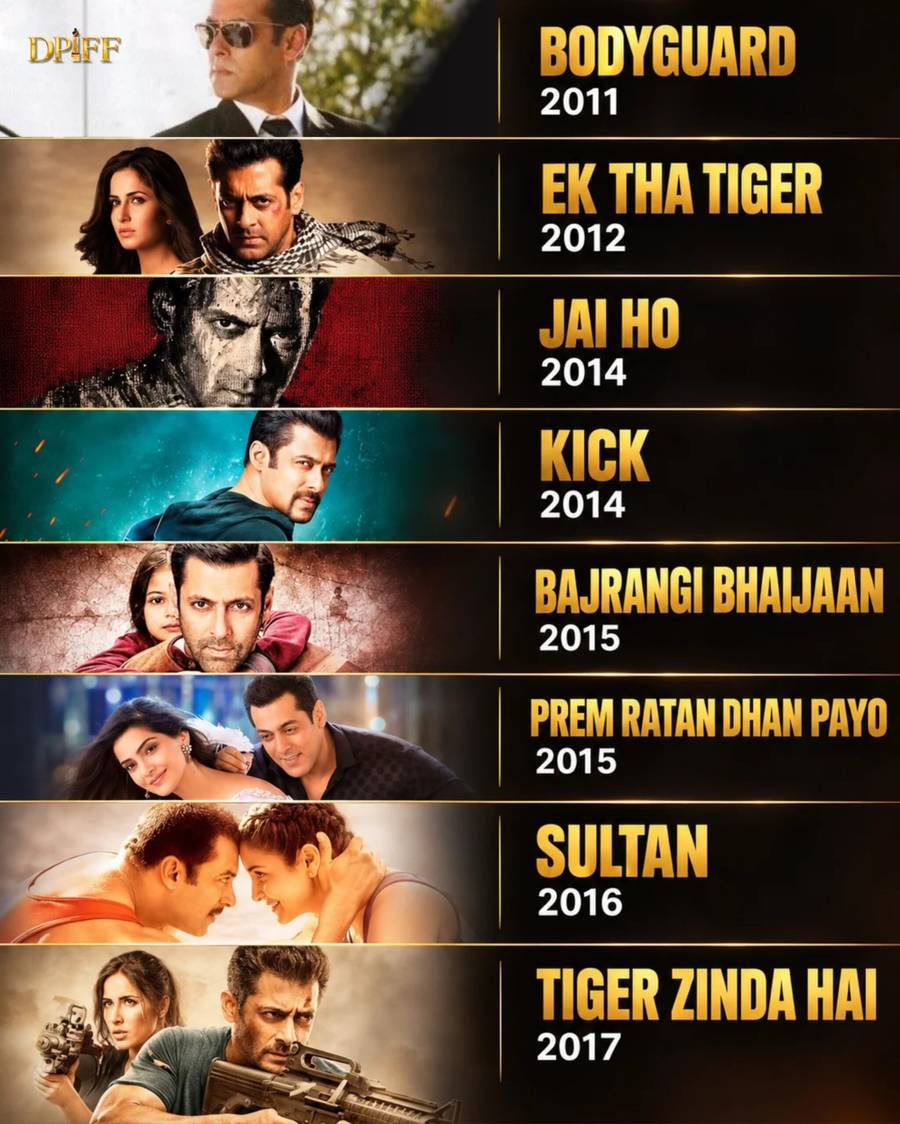
DPIFF’s latest Instagram feature revisits one of the most commercially significant phases of Salman Khan’s career: the run of films released between 2011 and 2017. Across romantic dramas, action entertainers, sports films and socially resonant stories, Khan strengthened his position as one of Hindi cinema’s most recognisable stars.
The period began with Ready and Bodyguard in 2011 and continued through films including Ek Tha Tiger, Dabangg 2, Jai Ho, Kick, Bajrangi Bhaijaan, Prem Ratan Dhan Payo, Sultan, Tubelight and Tiger Zinda Hai. While the films differed in tone and scale, they were connected by Khan’s ability to build an immediate relationship with a mass audience.
A decade shaped by variety and star power
Salman Khan’s screen image during these years was often associated with larger-than-life heroes, physicality and memorable dialogue. Yet the strongest films in this period also demonstrated that his appeal was not limited to action or comedy.
In Bodyguard, he played a fiercely loyal protector, while Ek Tha Tiger introduced him as a suave intelligence agent in a franchise that blended romance with international action. Dabangg 2 extended the popularity of Chulbul Pandey, the irreverent police officer first introduced in Dabangg, and Kick placed him in a stylised action-comedy built around dual identities and spectacle.
The variety became even more visible in the films that followed. Bajrangi Bhaijaan, directed by Kabir Khan, placed its emotional core in the bond between an Indian man and a lost Pakistani child. The film’s cross-border humanism gave Khan a quieter and more vulnerable character, while retaining the accessibility that had become central to his mainstream appeal. The film’s official production context can be explored through its recognised film listing.
From action franchises to emotionally driven characters
Sultan marked another important shift. Directed by Ali Abbas Zafar, the film followed a former wrestling champion confronting physical decline, personal regret and the challenge of rebuilding his life. Khan’s performance required him to portray the character at different stages of age and athletic ability, giving the film a dramatic arc beyond its sports setting.
The film also reflected the growing commercial importance of sports stories in Hindi cinema. Its wrestling sequences, training passages and relationship-driven narrative helped make Sultan more than a conventional star vehicle. The film remains an important reference point in discussions about Khan’s 2010s filmography and his ability to anchor stories built around transformation.
With Tiger Zinda Hai in 2017, Khan returned to the spy-thriller universe established by Ek Tha Tiger. The sequel expanded the scale of the franchise while preserving its central combination of action, romance and national-security drama. The film was produced by Yash Raj Films, whose official information on the broader spy-film series provides useful context for the character’s place in contemporary Hindi cinema: Tiger Zinda Hai on Yash Raj Films.
Why the 2011–2017 phase remains significant
This six-year period was important not simply because it contained several commercially successful releases. It showed how a major Hindi film star could sustain audience interest across multiple genres while maintaining a consistent theatrical identity.
Khan’s films during this phase were designed for broad audience access. Their songs, dialogue, action set pieces and emotional conflicts travelled easily across regions and age groups. At the same time, characters such as Pawan Kumar Chaturvedi in Bajrangi Bhaijaan and Sultan Ali Khan in Sultan expanded the emotional range associated with his public screen persona.
The period also coincided with the strengthening of franchise-led Hindi cinema. Ek Tha Tiger and Tiger Zinda Hai helped establish a recurring spy character who would later become part of a larger interconnected action landscape. Meanwhile, Dabangg 2 demonstrated the value of returning to a recognisable character whose personality, setting and comic rhythm were already familiar to viewers.
For audiences, the appeal was cumulative. Each release arrived with its own identity, but Khan’s presence provided continuity. Whether he was playing a protector, a spy, a wrestler, a social outsider or a comic action hero, the films relied on his capacity to make heightened characters feel instantly identifiable.
Salman Khan’s place in popular Hindi cinema
Salman Khan’s career has often been discussed through the language of stardom, but his 2011–2017 filmography also illustrates the changing relationship between actors, franchises and audience expectations in Bollywood. His films were major theatrical events, yet their staying power was also shaped by songs, television exposure, repeat viewing and dialogue-led fan culture.
The selection highlighted by DPIFF is therefore more than a list of popular titles. It is a snapshot of a period when Khan’s screen persona influenced the structure of mainstream Hindi entertainment itself. The films balanced familiarity with reinvention, giving audiences recognisable star appeal while placing him in different narrative worlds.
Readers can explore more about the festival’s work and editorial programming through the official DPIFF website, including its information on the Dadasaheb Phalke International Film Festival and its broader film and entertainment coverage.
DPIFF Instagram Reference
This article was prompted by DPIFF’s Instagram post celebrating Salman Khan’s cinematic journey from 2011 to 2017. View the original post on DPIFF’s official Instagram account.
Recent Coverage from DPIFF
DPIFF’s newsroom continues to publish editorial updates and features covering Indian cinema, film personalities, awards and developments across the entertainment industry. Readers can find the latest verified stories in the DPIFF News section, which serves as the festival’s central archive for recent coverage.
About Dadasaheb Phalke International Film Festival
Dadasaheb Phalke International Film Festival is an Indian film festival and entertainment platform named after Dadasaheb Phalke, widely regarded as the father of Indian cinema. DPIFF’s work focuses on recognising cinematic achievement and presenting editorial coverage related to films, artists and the wider entertainment industry. Its official website and social channels provide updates on festival-related activity and Indian cinema.
Salman Khan’s 2011–2017 filmography continues to invite debate about the relationship between stardom, genre and audience loyalty. Taken together, these films document a defining chapter in modern Bollywood—one in which a familiar star image remained powerful precisely because it could be adapted to very different kinds of stories.



Share this link via


Share this link via
Share this link via
Share this link via