


Lajja: How Rajkumar Santoshi’s Film Turned Women’s Stories into a Collective Fight for Freedom
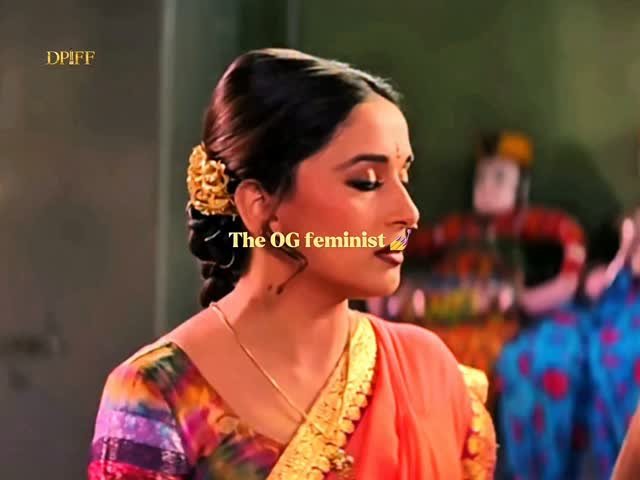
Dadasaheb Phalke International Film Festival’s recent Instagram post revisits Lajja (2001), Rajkumar Santoshi’s socially charged drama about a woman who walks away from an unhappy marriage and discovers that her personal struggle is connected to a much wider fight against patriarchy. Led by Manisha Koirala as Vaidehi, the film remains significant for placing women’s dignity, agency and resistance at the centre of a mainstream Hindi narrative.
Rather than presenting Vaidehi’s journey as an isolated act of rebellion, Lajja builds its story around the women she meets along the way. Each encounter exposes a different form of social control—from pressure within the family to the policing of women’s choices, ambitions and independence. Their experiences gradually reshape Vaidehi’s understanding of freedom.
Vaidehi’s journey from escape to self-discovery
At the beginning of Lajja, Vaidehi leaves a marriage that has denied her emotional security and personal happiness. Her decision is not treated simply as a romantic or domestic conflict. It becomes the starting point of a larger journey in which she confronts the realities faced by women across different social environments.
As Vaidehi encounters other women, the film moves beyond the idea that empowerment is only an individual achievement. The central character begins to recognise that her circumstances are linked to a broader system in which women are expected to compromise, remain silent or accept injustice as part of social duty.
A multi-layered portrait of women’s lives
The film’s structure is built around interconnected stories. Madhuri Dixit’s Janki, Mahima Chaudhry’s Maithili and Rekha’s Ramdulaari represent different experiences of womanhood and resistance. Their stories are distinct, but they are united by the pressures placed on them by family, tradition and patriarchal authority.
This ensemble approach gives Lajja a wider emotional and social range than a conventional single-protagonist drama. Vaidehi’s story provides the narrative thread, while the women she meets broaden the film’s argument. Together, their experiences suggest that injustice can take many forms, even when it is normalised by the people and institutions around them.
Why Lajja continues to invite discussion
Lajja arrived at a time when Hindi cinema was increasingly engaging with questions of gender, identity and social inequality, but its approach remained closely connected to the conventions of popular filmmaking. The film combined drama, performance, music and large-scale storytelling with a direct examination of women’s limited choices.
Its relevance lies in the way it connects personal freedom with collective dignity. Vaidehi does not simply seek a new life for herself; her encounters force her to understand how the same social attitudes can affect women in different circumstances. That movement—from private pain to shared awareness—is the film’s central emotional progression.
The film also draws strength from its female-led dramatic framework. The women are not presented only as supporting figures in a male-centred story. Their decisions, conflicts and acts of resistance drive the narrative, while the male characters function largely within the social structures that the film examines.
Performances that anchor the film
Manisha Koirala’s performance as Vaidehi gives the film its central perspective. Her character begins in a state of emotional uncertainty and gradually develops a clearer sense of self. The performances by Madhuri Dixit, Mahima Chaudhry and Rekha add contrasting textures to the film’s portrait of women navigating social expectations.
That combination of individual performances and interconnected storytelling allows Lajja to operate on two levels: as Vaidehi’s personal search for independence and as a broader reflection on the conditions that shape women’s lives. It is this combination that keeps the film relevant to discussions about representation in Hindi cinema.
DPIFF’s Instagram reference
The DPIFF Instagram post highlights Vaidehi’s journey and the way the film connects her experience with the struggles of other women. The post serves as the editorial reference for this retrospective.
Recent Coverage from DPIFF
DPIFF’s digital publishing and social-media coverage continue to revisit films, performers and creative milestones that have shaped Indian cinema. For the latest verified editorial updates and film-related features, readers can visit the official DPIFF website.
About Dadasaheb Phalke International Film Festival
Dadasaheb Phalke International Film Festival is an Indian film and entertainment platform that recognises creative achievements across cinema and related areas. It also uses its digital channels to spotlight notable films, artists, filmmakers and stories from the country’s cinematic heritage. Through its editorial and festival-oriented work, DPIFF connects audiences with significant contributions to Indian screen culture.
By returning to Lajja, DPIFF’s post draws attention to a film whose central question remains enduring: what does it take for a woman to claim dignity and independence in a society that repeatedly asks her to surrender both?



Share this link via




Share this link via

Share this link via