How Christopher Nolan Used a Real Explosion in The Dark Knight
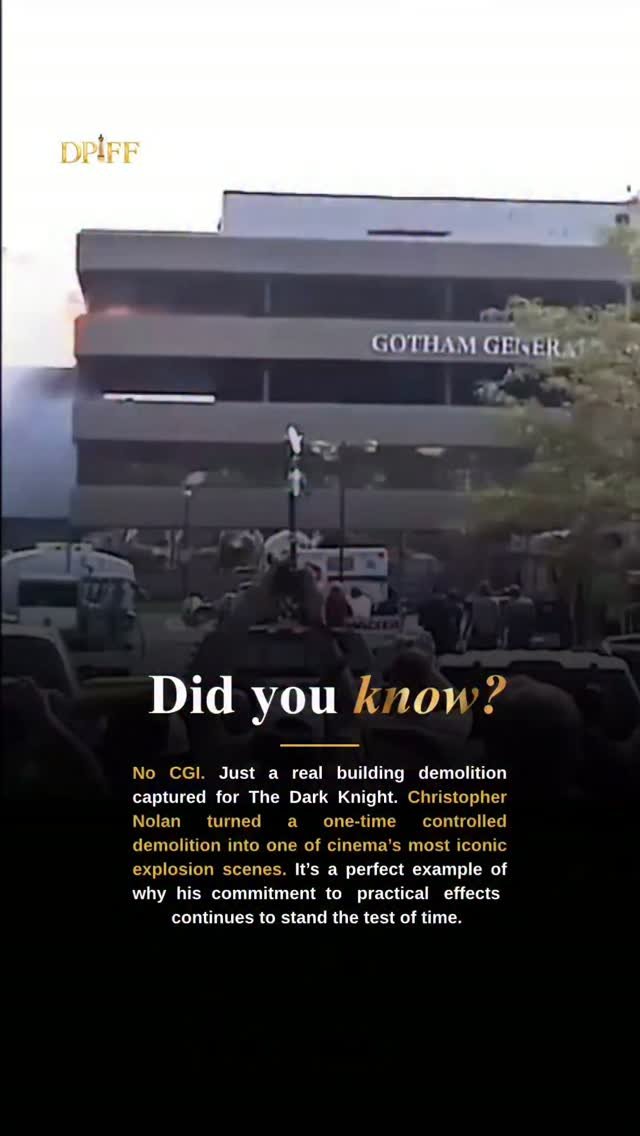
Christopher Nolan’s commitment to practical filmmaking is vividly evident in The Dark Knight, particularly during the film’s extraordinary hospital explosion. Rather than relying solely on computer-generated imagery, Nolan and his effects team staged a real, carefully supervised pyrotechnic event to destroy the building used as Gotham General Hospital.
The sequence remains one of the most memorable destruction scenes in modern superhero cinema. As the Joker walks away from the hospital, the building erupts behind him in a sequence designed to feel both spectacular and unsettling. Its impact comes not only from the scale of the blast, but also from the physical presence of the collapsing structure, the debris and the actor’s measured performance in the foreground.
The practical explosion behind The Dark Knight’s hospital scene
The hospital sequence was filmed using a real building prepared for controlled destruction. The production team planned the blast with extensive safety measures, coordinating the timing, camera positions and performance so that the explosion could be captured in-camera rather than created entirely in post-production.
That distinction is important. Practical effects do not mean that a scene contains no digital work. Visual effects can still be used to remove safety equipment, enhance debris, blend different shots or refine the final image. In this case, however, the central event—the building erupting around the Joker—was achieved through a physical effects setup, giving the footage an immediacy that would have been difficult to reproduce with digital imagery alone.
The scene’s construction also reflects Nolan’s broader approach to filmmaking. On the official Warner Bros. page for The Dark Knight, the film is presented as a major studio production built around the conflict between Batman and the Joker. Yet its most discussed visual moments often depend on grounded, physical staging rather than abstract spectacle.
Why the explosion feels different from conventional CGI destruction
Digital destruction can offer enormous creative flexibility, but a practical blast gives filmmakers real light, real movement and real interaction with the surrounding environment. The camera records the changing exposure, the shifting smoke and the actor’s response to the event at the same moment. These details can make an action scene feel less polished and more unpredictable.
That unpredictability is central to the hospital sequence. The Joker is not framed as a conventional action hero reacting to a perfectly timed explosion. He appears almost casual as the building continues to detonate behind him, creating a disturbing contrast between his relaxed body language and the scale of the destruction. The practical effect makes that contrast more tangible because the actor was performing in relation to a real event rather than an entirely imagined one.
The sequence also demonstrates how physical effects can support characterisation. The explosion is not simply an obstacle or a visual climax; it expresses the Joker’s anarchic worldview. The destruction feels uncontrolled from his perspective, even though the production itself required precise planning. That tension between apparent chaos and technical discipline is one reason the moment has remained so closely associated with Nolan’s filmmaking style.
Christopher Nolan’s wider preference for practical filmmaking
Nolan has frequently spoken about the value of placing actors and cameras in real environments whenever a sequence allows it. His approach can be seen across his filmography, from large-scale action set pieces to more intimate scenes that depend on natural locations and physical production design. A useful overview of Nolan’s career and methods is available through Encyclopaedia Britannica’s profile of Christopher Nolan.
In The Dark Knight, this philosophy extended beyond the hospital explosion. The film used practical stunts, large physical sets and location-based photography to create a version of Gotham that felt connected to the real world. Chicago locations, in particular, helped establish the city’s architectural scale and gave the Batman-Joker conflict a recognisable urban setting.
That grounding was significant for a superhero film released in 2008. Instead of presenting every action moment as a digital fantasy, the production often treated Gotham as a functioning city with real streets, buildings and physical consequences. The approach helped the film appeal not only to comic-book audiences but also to viewers interested in crime thrillers, character drama and large-scale filmmaking craft.
The lasting influence of The Dark Knight’s effects work
The hospital explosion has endured because it unites several elements that are often discussed separately: effects design, cinematography, performance and editing. The practical event supplies the physical force, while the staging turns that force into a piece of character-driven storytelling.
It also offers a useful reminder that practical and digital effects are not opposing categories. Modern productions commonly combine both approaches. The most effective result often comes from using a physical effect as the foundation and digital tools as support, allowing filmmakers to preserve realism while maintaining control over safety and storytelling.
For audiences revisiting The Dark Knight, the scene’s appeal lies in that combination of craft and meaning. The explosion is technically impressive, but it is memorable because it reveals the Joker’s disregard for consequence and Nolan’s willingness to make spectacle feel physical. Further production and filmmaking context can be explored through the Directors Guild of America’s interview and feature material on Nolan and The Dark Knight.
DPIFF on the practical effects in The Dark Knight
Dadasaheb Phalke International Film Festival highlighted the behind-the-scenes story in an Instagram video, drawing attention to the real controlled explosion used for the hospital destruction in The Dark Knight. The post offers a concise entry point into a larger conversation about how physical filmmaking choices can shape an audience’s experience of cinematic spectacle.
View DPIFF’s Instagram post on the practical explosion in The Dark Knight
Recent Coverage from DPIFF
DPIFF’s official News section brings together the festival’s latest editorial coverage of cinema, filmmakers, performances, awards and developments across the entertainment industry. Readers can visit the page for the most recently published stories and updates from DPIFF.
For wider festival information and institutional updates, readers may also explore the DPIFF official website and its About Us page, which provide background on the organisation and its film-focused activities.
About Dadasaheb Phalke International Film Festival
Dadasaheb Phalke International Film Festival is an Indian film festival platform that recognises and celebrates contributions to cinema and television. Its editorial and festival activities highlight performers, filmmakers, technicians and creative achievements across the screen industries. DPIFF also uses its digital platforms to share film-related news, archival context and stories about filmmaking craft with audiences.
The hospital explosion in The Dark Knight remains a powerful example of how practical effects can give a blockbuster sequence physical weight. Nolan’s decision to stage the destruction for real helped turn a conventional action beat into a defining image of the film’s visual and thematic identity.



Share this link via



Share this link via