


DPIFF Celebrates Chiyaan Vikram’s Transformative Acting Journey
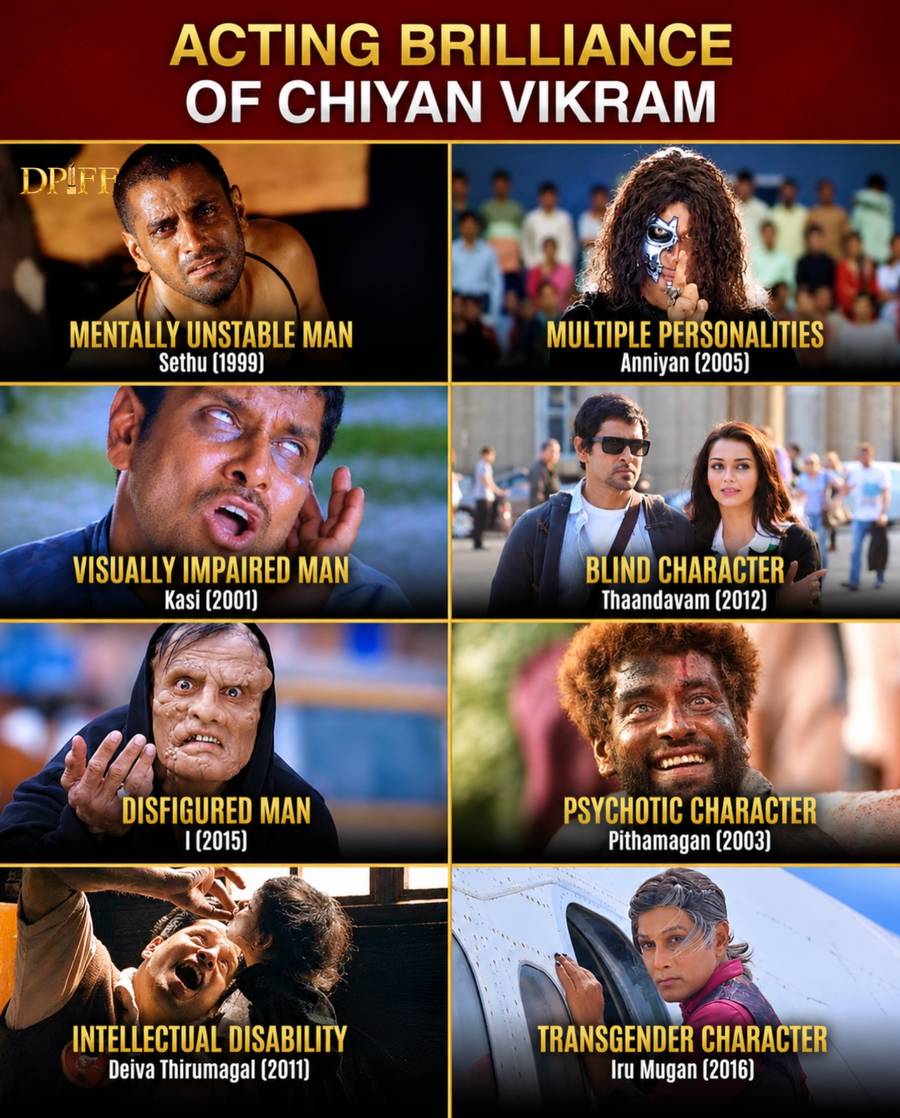
Dadasaheb Phalke International Film Festival has highlighted the remarkable acting journey of Chiyaan Vikram, an actor whose career has been defined by physical commitment, emotional range and an unusual willingness to take creative risks. From the raw intensity of Sethu to the layered performance in Anniyan, Vikram has repeatedly treated transformation as an essential part of storytelling.
The DPIFF tribute draws attention to a body of work that extends beyond star image or conventional heroism. Vikram’s most memorable characters are often marked by contradiction: strength and vulnerability, innocence and pain, identity and disguise. That ability to inhabit dramatically different inner worlds has made him one of the most distinctive performers in Tamil cinema.
A career built on transformation
Vikram’s breakthrough as a leading performer is closely associated with Sethu, the 1999 Tamil film directed by Bala. His portrayal of Sethu combined aggression, romance and emotional fragility, helping establish the intensity that would become a defining feature of his screen presence. The performance also demonstrated his ability to carry a character through a substantial emotional shift rather than relying only on dialogue or appearance.
That commitment became even more visible in Pithamagan, another collaboration with Bala. As Chithan, Vikram played a character shaped by isolation and limited social contact. The role required him to communicate largely through physical behaviour, silence and instinct, and earned him the National Film Award for Best Actor. The film remains an important reference point in discussions about his range.
Readers exploring the wider history of Indian cinema can also visit the DPIFF official website, which documents the festival’s engagement with performers, filmmakers and significant cinematic work.
From multiple identities to psychological complexity
In Shankar’s Anniyan, Vikram moved in a very different direction. Released in 2005, the film presented him through three distinct identities: the disciplined and anxious Ambi, the flamboyant Remo and the vigilante figure Anniyan. The performance demanded changes in voice, body language, rhythm and screen energy, allowing Vikram to distinguish each persona while maintaining the character’s underlying psychological connection.
The film’s theatrical scale made the transformation immediately visible, but its lasting impact came from the precision of the performance. Vikram did not treat the identities as simple costume changes; he gave each one a separate physical vocabulary and emotional register. This remains one of the clearest examples of how mainstream Tamil cinema can use performance to support an ambitious character concept.
His filmography also includes roles in which emotional restraint becomes as important as outward transformation. In Deiva Thirumagal, Vikram played Krishna, a man with the cognitive development of a child who is determined to remain connected to his daughter. The performance depended on innocence, vulnerability and careful control, and it reached audiences through the character’s emotional sincerity rather than spectacle alone.
The physical demands of I
Vikram’s dedication to transformation was again central to Shankar’s I, released in 2015. Playing Lingesan, a bodybuilder and model whose life changes dramatically, he moved through several physical and emotional phases within the same narrative. The role required substantial changes in appearance and performance style, reinforcing his reputation for approaching demanding characters with discipline.
For audiences, the significance of I lies not only in the scale of its production but also in the way the film made the actor’s changing physicality part of its storytelling. Vikram’s work across the film’s different stages reflected the character’s shifting confidence, vulnerability and sense of identity.
Film references for Chiyaan Vikram’s filmography and individual titles such as Anniyan and Pithamagan offer useful starting points for viewers revisiting these performances. The films themselves, however, reveal why Vikram’s work is best understood across a range of roles rather than through any single transformation.
Why Vikram’s performances continue to matter
Vikram’s contribution to Tamil cinema is significant because he has consistently used popularity to pursue demanding material. His choices have moved between commercial entertainers, emotionally driven dramas and character-led films, often requiring him to surrender the familiar image of a conventional leading man.
That willingness to alter his voice, appearance, movement and emotional register has also expanded the possibilities available to actors working within mainstream Indian cinema. His performances show that transformation is most effective when it serves character and narrative, rather than functioning as a publicity device.
DPIFF’s Instagram tribute captures this quality by placing roles such as Sethu, Ambi, Chithan, Krishna and Lingesan within the same artistic conversation. Together, they reflect an actor who approaches performance as an act of complete involvement—one that asks audiences to recognise the character before they recognise the star.
DPIFF’s Instagram reference
Read the original DPIFF tribute to Chiyaan Vikram on Instagram.
Recent Coverage from DPIFF
DPIFF’s News section carries the festival’s latest editorial updates, including coverage connected to Indian cinema, artists, awards and festival developments. Readers can use the newsroom archive to explore the most recent published stories and announcements from the organisation.
- DPIFF newsroom updates – The central archive for the festival’s latest editorial coverage and announcements.
- Dadasaheb Phalke International Film Festival – The official festival platform, with information about its identity, activities and cinematic focus.
- About DPIFF – Background on the organisation and its work in recognising and celebrating contributions to Indian cinema.
About Dadasaheb Phalke International Film Festival
Dadasaheb Phalke International Film Festival is a platform dedicated to celebrating achievements across Indian cinema and recognising the creative work of artists and technicians. Named after Dadasaheb Phalke, widely regarded as the father of Indian cinema, the festival connects contemporary film culture with the heritage of the medium. Through its editorial initiatives and festival-related activities, DPIFF engages audiences with the people, performances and stories shaping cinema.
Chiyaan Vikram’s career illustrates why acting remains central to the cinematic experience: a memorable performance does not merely present a character, but gives that character a distinct emotional life. Across radically different roles, Vikram has made that process of disappearance into character one of the defining features of his work.



Share this link via


Share this link via
Share this link via
Share this link via