₹1,000 Crore Club in Indian Cinema: Why the Milestone Matters
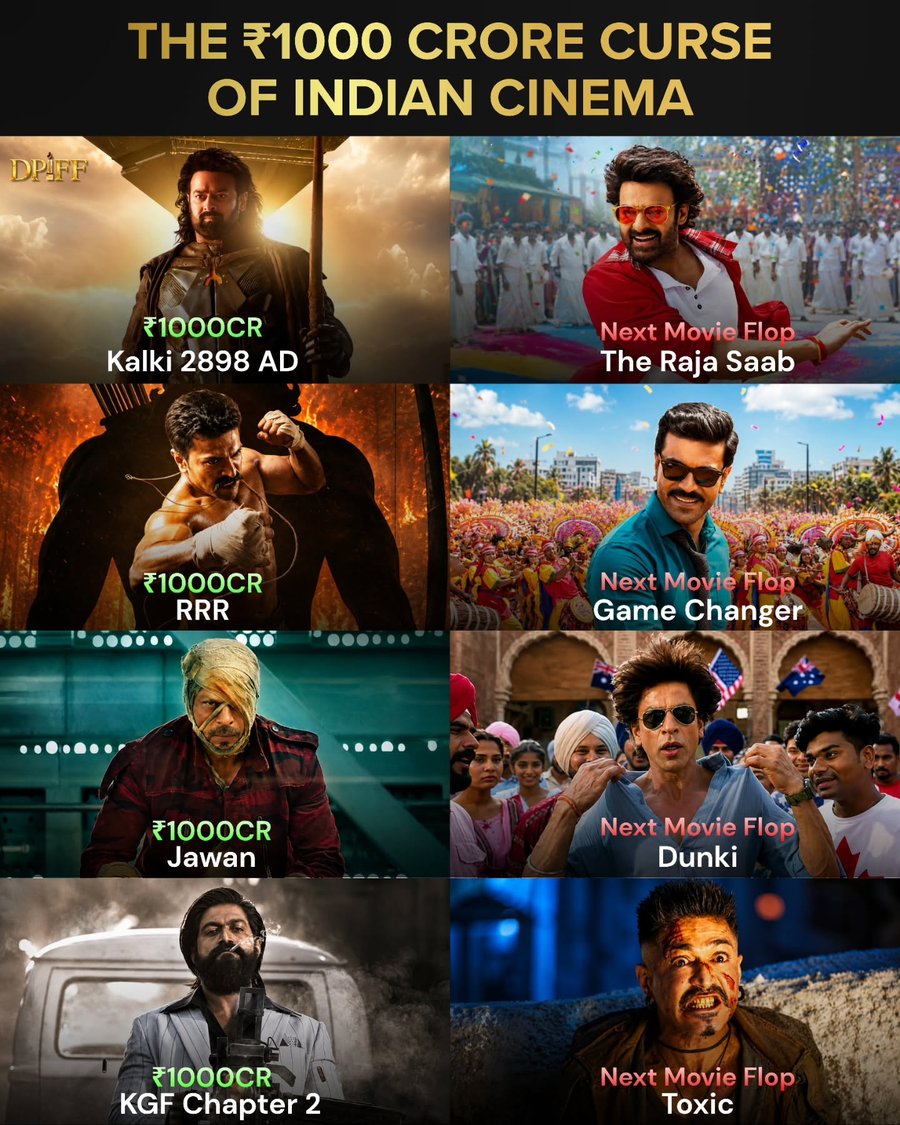
The ₹1,000 crore club has emerged as one of the most closely watched benchmarks in Indian cinema. Films such as RRR, KGF: Chapter 2, Jawan and Kalki 2898 AD have demonstrated that a film’s commercial reach can extend far beyond its original language market and domestic audience.
DPIFF’s recent Instagram post highlights an important distinction behind the headline figure: an actor’s association with a ₹1,000 crore success does not automatically guarantee that the next release will achieve the same result. Box-office performance depends on several factors, including the film’s content, scale, release strategy, audience reception, competition and international distribution.
What does the ₹1,000 crore club represent?
The term “₹1,000 crore club” is an informal industry expression used for films whose reported worldwide gross crosses the ₹1,000 crore mark. It is not an official award or certification, and different trade sources may use varying methodologies when calculating gross collections, taxes, distributor shares and overseas revenue.
Even with those differences, the milestone remains significant because it indicates an unusually broad commercial footprint. A film entering this category has generally connected with audiences across multiple regions, languages and viewing markets. The achievement also reflects the increasing importance of overseas releases, dubbed versions, premium formats and large-scale promotional campaigns.
Films that changed the scale of Indian box-office success
S.S. Rajamouli’s RRR became a major international success after its theatrical release, with its Telugu-language story reaching audiences in India and overseas. Its global visibility was further strengthened by international recognition and sustained interest in its music, action set pieces and performances.
KGF: Chapter 2, led by Yash and directed by Prashanth Neel, expanded the reach of Kannada cinema on a national scale. The film built on the popularity of its predecessor and demonstrated how a regional-language franchise could become a pan-Indian theatrical property.
Jawan, starring Shah Rukh Khan and directed by Atlee, combined mass entertainment with a Hindi-language release strategy designed for audiences in India and international markets. Its performance reinforced the commercial influence of established stars while also showing the value of collaboration across film industries.
Kalki 2898 AD, directed by Nag Ashwin and produced by Vyjayanthi Movies, brought science fiction, mythology and futuristic production design into a large-scale Indian theatrical framework. The film’s performance reflected audience interest in original world-building and ambitious franchise-led storytelling.
Why one ₹1,000 crore success does not guarantee another
Box office is not a permanent measure of an actor’s market value. A successful film may benefit from a particularly strong script, a popular franchise, positive word of mouth, favourable release timing or a combination of these factors. Those conditions cannot always be reproduced in the next project.
The distinction is especially important when a film becomes identified primarily with its concept, ensemble, director or franchise rather than with one performer alone. Audiences may return for a star, but sustained theatrical success usually depends on whether the new film offers a compelling reason to buy a ticket.
Release competition also plays a major role. A film arriving during a holiday period may have access to more screenings, while a crowded release calendar can limit its reach. Screen availability, ticket pricing, regional distribution and overseas promotion can all influence the final worldwide gross.
The growing importance of pan-Indian audiences
The ₹1,000 crore benchmark also reflects a structural change in Indian film consumption. Viewers are increasingly comfortable watching films made in languages other than their own, supported by dubbing, subtitles, social media discovery and national-scale marketing.
This has created opportunities for stories from Telugu, Kannada, Tamil, Malayalam and Hindi cinema to travel across traditional boundaries. However, pan-Indian success is not simply a matter of releasing a film in several languages. The film must still offer strong storytelling, memorable characters and a viewing experience that feels relevant to audiences in different regions.
For the industry, the milestone has encouraged larger investments in visual effects, action design, production infrastructure and international distribution. It has also raised expectations. Once a film reaches exceptional commercial heights, audiences and trade observers naturally examine whether the next release can match its scale or create a new benchmark.
What audiences may watch next
DPIFF’s post invites viewers to consider which upcoming film could enter the ₹1,000 crore club. That question is best treated as a discussion about audience expectations rather than a prediction of confirmed box-office results. No upcoming film can be guaranteed to reach the milestone before its release and public response are known.
The more useful question is what makes a potential blockbuster: a strong premise, a credible creative team, a clear audience proposition, effective distribution and the ability to generate interest across markets. Those elements, rather than star power alone, will continue to shape the next phase of Indian theatrical cinema.
DPIFF’s Instagram reference
DPIFF raised this discussion in its original Instagram post on the ₹1,000 crore club, referring to the milestone achieved by films including Kalki 2898 AD, RRR, Jawan and KGF: Chapter 2. The post also asks audiences to share their views on which upcoming film could join the group.
Recent Coverage from DPIFF
Readers can find DPIFF’s latest editorial updates, film-industry features and entertainment coverage in the official DPIFF news archive. As the archive is updated regularly, it remains the most reliable destination for the festival’s newest published stories and announcements.
For additional festival updates and visual content, readers can also follow DPIFF’s official Instagram channel. The channel provides the original social posts that often serve as starting points for wider editorial discussions on Indian cinema.
Information about the festival, its work and its institutional identity is available through the official Dadasaheb Phalke International Film Festival website.
About Dadasaheb Phalke International Film Festival
Dadasaheb Phalke International Film Festival is an Indian film festival and entertainment platform that celebrates cinema, creativity and contributions to the screen industries.
DPIFF publishes information and editorial content connected with Indian and international cinema, filmmakers, performers and cultural developments.
Through its digital platforms, the festival engages audiences with film-related stories, industry milestones and conversations shaping contemporary entertainment.
Its coverage is intended to support appreciation of cinema while placing popular developments within a broader cultural and industry context.



Share this link via




Share this link via