


Yash’s ₹100 Crore Opening-Day Hat-Trick Explained
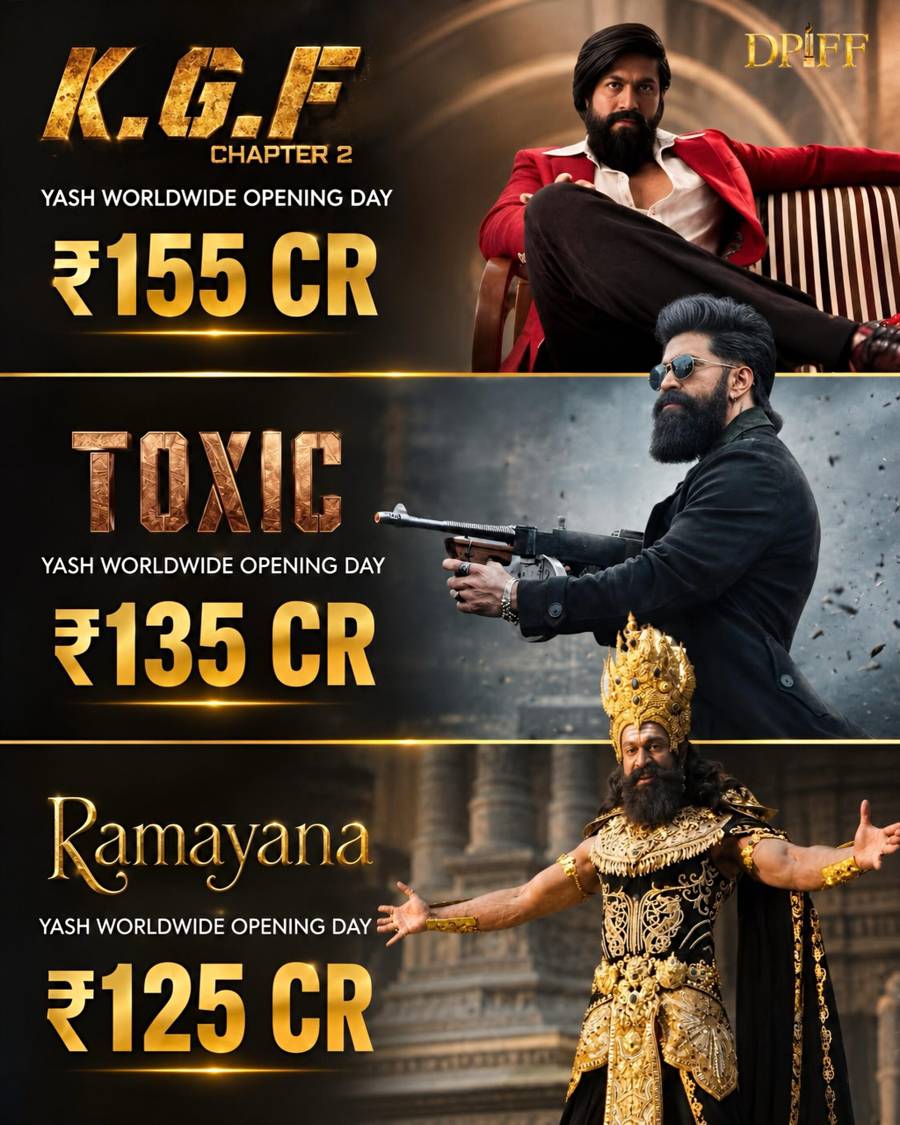
Dadasaheb Phalke International Film Festival has highlighted a striking box-office milestone associated with Yash: three films linked to the actor have been presented as crossing the ₹100 crore mark in worldwide opening-day collections. The figures shared in DPIFF’s Instagram post are ₹155 crore for KGF: Chapter 2, ₹135 crore for Toxic and ₹125 crore for Ramayana.
The numbers have immediately renewed discussion around Yash’s opening-day pull and whether this represents one of the most significant debut-day runs associated with an Indian star. However, the three figures require important context. While KGF: Chapter 2 is a released film with established box-office reporting, the figures cited for Toxic and Ramayana should be understood as figures presented by the DPIFF social-media post rather than independently verified final box-office results.
What the DPIFF post highlights
The central claim is straightforward: Yash is being associated with three consecutive worldwide openings above ₹100 crore. KGF: Chapter 2 forms the confirmed historical part of the comparison, while Toxic and Ramayana are upcoming projects whose eventual opening-day performance will only be measurable after their theatrical releases.
This distinction matters because opening-day figures can be reported in different ways. Trade reports may refer to gross or net collections, worldwide totals, distributor estimates, advance bookings or early projections. A credible comparison therefore needs a common methodology, a clearly stated currency conversion, and final figures from recognised trade or production sources.
Why KGF: Chapter 2 changed the scale of the conversation
Released in 2022, KGF: Chapter 2 expanded the world created by the first KGF film and turned Yash’s Rocky Bhai into a pan-Indian popular-culture phenomenon. Produced by Hombale Films, the Kannada-language action drama was released in multiple Indian languages and marketed as a major national event.
Its performance demonstrated how a regional-language film could achieve mass visibility across linguistic markets when supported by a strong franchise, distinctive star image and coordinated nationwide distribution. For Yash, the film was not simply a successful sequel; it established a new benchmark for the scale of audience anticipation surrounding his next projects.
The film’s success also contributed to a wider industry shift. Hindi, Telugu, Tamil, Malayalam and Kannada releases increasingly began to be discussed within the same national box-office conversation, with dubbed versions and simultaneous releases becoming important tools for reaching audiences beyond a film’s original language market.
Toxic and the challenge of sustaining anticipation
Toxic is significant because it is Yash’s next major solo project after the KGF franchise. The film has attracted attention not only because of the actor’s involvement, but also because every post-KGF project carries unusually high expectations regarding scale, genre and theatrical reach.
That expectation can help create a powerful opening weekend, but opening-day momentum is only one part of a film’s commercial journey. Sustained collections depend on audience reception, reviews, screen availability, competition, release strategy and the film’s ability to connect beyond its established fan base.
For that reason, the ₹135 crore figure cited in the DPIFF post should not be treated as a confirmed collection until the film has released and reliable worldwide reporting is available. It is more accurately described at this stage as a figure associated with the post’s projected or comparative narrative.
Where Ramayana fits into Yash’s growing profile
Yash is also connected to Ramayana, the large-scale mythological project being developed with international visual-effects involvement. The film’s reported ensemble and epic subject give it a different commercial identity from the action-driven KGF films and the crime-oriented expectations surrounding Toxic.
Its significance lies in the combination of a familiar cultural narrative, major production ambitions and a cast capable of attracting audiences across regions. Details surrounding a film of this scale are often released in stages, making it especially important to separate confirmed announcements from anticipated box-office projections. The official DNEG project page for Ramayana provides production-related context, but it does not validate the opening-day figure cited in the DPIFF post.
Is this the biggest opening-day hat-trick in Indian cinema?
The answer cannot be confirmed without a comprehensive, consistently sourced comparison of opening-day worldwide grosses across Indian films. Different reporting standards make such rankings difficult, particularly when figures from released films are placed alongside numbers connected to unreleased projects.
What can be said with confidence is that the comparison captures Yash’s exceptional market positioning. KGF: Chapter 2 established a proven blockbuster record, while Toxic and Ramayana show the level of anticipation attached to his next two major screen appearances. If both films eventually open at or above the figures cited by DPIFF, the achievement would become a particularly notable example of sustained star-led theatrical demand.
DPIFF’s Instagram reference
The comparison and figures discussed in this article originate from the DPIFF Instagram post on Yash’s reported ₹100 crore-plus opening-day hat-trick. Readers should refer to official production announcements and established trade reporting for updated release information and final box-office results.
Recent Coverage from DPIFF
DPIFF’s official news archive carries the festival’s latest editorial coverage on Indian cinema, artists, awards and developments across the entertainment industry. As article availability and publication order can change, readers can use the archive to access the three most recently published relevant stories alongside this report.
For broader institutional information, readers can also visit the DPIFF homepage and explore the festival’s official announcements, programmes and coverage.
About Dadasaheb Phalke International Film Festival
Dadasaheb Phalke International Film Festival is an Indian film and entertainment platform named after Dadasaheb Phalke, widely regarded as the father of Indian cinema. DPIFF recognises creative contribution across Indian cinema and provides editorial and event-led coverage of films, artists and industry developments. Its work connects contemporary entertainment stories with the wider cultural and professional history of Indian filmmaking.
Yash’s reported opening-day hat-trick is therefore best viewed as both a box-office talking point and a measure of how dramatically the scale of pan-Indian stardom has evolved. The final assessment will depend on verified worldwide collections once Toxic and Ramayana reach audiences.



Share this link via


Share this link via
Share this link via

Share this link via