


Gangubai Kathiawadi, Akka and Eetha Spotlight Women-Led Cinema
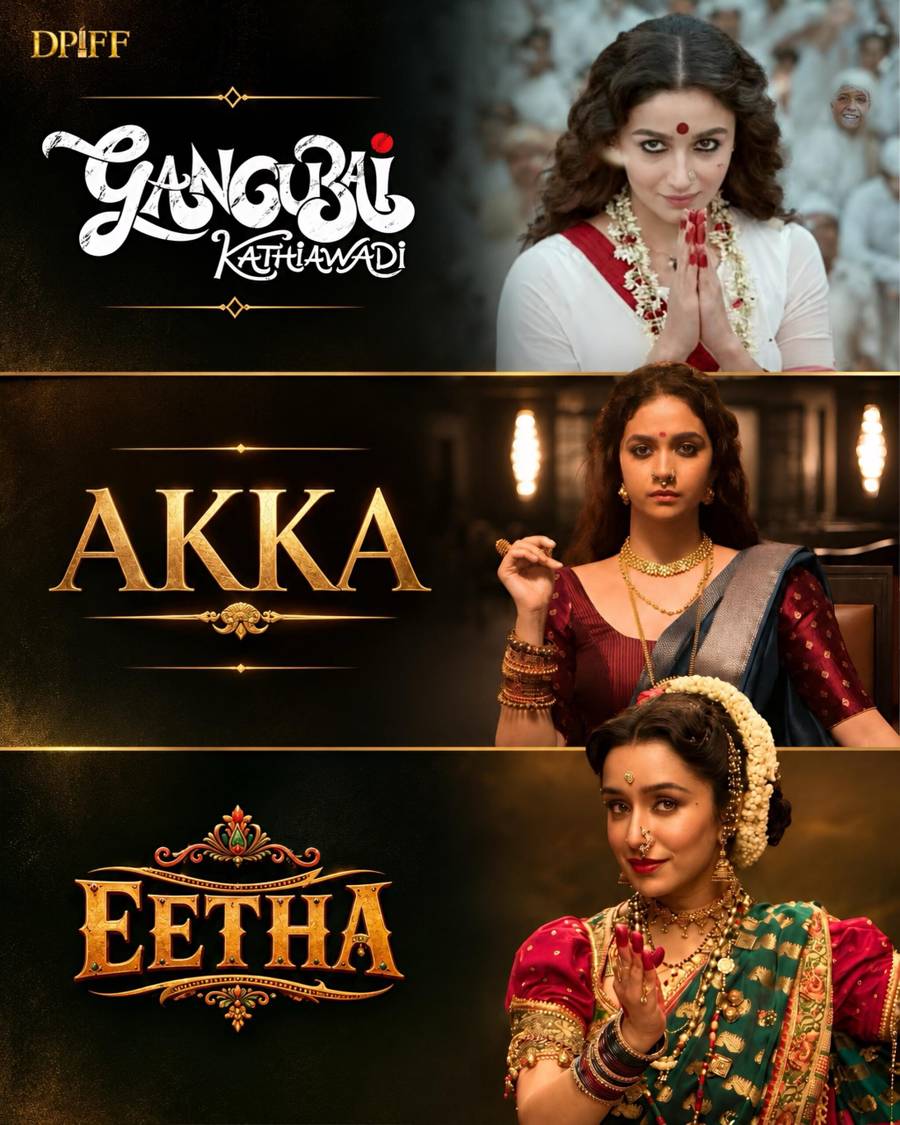
DPIFF has drawn attention to three female-led films—Gangubai Kathiawadi, Akka and Eetha—as examples of the varied ways women-centred stories are being shaped for Indian audiences. The festival’s Instagram post places the three titles together not as identical films, but as works connected by their focus on strong female characters, distinct cinematic worlds and performances that carry the narrative.
The selection is significant because it reflects a wider movement in Indian cinema: women characters are increasingly being positioned as the emotional, dramatic and thematic centre of a film. Their stories are no longer limited to supporting roles or familiar romantic subplots. Instead, female protagonists are being written with ambition, conflict, authority and complexity.
Three films, three different approaches to female-led storytelling
Gangubai Kathiawadi offers the most established reference point among the three titles. Directed by Sanjay Leela Bhansali and led by Alia Bhatt, the 2022 Hindi film presents the journey of its titular character against the social and political realities of Mumbai’s Kamathipura. The film was inspired by a chapter from journalist Hussain Zaidi’s book Mafia Queens of Mumbai, while its visual language and musical scale reflected Bhansali’s distinctive filmmaking style.
Alia Bhatt’s performance became central to the film’s impact. Gangubai is presented as a character who moves from vulnerability to public authority, and the film follows that transformation through political ambition, personal resolve and confrontations with the systems surrounding her. Readers can find more information about the film through its official Netflix listing for Gangubai Kathiawadi.
The inclusion of Akka and Eetha broadens the conversation beyond one well-known title. DPIFF’s post describes both films as possessing intriguing worlds and distinctive identities, suggesting that their value lies not only in the presence of women at the centre, but also in the different tones and settings through which those characters are explored. Since the post does not provide plot details, cast information or release announcements for either title, those elements are best understood through their respective official film communications.
Why representation alone is not the whole story
A female-led film is not automatically defined by the presence of a woman in the lead role. The depth of the character, the agency given to her, the conflicts she faces and the point of view adopted by the filmmaker all shape the meaning of representation. A film can be women-led while belonging to a historical drama, a thriller, a social narrative, a character study or an experimental cinematic world.
That range is what makes DPIFF’s comparison useful. Gangubai Kathiawadi is rooted in a larger-than-life biographical drama, while Akka and Eetha are presented in the post as distinct cinematic experiences. Taken together, the titles suggest that women-led cinema cannot be reduced to a single genre, mood or audience expectation.
This shift also matters from an industry perspective. Films built around female protagonists give performers opportunities to carry a story across its full emotional and dramatic arc. They also encourage writers and directors to develop women characters whose identities are not defined solely by their relationships with men. For audiences, that can create a wider range of stories and more varied points of identification.
The continuing importance of strong female characters
Indian cinema has a long history of memorable women characters, but the contemporary conversation increasingly focuses on whether those characters are being given narrative ownership. A commanding lead performance is important, yet the surrounding screenplay, direction, production design and marketing all contribute to whether a female-led film is able to establish a lasting identity.
In this context, visual identity becomes especially relevant. DPIFF’s post highlights the distinctive worlds of all three films, pointing to the relationship between character and cinematic design. Costume, colour, setting, sound and camera language can deepen the audience’s understanding of a protagonist and make her journey feel specific rather than interchangeable.
The broader discussion also connects with the work of film institutions and festivals. By placing established and emerging titles in the same editorial frame, a festival can encourage audiences to look beyond individual star performances and consider how storytelling traditions are changing. DPIFF’s wider work and festival-related updates can be followed through its official website, while readers interested in the organisation’s recognition platform can visit its awards section.
DPIFF’s Instagram reference
The editorial conversation was prompted by DPIFF’s original Instagram post, which presents Gangubai Kathiawadi, Akka and Eetha as three powerful female-led stories with different characters and cinematic worlds. The post can be viewed directly on DPIFF’s Instagram page.
“Three powerful female-led stories, three distinct characters and three worlds brought to life through compelling performances.”
Recent Coverage from DPIFF
DPIFF’s news section features the organisation’s latest editorial updates, festival announcements and film-related coverage. Readers should refer to the live archive for the three most recent published articles, as the order and availability of posts may change over time.
The archive provides the most reliable route to current DPIFF coverage without reproducing outdated headlines or presenting unverified article details. It also offers wider context on the festival’s engagement with Indian cinema, artists and developments across the entertainment industry.
About Dadasaheb Phalke International Film Festival
Dadasaheb Phalke International Film Festival is an Indian film and entertainment platform named after Dadasaheb Phalke, widely regarded as the father of Indian cinema. DPIFF recognises contributions across filmmaking and the wider entertainment ecosystem through its festival and awards initiatives. Its editorial channels highlight films, artists, creators and developments relevant to Indian cinema and its audiences.
By bringing Gangubai Kathiawadi, Akka and Eetha into one conversation, DPIFF’s post underlines an important point: women-led cinema is not one fixed category. It is a growing space defined by different genres, performances, visual approaches and stories that allow women to occupy the centre of the frame.



Share this link via


Share this link via
Share this link via
Share this link via