


Taal Se Taal Mila: How Aishwarya Rai’s Grace Defined a Classic
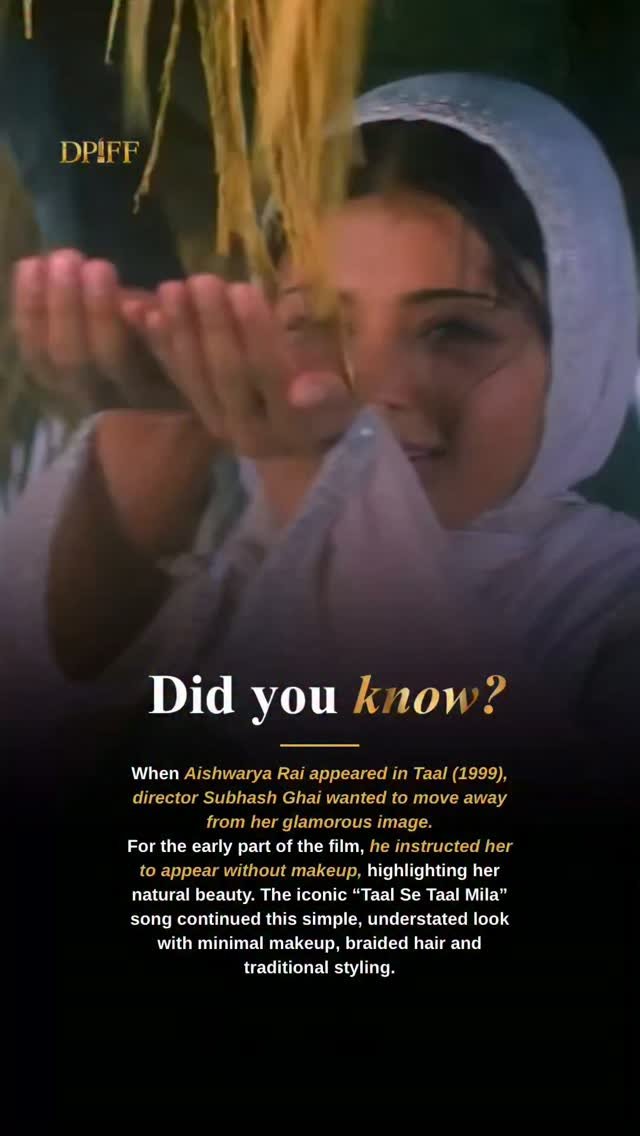
Dadasaheb Phalke International Film Festival’s latest Instagram reel revisits the distinctive screen presence Aishwarya Rai brought to Taal, Subhash Ghai’s 1999 musical drama. The post highlights how “Taal Se Taal Mila” presented Rai with a natural, graceful and understated appeal—an approach that helped make the song one of the most enduring memories of late-1990s Hindi cinema.
Rather than relying only on elaborate styling or overt theatricality, the sequence allows Rai’s performance to emerge through movement, expression and musical timing. That restraint became an important part of the song’s visual identity and complemented the larger aesthetic of Taal, a film built around music, rhythm and the meeting of different cultural worlds.
Aishwarya Rai’s understated performance in Taal
By the time Taal arrived, Aishwarya Rai was already recognised for her striking screen presence. The film, however, used that presence in a particularly controlled way. In “Taal Se Taal Mila”, her character Mansi is not introduced through spectacle alone; the performance is shaped by fluid choreography, poised gestures and an ease that keeps the focus on the music.
That creative decision mattered. The song’s appeal does not depend on a single dramatic moment. Instead, it builds through the interaction of Rai’s expressions, the choreography and A. R. Rahman’s layered composition. The result is a performance that feels polished without becoming overly rigid, allowing the actor’s natural elegance to remain central.
The song also demonstrates how a film performance can become inseparable from its musical arrangement. “Taal Se Taal Mila” was written by Anand Bakshi, composed by A. R. Rahman and performed by Udit Narayan and Alka Yagnik. Its melody, vocal arrangement and visual presentation work together rather than competing for attention.
Why Taal Se Taal Mila remains memorable
Taal was directed and produced by Subhash Ghai and featured Aishwarya Rai alongside Anil Kapoor and Akshaye Khanna. Music was not simply an accessory in the film; it was central to the storytelling and to the way the characters’ relationships and ambitions were presented.
The title itself places rhythm at the heart of the film, and “Taal Se Taal Mila” reflects that idea in both its sound and its choreography. The sequence balances grandeur with simplicity. Its visual language is carefully composed, but Rai’s performance never appears burdened by the scale of the production.
That balance helps explain why the song continues to resonate with audiences familiar with 1990s Bollywood music. It belongs to an era of highly memorable film soundtracks, yet its lasting appeal is not based only on nostalgia. The song remains a useful example of how choreography, costume, camera movement and performance can be calibrated to preserve an actor’s individuality.
The IMDb listing for Taal records the film’s principal credits and places the song within the broader context of the 1999 production. The film also formed part of Subhash Ghai’s long association with large-scale Hindi musical dramas, a creative tradition represented through the Mukta Arts banner and his work as a filmmaker and producer.
AR Rahman’s role in the film’s musical identity
A. R. Rahman’s score gave Taal a sound that combined the emotional directness of Hindi film music with modern studio production and a strong rhythmic foundation. “Taal Se Taal Mila” is among the clearest examples of that approach: the composition is accessible, but it also leaves room for texture, vocal interplay and movement.
For listeners interested in Rahman’s wider body of work, the composer’s official website offers additional context on his career and musical projects. In Taal, his collaboration with Ghai and the film’s vocal and lyrical team produced a soundtrack that remains closely associated with the visual culture of its period.
A song that shaped Bollywood nostalgia
For many viewers, “Taal Se Taal Mila” is remembered not merely as a popular song but as a complete cinematic set piece. Aishwarya Rai’s controlled performance gave the sequence emotional clarity, while the choreography and music created a visual and sonic signature that audiences could immediately recognise.
DPIFF’s Instagram post draws attention to a valuable aspect of that legacy: memorable screen performances do not always need to be loud or heavily embellished. In this case, grace, precision and restraint became the defining qualities, helping the song remain relevant to viewers revisiting the music and performances of 1990s Hindi cinema.
DPIFF Instagram Reference
View DPIFF’s Instagram reel on Aishwarya Rai, Taal and “Taal Se Taal Mila”
Recent Coverage from DPIFF
DPIFF’s official news section carries the festival’s latest editorial coverage across Indian cinema, filmmakers, performers, music and major developments in the entertainment industry. Readers can visit the newsroom directly for the most recent published stories and festival-related updates.
The wider DPIFF website also brings together information about the festival, its purpose and its coverage of cinema. As article availability and publication order change, the official news index remains the most reliable source for current DPIFF editorials.
About Dadasaheb Phalke International Film Festival
Dadasaheb Phalke International Film Festival is an Indian film festival named after Dadasaheb Phalke, widely regarded as the father of Indian cinema. The festival recognises creative contributions across Indian and international screen entertainment while providing a platform for conversations around cinema and its evolving craft. Through its official website and social channels, DPIFF shares film-related stories, cultural context and updates for audiences and industry professionals.
“Taal Se Taal Mila” continues to stand out because every part of the sequence supports the same artistic idea: rhythm can be powerful without becoming excessive. In Aishwarya Rai’s performance, that principle became one of the song’s most enduring visual strengths.


Share this link via


Share this link via

Share this link via