Who Suffered the Most in the MCU: Wanda, Peter, Thor or Rocket?
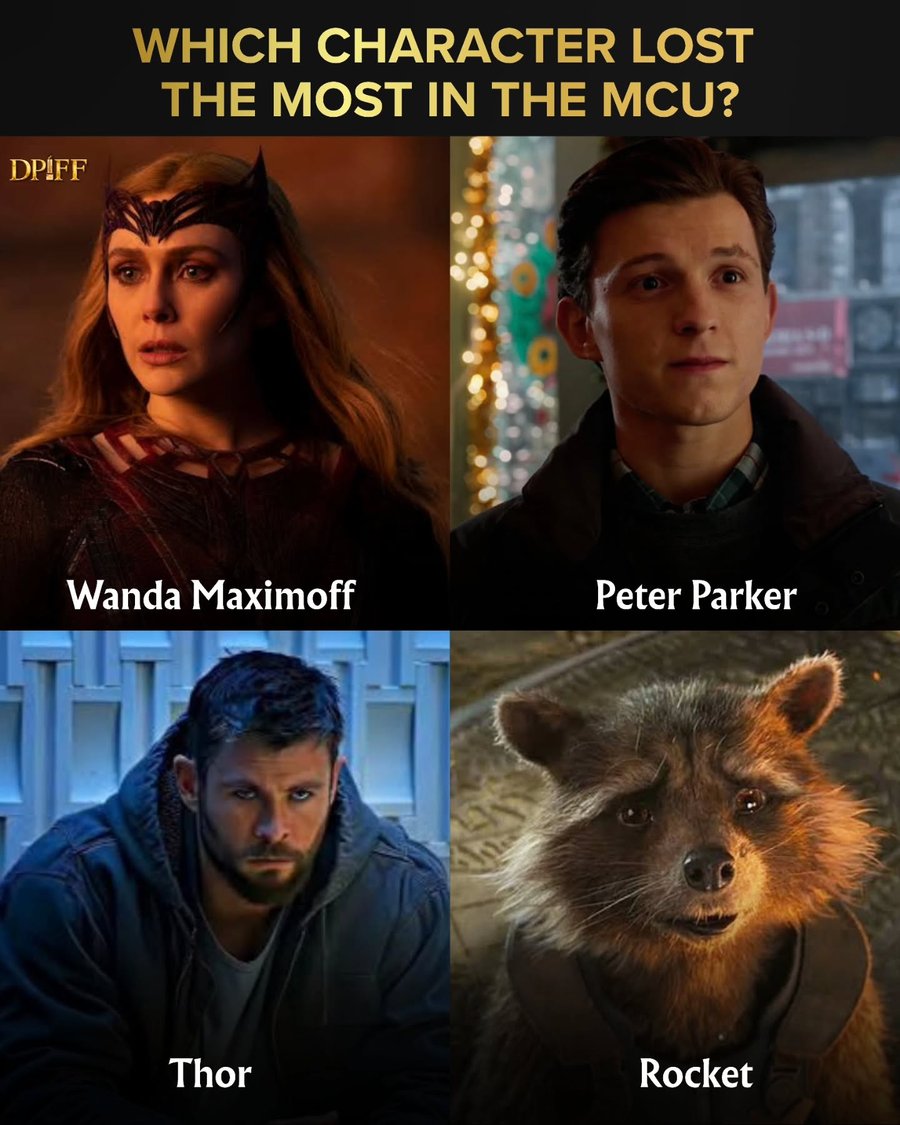
The Marvel Cinematic Universe has built some of its most memorable heroes around grief. Wanda Maximoff, Peter Parker, Thor and Rocket have each survived devastating personal losses, but the scale and nature of their suffering are very different. A recent Dadasaheb Phalke International Film Festival Instagram post revisits that debate and asks a difficult question: who has truly lost the most in the MCU?
There is no definitive answer because the characters’ experiences cannot be measured by a single standard. Some losses are defined by their sheer number, while others are shaped by prolonged trauma, isolation or the destruction of a person’s sense of belonging. Looking at the stories of Wanda, Peter, Thor and Rocket shows why the question continues to resonate with Marvel audiences.
Wanda Maximoff’s grief is closely tied to her powers
Wanda’s story begins with a childhood marked by violence. She and her twin brother Pietro lost their parents when they were young, an event that shaped their anger and distrust. Pietro later died while saving civilians during the Battle of Sokovia in Avengers: Age of Ultron, leaving Wanda without her closest remaining family member.
Her relationship with Vision offered a brief sense of stability, but that too ended in tragedy. Wanda was forced to destroy the Mind Stone and kill Vision in Avengers: Infinity War, only to watch Thanos reverse that sacrifice and kill him again after taking the Stone. When Vision was restored during the events of WandaVision, the couple’s life remained temporary and ultimately disappeared when Wanda’s Westview reality collapsed.
Wanda also experienced the loss of the twin boys Billy and Tommy, who existed within the magical reality she created in Westview. Although they were not ordinary biological children, Wanda experienced them as her family. Her grief, combined with the influence of the Darkhold, became a central part of her actions in Doctor Strange in the Multiverse of Madness. Her losses are therefore not only numerous; they are closely connected to her identity and powers.
Peter Parker loses family, mentorship and anonymity
Peter Parker’s losses are more intimate and grounded in the emotional world of family and friendship. The death of Aunt May in Spider-Man: No Way Home removes the person who served as his moral anchor and closest parent figure. Her final advice reinforces the responsibility associated with being Spider-Man, but it also leaves Peter to face adulthood alone.
Peter also loses Tony Stark, whose role in his life developed from technological benefactor to mentor and surrogate father figure. Tony’s death in Avengers: Endgame affects Peter deeply, particularly because their relationship had become one of the MCU’s most important intergenerational bonds.
The conclusion of No Way Home adds another kind of loss. Doctor Strange’s spell makes the world forget Peter Parker’s identity. Peter remains alive, but his relationships with MJ and Ned are effectively erased from their memories. Unlike a conventional death, this loss leaves no shared public grief and no possibility of openly reclaiming the life he once knew.
Thor’s losses span family, home and an entire civilisation
Thor has perhaps the strongest case when loss is measured by scale. Over the course of the MCU, he loses his parents, Odin and Frigga; his brother Loki; his sister Hela; close friends and fellow warriors; Jane Foster; his homeworld of Asgard; and a significant part of his people.
Thor’s grief is especially visible in Avengers: Infinity War and Avengers: Endgame. He fails to stop Thanos from eliminating half of all life, and his guilt contributes to a prolonged period of withdrawal. The destruction of Asgard also means that Thor is not simply mourning individuals. He is carrying the burden of a displaced people and the loss of a civilisation that defined his identity as a prince and king.
Jane Foster’s death in Thor: Love and Thunder adds another deeply personal wound. By that stage, Thor has already lost much of his family and community. His journey is not only about recovering from grief but also about learning how to remain emotionally connected despite everything that has been taken from him.
Rocket’s trauma is measured by cruelty and survival
Rocket’s suffering differs from that of the other characters because it begins with years of deliberate abuse. In Guardians of the Galaxy Vol. 3, the MCU reveals that Rocket was experimented on by the High Evolutionary. His body was altered, his intelligence was exploited and his childhood was defined by captivity rather than safety.
The film also introduces Lylla, Teefs and Floor, the fellow test subjects who became Rocket’s first true friends. Their deaths show how early Rocket was forced to associate love with loss. His later relationships with the Guardians are shaped by the same fear of abandonment, even as the group gradually becomes his chosen family.
Rocket’s story makes the comparison more complicated. He may not have lost an entire kingdom, but he endured prolonged torture and survived the destruction of nearly every bond formed during his earliest years. His eventual acceptance of friendship and leadership is therefore one of the MCU’s clearest examples of healing after trauma.
Why Thor has the strongest case, but not the only one
If the question is based on the number of major losses and their wider consequences, Thor has a compelling claim. He loses family members, friends, a partner, a homeland and countless citizens. His grief is both personal and collective, making him responsible for memories and responsibilities far beyond his own life.
However, a numerical ranking risks overlooking the distinct nature of the others’ experiences. Wanda’s grief is repeatedly connected to her unstable powers. Peter loses the ordinary life he was trying to protect. Rocket survives systematic cruelty before finding belonging. Each character represents a different form of suffering, which is why the debate remains open even after the MCU has shown so much of their past.
DPIFF Instagram reference
The original DPIFF post compares the losses of Wanda Maximoff, Peter Parker, Thor and Rocket, while inviting viewers to decide which character endured the greatest hardship. Read the full post on DPIFF’s official Instagram account.
Recent Coverage from DPIFF
DPIFF publishes entertainment, cinema and festival-related editorial updates through its official news section. Readers can visit the page for the latest verified coverage from the festival, including stories connected to Indian cinema, international films, artists and the wider screen industry.
About Dadasaheb Phalke International Film Festival
Dadasaheb Phalke International Film Festival is a platform dedicated to recognising and celebrating excellence in Indian cinema and the wider entertainment industry. Named after Dadasaheb Phalke, widely regarded as the father of Indian cinema, the festival highlights the work of actors, filmmakers, technicians and creators. Through its awards, events and editorial channels, DPIFF connects audiences with significant developments across the world of film.
Thor may represent the greatest scale of loss in the MCU, but Wanda, Peter and Rocket demonstrate that suffering cannot be judged by numbers alone. Their stories remain powerful because each character responds to grief differently: through anger, responsibility, withdrawal, survival and, eventually, the possibility of connection.


Share this link via



Share this link via

Share this link via