


Marvel’s Most Notable Actors to Play Multiple Superhero Roles
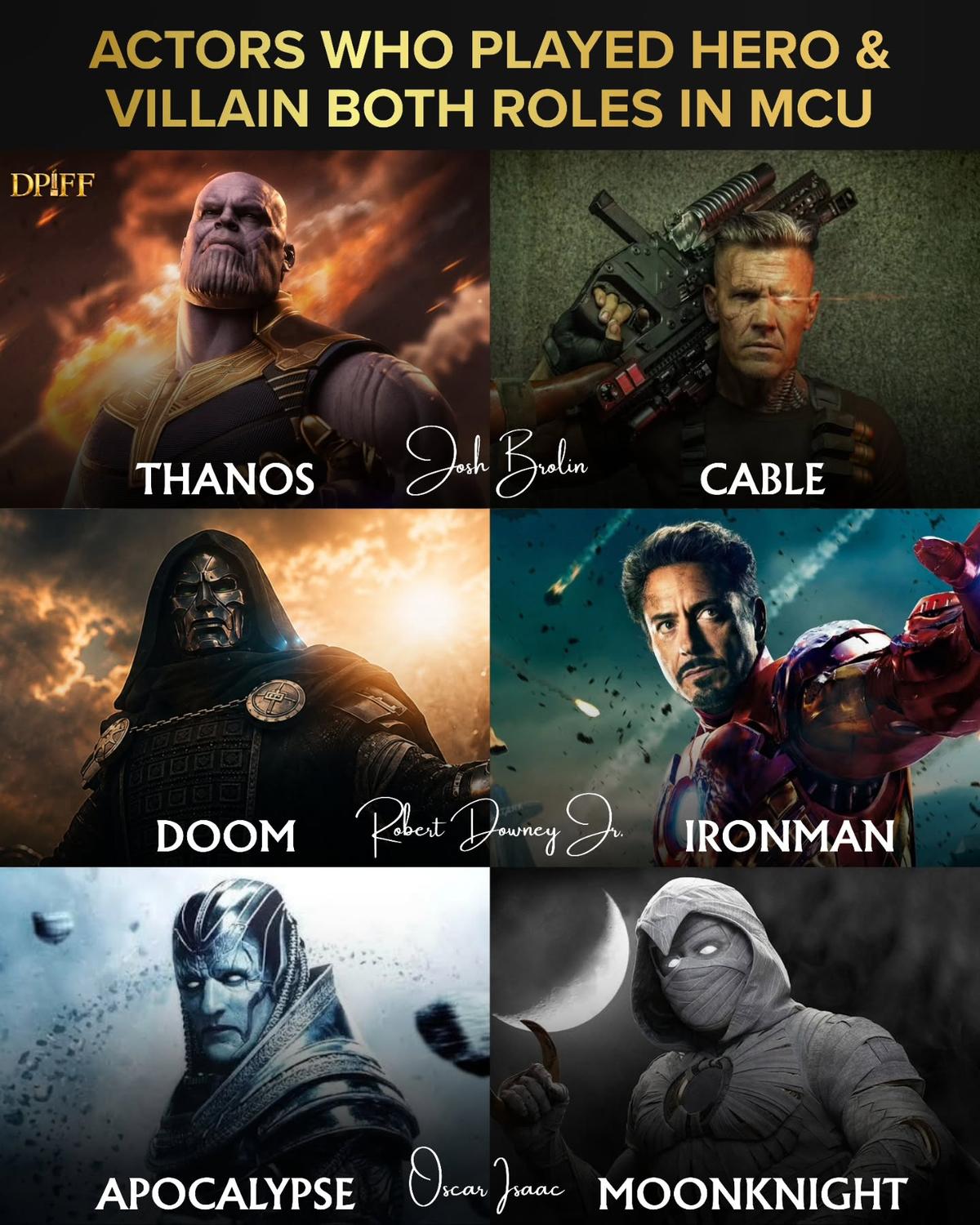
Marvel’s screen history is filled with actors who have moved between entirely different characters, franchises and even studio continuities. Josh Brolin’s transition from Thanos in the Marvel Cinematic Universe to Cable in Fox’s X-Men films is one of the clearest examples, while Robert Downey Jr.’s announced return as Doctor Doom has added another striking chapter to that history.
A DPIFF Instagram post revisits these casting connections, including Oscar Isaac’s performances as Apocalypse in X-Men: Apocalypse and Moon Knight in the MCU. The comparison is especially interesting because the characters do not all belong to the same continuity. Some originated in Fox’s pre-MCU X-Men films, while others were created or reintroduced under Marvel Studios.
Josh Brolin moved from Thanos to Cable
Josh Brolin’s Thanos remains one of the most recognisable villain performances in contemporary superhero cinema. He played the Mad Titan across key MCU films, including Avengers: Infinity War and Avengers: Endgame, where Thanos became the central force behind the Avengers’ defining conflict.
Only a short time after his major MCU appearances, Brolin took on the role of Cable in Fox’s Deadpool 2. Cable is a time-travelling mutant from the X-Men mythology, and the part required Brolin to deliver a very different screen presence: more militaristic and emotionally restrained than Thanos, but still capable of dry humour and physical intensity.
Brolin’s casting became a popular example of how an actor can occupy two major Marvel-related roles without allowing one performance to erase the other. Cable later appeared again in Deadpool & Wolverine, a film that further connected Marvel’s older Fox properties with the MCU’s multiverse framework.
Robert Downey Jr. is returning in a new Marvel role
Robert Downey Jr.’s Tony Stark, also known as Iron Man, was one of the foundational performances of the MCU. Beginning with Iron Man in 2008, Downey helped establish the tone and interconnected storytelling model that shaped Marvel Studios’ first major era. His portrayal continued through several Avengers films before Tony Stark’s story concluded in Avengers: Endgame.
Marvel Studios later announced Downey’s return to the franchise in the role of Victor von Doom, better known as Doctor Doom, for Avengers: Doomsday. The announcement attracted considerable attention because it places an actor strongly associated with a heroic MCU character in the role of one of Marvel Comics’ most important villains.
Doctor Doom is not simply another masked antagonist. In Marvel Comics, Victor von Doom is a scientist, monarch and strategist whose conflicts with the Fantastic Four and other heroes have made him a central figure in the Marvel universe. Downey’s casting therefore represents more than a familiar actor returning: it introduces the possibility of a dramatically different performance built around power, intellect and political authority rather than Tony Stark’s wit and technological heroism.
Oscar Isaac connects Fox’s X-Men films with the MCU
Oscar Isaac also demonstrates how Marvel casting can cross franchise boundaries. He played the ancient mutant Apocalypse in X-Men: Apocalypse, released in 2016 as part of Fox’s X-Men film series. The role required extensive prosthetics and visual effects, making Isaac’s performance less recognisable than some of his later work.
Isaac subsequently became the lead of Marvel Studios’ Moon Knight, the Disney+ series that premiered in 2022. As Marc Spector and Steven Grant, he portrayed a character dealing with dissociative identity disorder while becoming involved in an ancient Egyptian conflict. The role allowed Isaac to move from a large-scale comic-book antagonist to a psychologically complex superhero at the centre of his own story.
Although Apocalypse and Moon Knight are both Marvel characters, their original screen appearances belong to different production eras and continuities. This distinction matters. The Fox X-Men films were developed before Marvel Studios’ current interconnected MCU structure, while Moon Knight was produced directly within the MCU. The two properties should not automatically be treated as parts of one continuous storyline simply because they share the Marvel name.
Why these casting connections matter
Superhero franchises are built around recognisable characters, but audiences also follow the actors who play them. When a performer returns in a second Marvel role, viewers bring memories of the earlier performance to the new character. That can create an additional layer of interest, particularly when the two roles are opposites, as with Brolin’s Thanos and Cable or Downey’s Iron Man and Doctor Doom.
These recastings also reflect the changing structure of comic-book cinema. Earlier Marvel properties were divided among different studios, including Fox, Sony and Marvel Studios. The expansion of multiverse storytelling has made it easier for filmmakers to reference, revisit or reposition characters from those older films, even when the original films were not part of the MCU’s primary continuity.
At the same time, a familiar actor does not necessarily mean that two characters are secretly connected. Casting is often a creative and practical decision, and the success of these performances ultimately depends on whether each role has its own identity. The strongest examples are those in which the actor’s range becomes more visible rather than the audience seeing only a repeat of a previous character.
DPIFF Instagram reference
DPIFF’s original post highlights these Marvel casting connections and notes the important distinction between MCU productions and the pre-MCU Fox X-Men films. View the post on DPIFF’s official Instagram account.
Instagram post: Marvel actors who have played different characters across superhero franchises
Recent Coverage from DPIFF
DPIFF’s newsroom continues to publish editorial coverage of cinema, performers, filmmakers, awards and major developments across the entertainment industry. The latest published stories can be read through the official DPIFF News archive.
- Explore the latest DPIFF editorial coverage for recent stories and festival-related updates.
- Read more from the DPIFF newsroom for coverage of cinema personalities, films and industry developments.
- Browse recent articles on DPIFF.in for the festival’s continuing entertainment and film coverage.
About Dadasaheb Phalke International Film Festival
Dadasaheb Phalke International Film Festival is a platform dedicated to celebrating cinema and recognising talent across the Indian film industry and the wider entertainment landscape. Named after Dadasaheb Phalke, regarded as the father of Indian cinema, the festival honours the contribution of artists, technicians and creators. Through its awards, events and editorial initiatives, DPIFF connects audiences with significant developments in film and popular culture.
The Marvel examples highlighted here show how modern franchise cinema increasingly depends on both character legacy and performer versatility. For audiences, seeing an actor take on a new role can make a familiar cinematic universe feel expansive without erasing the performances that came before.


Share this link via


Share this link via

Share this link via

Share this link via