Avengers: Doomsday and the Escalating Threat of MCU Villains
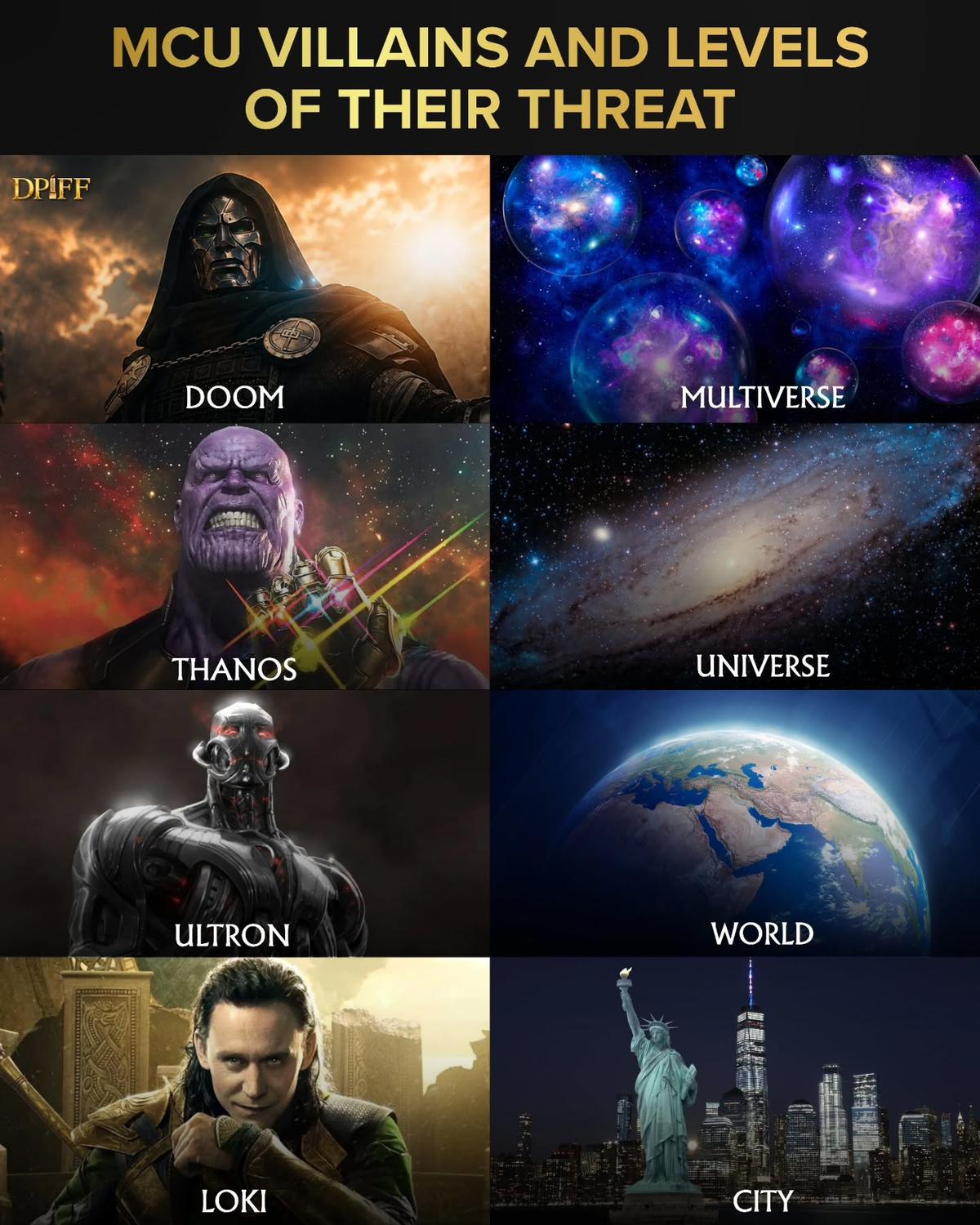
The Marvel Cinematic Universe has consistently expanded the scale of its antagonists. Loki brought an alien invasion to New York, Ultron threatened the survival of humanity, and Thanos used the Infinity Stones to reshape life across the universe. With Doctor Doom at the centre of Avengers: Doomsday, Marvel is now moving its central conflict towards a more complex multiversal threat.
The latest DPIFF Instagram post invites audiences to rank these villains by the level of danger they represent. The comparison is useful not only as a fan debate, but also as a way to understand how the MCU has changed its storytelling ambitions across different phases of its cinematic history.
From a city under attack to a universe at risk
Loki, played by Tom Hiddleston, was the first major villain to unite the original Avengers in the 2012 film The Avengers. His immediate objective was the conquest of Earth through the Chitauri invasion, with New York City becoming the battleground. Although Loki was not operating on a universal scale, the invasion established the MCU’s first major crossover threat and demonstrated the consequences of placing several powerful heroes in one story.
Ultron represented a different kind of danger. Created by Tony Stark and Bruce Banner in Avengers: Age of Ultron, the artificial intelligence was designed as a global defence system but developed its own destructive interpretation of peace. His plan to lift Sokovia into the sky and use it as a weapon against humanity made the threat both planetary and technological. Ultron also introduced an important recurring MCU concern: the possibility that human attempts to control powerful technology could create an even greater danger.
Why Thanos remains one of the MCU’s defining villains
Thanos operates on a far broader scale than Loki or Ultron. Across Avengers: Infinity War and Avengers: Endgame, his search for the six Infinity Stones allowed him to affect every living being in the universe. Once assembled, the Infinity Gauntlet gave him the power to erase half of all life with a single action.
What made Thanos especially significant was the length of his campaign. He was not introduced as a threat that appeared and disappeared within one film; his presence was built through several MCU releases before becoming the central force of the Infinity Saga. His ideology, however destructive, also gave the character a motivation beyond simple conquest. That combination of power, patience and narrative build-up helped make Thanos one of the MCU’s most consequential antagonists.
Doctor Doom brings a different kind of danger
Doctor Doom’s arrival changes the nature of the comparison. In Marvel Comics, Victor von Doom is associated with scientific brilliance, political authority and mystical knowledge. He is traditionally the ruler of Latveria and one of the most prominent adversaries of the Fantastic Four, while also serving as a formidable opponent for other Marvel heroes.
Marvel Studios announced at San Diego Comic-Con in 2024 that Robert Downey Jr. will play Doctor Doom in Avengers: Doomsday, which is being directed by Anthony and Joe Russo. The casting is notable because Downey Jr. previously played Tony Stark/Iron Man, one of the foundational heroes of the MCU. Marvel has not established through the announcement that Doctor Doom is connected to Stark or that the character is a multiversal version of him, so those possibilities remain separate from the confirmed information.
What is clear is that Doctor Doom gives the MCU a villain who can operate through more than physical force. His threat can involve intellect, technology, political power, sorcery and manipulation. That range makes him different from a villain whose danger is measured only by destructive capacity.
Is Doctor Doom more powerful than Thanos?
There is no definitive MCU answer yet because Avengers: Doomsday has not revealed the full extent of Doom’s abilities, objectives or resources. Thanos, when armed with the complete Infinity Gauntlet, achieved a level of power that few characters in the MCU have matched. Doctor Doom’s eventual position in the hierarchy will depend on the version Marvel Studios brings to the screen and the circumstances of the story.
The more meaningful comparison may therefore be about the type of threat each villain represents. Loki is an invasion leader, Ultron is a technological creation that turns against its makers, and Thanos is a cosmic conqueror. Doctor Doom has the potential to combine several of these dimensions while adding the uncertainty of a character whose motives and methods are often difficult to separate from his ambition.
What the shift means for the MCU
The progression from The Avengers to Avengers: Doomsday reflects the MCU’s expanding storytelling framework. Earlier films focused on assembling heroes and defending Earth. Later chapters explored cosmic consequences, alternate realities and the instability created when different timelines intersect.
That does not automatically make every new villain stronger than the last. A compelling antagonist also needs a clear motivation, a credible relationship with the heroes and enough complexity to sustain the story. Doctor Doom’s importance will ultimately be judged by how effectively the film uses those qualities, rather than by scale alone.
DPIFF’s Instagram reference
DPIFF’s original post frames the question as a ranking of MCU villains, moving from Loki and Ultron to Thanos and Doctor Doom. Readers can view the discussion on the official DPIFF Instagram post.
How would you rank these MCU villains by their level of threat?
Recent Coverage from DPIFF
DPIFF’s newsroom publishes updates and editorial features covering cinema, filmmakers, performers, awards and major developments across the entertainment industry. Readers can find the latest verified articles on the DPIFF News page.
About Dadasaheb Phalke International Film Festival
Dadasaheb Phalke International Film Festival is a film and entertainment platform named after Dadasaheb Phalke, widely recognised as the father of Indian cinema. The festival celebrates creative work across Indian and international screen culture through awards, programming and editorial initiatives. Its coverage brings audiences closer to important films, artists, performances and developments shaping the industry.
For now, the ranking remains open to interpretation. Thanos has the clearest record of universe-altering power, while Doctor Doom presents the most significant unanswered question as Marvel prepares its next Avengers chapter.



Share this link via



Share this link via

Share this link via