

Celebrating Indian Cinema: From Dadasaheb Phalke’s Vision to a Global Powerhouse
Indian cinema has undergone a remarkable transformation over the years. Today, Indian cinema is known as one of the largest,…
Dadasaheb Phalke International Film Festival


Explore how film posters evolved from hand-painted art to digital designs, becoming a powerful tool in cinema promotion.

In today’s world, when a new film is announced, the first thing we see is the poster of the film and the unveiling of the poster is the most exciting part for the audience. Be it on social media, theatres, on the streets or all over the Internet. It is the poster that is the first step, which catches the eyes of the audience. However, this tradition of film posters is not a modern phenomenon. It has been happening since the very inception of the cinema, posters have always served as a vital medium for the identity of film and for its promotion.
What is the primary objective of a film poster?
It is to catch the audience’s eye. It works as an information giver. Typically, it features the film’s title accompanied by the images of the lead actors. The director’s name the producer’s theme the release date and occasionally a tagline or any dialogue which offers a glimpse into the story while posters predominantly utilise photography of the actors before the 19 nine 1980s. The vast majority of posters consist of hand-painted illustrations.
History of Film Posters

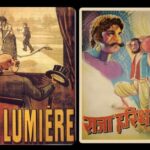
About the history of film posters back in the early days. Posters were used during public screenings of the cinema. In those days, Large boards were displayed outside the theatres to announce which films would be screened inside. Gradually this these boards began to incorporate images and visual seeds in 1985, for the screening of the Lumière Brothers’ film L’Arroseur Arrosé in Paris at the Grand Café, an artist named Marcellin Auzolle created a poster, which is regarded as one of the earliest posters created specifically for a particular film.

In India, the history of film posters is quite fascinating. In 1913, the first feature film Raja Harishchandra, was a silent film and subsequently the first sound film ‘Alam Ara’, was released in 1931. These two films were primarily promoted through newspapers and leaflets. However, in the 1920s, the artist painter, Baburao created a hand-painted poster for a Marathi film ‘Kalyan Khajana’, which is considered one of the earliest film posters in the history of Indian cinema.
Golden Age (1940-1980)
From the 1940s to the 1980s was the golden age of hand-painted film posters in India. During this time, city walls, street corners, and massive hoardings would be plastered with his vibrant posters. These posters are in colossal proportions to capture the attention of the passersby, even while they are at a distance.During the period there were several renowned poster artists with names such as, B.M Gupta and C. Mohan outstanding in their work. The celebrated M.F. Husain also began his career by creating film posters. The artwork of these artist were characterised by such a rich use of colour and a distinct sense of dramatic expression.
The poster for the 1957 film Mother India is counted among the most iconic posters in Indian cinema history; it was created by B.M. Gupta. Similarly, the posters for Pakeezah (1972) and Sholay (1975) are also regarded as significant examples of Indian poster art.

In the 1970s, with the rise of the “Angry Young Man” era in cinema, a similar aesthetic began to show in film posters. A single poster would often feature multiple characters, action sequences, and dramatic colour palettes. This style became the hallmark of the “masala” films of that era.
Evolution of Film Posters
In a linguistic country of India, film posters were crucial in conveying information about a film to audiences across different regions. Posters displayed the film’s title in three languages: Hindi, English and Urdu. Furthermore, given the lower literacy rates in the country at that time, the posters were heavily on image than text. Film posters have evolved in their unique way in other parts of the world. In countries like India, Poland and Ghana, local artists would create alternative posters for Hollywood films, interpreting them in their own regional style. This was the reason, posters of the same film often looked completely different in different countries.
Between 1950 and 1985, the National Screen Service handled the printing and distribution of film posters. Posters were provided to theatres and they had to be returned once the film’s run had ended. Old posters frequently became damaged or were simply discarded since they were often reused. After 1980, film studios started producing and distributing the posters themselves. During this period, digital technology also began with the advent of computers and graphic design in the 1990s
Modern-Day Posters
Today, film posters are no longer limited to theatres. They appear on social media, websites, television promotions and various online platforms. The creation of digital posters has become both easier and faster, leading to rapid usage. Still, the significance of vintage, hand-drawn posters remains undiminished to this day. Across the globe, numerous collectors now acquire and preserve vintage film posters. The value of certain rare posters has even lifted off into the millions of dollars. For example, the 1927 film ‘Metropolis’, represented an astronomical sum at an auction. Similarly, posters for many horror and science fiction films are also considered of high value.
In India too, Bollywood posters from old times have now found their way into multiple museums and institutions that are engaged in preserving this craftwork, ensuring that future generations can appreciate and understand this remarkable and unique chapter of cinema history.